
Chemistry
Browse through our extensive collection of teaching materials for the subject Chemistry.
Formats
Create interactive content and much more optimized for the subject Chemistry.
New worksheets
Recently published worksheets for Chemistry.
Group Puzzle for Chemistry Class
This worksheet uses the cooperative learning method known as the “group puzzle” to teach complex concepts in chemistry and atomic physics. The goal is for students to gain a deep understanding of the selected topic through self-directed learning and peer teaching.
Content and Methods: The content is taught using a structured five-phase model that combines cooperative and independent learning: In home groups, each member takes on a specific subtopic, which is then explored in a subsequent “expert phase” in groups of students with the same subtopic, using informational texts and in-depth tasks. Afterward, the students return to their core groups, share their knowledge with one another, and consolidate their findings together before moving on to a cooperative work phase in which they solve complex tasks that can only be mastered by combining all the individual aspects. The process concludes with a joint evaluation in a plenary session and a reflection on the learning process.
Competencies:
Subject-Specific Competence: Acquiring in-depth knowledge of a topic in chemistry
Social Competence: Fostering teamwork and communication skills through the “expert” model
Methodological Competence: Applying cooperative learning methods to independently process information and convey knowledge
Transferability: Applying expert knowledge to hypothetical scenarios, such as the discovery of new elementsTarget Audience and Level: High School
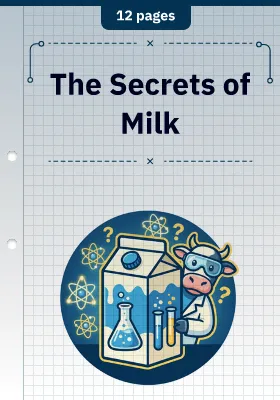
The Secrets of Milk
This workbook explores a historical and materials-science phenomenon: the production of casein, an early milk-based bioplastic. Students work as a team of researchers to investigate how the organic components of liquid cow’s milk can be transformed into a solid plastic through the action of acid.
Content and Methods: The content is conveyed through a combination of historical contextualization, experimental laboratory work, and material analysis: Starting with the question of how a solid material can be produced from milk, students explore the composition of milk and the effect of acids on proteins. They then experimentally extract casein, document the course of the reaction, and examine the properties of the resulting bioplastic. Finally, the results are used in a scientific application to evaluate the historical significance and material properties of casein as an alternative to plastic.
Competencies:
Technical expertise: Understanding of protein denaturation (acid precipitation of milk protein/casein) and the classification of galalith as a historical bioplastic
Knowledge acquisition: Planning, conducting, and systematically documenting a preparative organic chemistry experiment (filtration, solid isolation)
Materials and testing skills: Criteria-based analysis of the physical properties of a self-produced solid
Argumentation and language skills: Writing a technically sound report using precise scientific explanations
Target audience and level: Middle school
The Green Battery
This worksheet explores the electrochemical fundamentals of galvanic cells and how a lemon battery works in the context of modern, sustainable technology development. Students take on the role of a startup research team to experimentally and ecologically evaluate the suitability of a lemon as an environmentally friendly electrolyte, as well as the efficiency of various electrode pairings.
Content and Methods: The content is taught by combining theoretical fundamentals, experimental data collection, error analysis, and sustainability assessment: First, students explore the structure and functioning of electrochemical cells as well as the underlying redox reactions. They then test their hypotheses in an experiment, document measurement data, and analyze typical sources of error in the laboratory. Finally, they evaluate the performance and sustainability of various materials before summarizing their results in a technical report and a persuasive presentation.
Competencies:
Technical Competence: Understanding of redox reactions, electrode potentials, and the role of electrolytes in generating electrical power
Data Analysis: Conducting quantitative electrochemical measurements, systematically comparing variables, and identifying sources of methodological error
Evaluation Competence: Balancing maximum technical performance with environmental factors (extraction, recycling, toxicity) in the context of sustainable chemistry
Communication skills: Targeted, audience-oriented presentation of laboratory data for a business analysis or an investor pitch
Target audience and level: Middle School
Chemistry Glossary
The glossary serves to systematically document terminology and knowledge in this subject area. The goal is to foster a solid understanding of key technical terms and to develop the ability to apply them in professional contexts and visually connect them.
Content and Methods: The content is conveyed through precise definitions and the application of that knowledge: First, key technical terms are explored. Learners then deepen their understanding by visually representing relationships in a concept map and by independently writing a text using technical terminology that incorporates the terms they have learned.
Competencies:
Subject-matter expertise: Proficient use of chemical nomenclature and understanding
Methodological skills: Ability to organize complex information using concept maps
Language skills: Writing texts that are linguistically accurate in technical terms to demonstrate a thorough understanding of the subject matter
Target audience and level: Grades 7 and above
New content and sources
Published videos and images for Chemistry.