

Exhaust system of a car
Bild Photo:When you look under a car that has a diesel engine, you see the case containing the catalytic converter and diesel particulate filter in the exhaust pipe.

Water filter (household)
Bild Photo:A household tap water filter is being filled with water at the tap.

Section of a starch molecule
Bild Chemical structural formula:Section of a starch molecule showing the alpha-1,4 glycosidic bonds in amylose. Starch is a prominent example of plant polysaccharides. It has a soluble component (25%) and an insoluble component (75%). The soluble component, the amylose, forms long chains that coil up into an alpha-helix. By contrast, the insoluble component, the amylopectin, is highly branched with additional bonds between shorter chain sections. Amylose can be specifically detected using iodine. Iodine is deposited inside the alpha-helix of the starch molecule. This results in a complex that has a distinctive color ranging from deep blue, blue-violet, to black, depending on the iodine concentration.Information and ideas: Glycogen, the storage for carbohydrates in animals, is comparable in structure to amylopectin.

Entire ear with brain
Bild Unlabeled graphic: Cross-section of entire ear with auditory nerve and its connection to brain. For incorporation in presentations or for individual projection. The hearing process does not just involve the hearing organ but also the brain. It is there that the signals are received and understood. Information and ideas:This graphic can be used to describe and explain the most important functional areas of the ear and their role in the hearing process.The teacher can look at the graphic together with the students on the computer screen or get the students to do the labeling either on printouts or on the computer. Relevant for teaching:The human bodyStructure and function of a sensory organ

Inner ear section – labeling arrows
Bild Unlabeled graphic:Section with the main parts of the inner ear. The main parts are highlighted in color. Both the sense of balance and the sense of hearing are situated in the inner ear.The inner ear is formed by a complicated system of cavities. This system is called the bony labyrinth. Distinction is made between the cochlea, the semi-circular canals and, in between, the vestibule. In the cochlea there are two openings each covered with a taut membrane. These are named after their shape, i.e. round window and oval window. The oval window is a sort of entrance for sound and the round window a sort of exit. Information and ideas:Helps to put the inner ear in the overall context of the structure of the ear. Can be used, for example in a worksheet, for work together in class with the digital projector, as overhead transparency.Relevant for teaching:The human bodyStructure and function of a sensory organ

Middle ear section – labeling arrows
Bild Unlabeled graphic:Section view of human ear with the individual parts of the middle ear – with arrows for detailed labeling. The middle ear is formed by an air-filled cavity lined with mucous membrane and consists mainly of the tympanic cavity and the Eustachian tube. The tympanic cavity contains the ossicles “malleus", “incus" and “stapes".These are joined together loosely and can move so that, with their help, vibrations from the eardrum can be picked up and transmitted to the inner ear. Information and ideas:Can be used in worksheet, worked on together via digital projector, as an overhead transparency.Relevant for teaching:The human bodyStructure and function of a sensory organ
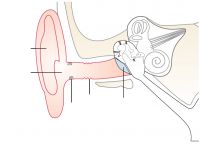
Outer ear section – labeling arrows
Bild Unlabeled graphic:The graphic is a section view of the entire ear showing all parts belonging to the outer ear. These parts are highlighted in color. The outer ear consists of the pinna and the ear canal. The ear canal ends at the eardrum. In the membranous wall of the ear canal there are glands which produce cerumen (earwax). At the edge of the ear canal there are some small hairs, hair follicles, which serve as protection against foreign bodies.Information and ideas:Helpful to distinguish outer, middle and inner ear. Can be used, for example in a worksheet, for work together in class with the digital projector, as overhead transparency.Relevant for teaching:The human bodyStructure and function of a sensory organ

Muscle power
Bild Photo: Two people jogging. Information and ideas:An example of the process whereby chemical energy is converted into mechanical energy.

With eyes blindfolded
Bild Photo:To illustrate the topic “Seeing with your ears”. When the sense of sight is not working, another sense can replace the eyes. We pick up a lot of information about our environment from our ears and can thus, in part, at least, substitute the sense of sight.Information and ideas:For example, students can try out themselves on a listening walk whether they can guess where they are.Relevant for teaching:The human bodyStructure and function of a sensory organSenses discover the environment

Sound transmission in the middle ear
Bild Labeled graphic:Sound transmission in the middle ear. The sound funnelled in the pinna and the ear canal hits the eardrum causing it to vibrate. The vibrating eardrum transmits its movements to the ossicles. These are connected to each other via joints: - The malleus moves the incus. - Malleus and incus move as a whole around a joint axis. - The incus transmits the movements to the stapes or its footplate. - The footplate is pressed into the oval window. Lever effects mean that the sound is amplified twentyfold during transmission from eardrum to inner ear.Information and ideas:The graphic is good for understanding the transmission of vibrations in the hearing organ. Relevant for teaching:Structure and functions of a sense organ Reception of stimuli and transmission of informationFunctions of senses

Speech as highly complex sound signal
Bild Graphic:Oscillographic curve of the spoken sentence “It's raining cats and dogs". Speech sounds are fluctuating sound signals where the composition of frequencies changes all the time. Aperiodical overlap periodical parts. Unlike noises, some of which have similar frequency curves, sound in speech is always the carrier of meaning or of messages sent out by the speaker. Other noises like smacking of lips, hissing, rhythms, basic pitch are typical of the individual (acoustic fingerprint) but not essential for the speech content! Information and ideas:Supplementary to worksheets and transparencies.Relevant for teaching:Sound/acoustics: parametersVibrations and wavesCommunication and understanding

Speech signal – individual word
Bild Chart:Screenshot of the oscillographic curve of the spoken word “dogs". Speech sounds are fluctuating sound signals where the composition of frequencies changes all the time.Aperiodical overlap periodical parts. Unlike noises, some of which have similar frequency curves, sound in speech is always the carrier of meaning or of messages sent out by the speaker. Other noises like smacking of lips, hissing, rhythms, basic pitch are typical of the individual (acoustic fingerprint) but not essential for the speech content! Information and ideas:Supplementary to worksheets and transparencies.Relevant for teaching:Sound/acoustics: parametersVibrations and wavesCommunication and understanding