
Cross-curricular content
Create content for a subject of your choice
Tools
Explore our AI-powered tools for your teaching
Formats
Create interactive content and much more for the subject of your choice.
New worksheets
Recently published worksheets for Cross-curricular content.
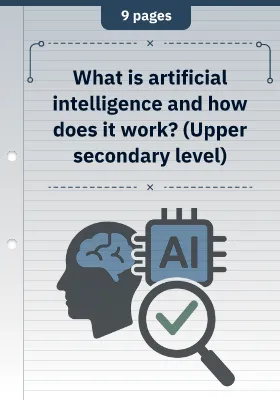
What is artificial intelligence and how does it work? (Upper secondary level)
This worksheet provides an in-depth understanding of the technical fundamentals and ethical implications of artificial intelligence at the upper secondary level. The aim is to go beyond mere application and understand the underlying mechanisms (such as neural networks and machine learning) and critically reflect on their social implications.
Content and methods: The content covers fundamental technical concepts of artificial intelligence such as machine learning, deep learning, and neural networks, the distinction between weak and strong AI, and the analysis of everyday digital applications according to criteria such as data volume, algorithms, and learning ability. This is supplemented by practical case studies on personalized learning systems and ethical and social issues such as bias, responsibility, and the impact on learning and creativity. The methods include technical term explanations, comparative classification tasks, scenario-based case analyses, multi-perspective role-plays from different points of interest, and stimulating discussion and position exercises in the classroom, in which learners justify and reflect on their attitudes.
Competencies:
Technical expertise: Confident use of technical terms such as algorithms, training data, and artificial neurons.
Analytical skills: Ability to identify the role of training data and bias in AI models.
Ethical judgment: Reflection on data protection and discrimination risks.
Discussion and argumentation skills: Ability to represent complex positions within a role-play and in a plenary discussion
Target group and level: From grade 10 onwards
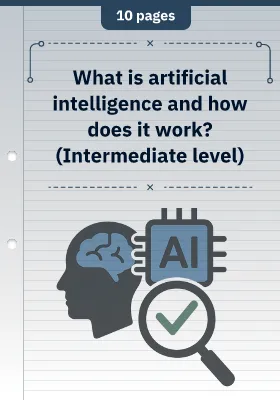
What is artificial intelligence and how does it work? (Intermediate level)
The worksheet provides a basic understanding of how artificial intelligence (AI) works at an intermediate level. Learners should be able to distinguish AI applications from classic programs, understand the technical learning process, and critically question algorithms in everyday life.
Content and methods: The content covers the basic definition of artificial intelligence, the distinction between static programs and adaptive systems, the three-step model of how AI works (data collection, pattern recognition, application), and the opportunities and risks of recommendation algorithms, such as filter bubbles and data bias. This is supplemented by practical case studies and the transfer of knowledge to school application scenarios. The methods include explanatory text work, tabular classifications, visual process diagrams to illustrate technical processes, analytical case studies, and creative transfer tasks in which learners take on developer roles to design their own AI ideas for everyday life.
Competencies:
Technical understanding: Understanding the logic of algorithms and machine learning
Judgment: Reflection on the limitations and error susceptibility of AI systems
Design skills: Development of innovative solutions for one's own environment (school)
Analytical skills: Distinguishing between different phases of the learning process using practical examples
Target group and level: From grade 8 onwards
Phishing and fraud with AI
The worksheet serves to educate learners about cyber fraud, particularly phishing and the use of artificial intelligence. The aim is for learners to recognize fraudulent intentions in digital messages, understand how AI-supported attacks work, and learn effective prevention and immediate measures.
Content and methods: The content covers the recognition and classification of phishing attempts, typical characteristics of fake websites and messages, the influence of AI on the professionalization of digital scams, and strategies for prevention and correct action in the event of fraud. This is supplemented by an examination of language, image, and audio clues, as well as a critical evaluation of digital forms of communication. The methods include visual website analysis, structured information and text work, audio evaluations, action-oriented prevention exercises, and cooperative group work in which participants create their own sample messages and then reflect on and review them together.
Competencies:
Media and information literacy: Recognizing psychological manipulation and technical obfuscation in digital media
Analytical skills: Identifying warning signs in text and audio messages
Action competence: Deriving and applying security rules for the digital space
Critical thinking: Developing a healthy skepticism toward unexpected requests to disclose personal data
Target group and level: Grade 10 and above
Protecting personal data when using AI
The worksheet raises learners' awareness of protecting their privacy when using artificial intelligence. The aim is to develop a deep understanding of what “personal data” is, the risks involved in sharing it, and how to protect oneself from misuse through targeted security rules.
Content and methods: The content includes an age-appropriate introduction to sensitive personal data, the risks involved in the digital space, and the conscious use of passwords, apps, and one's own digital footprint. This is supplemented by case studies on data misuse and the development of specific security rules for everyday life. Methods include visual image analysis, multiple-choice tasks to consolidate knowledge, active categorization exercises, scenario-based case studies, and creative group work such as designing security posters to promote reflection and decision-making skills.
Competencies:
Media literacy: Developing an awareness of one's “digital footprint” and protecting one's identity online
Risk perception: Ability to recognize potential dangers such as identity theft or unauthorized data transfer via apps
Action competence: Formulation and application of practical safety rules for everyday digital life
Critical thinking: Questioning the trustworthiness of applications, even if they promise useful functions
Target group and level: From grade 7 and above
New content and sources
Published videos and images for Cross-curricular content.