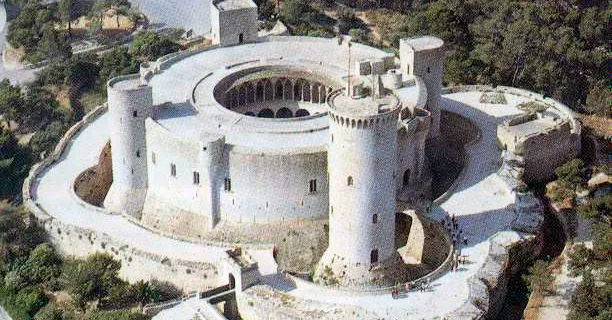

History
Browse through our extensive collection of teaching materials for the subject History.
Formats
Create interactive content and much more optimized for the subject History.
New worksheets
Recently published worksheets for History.
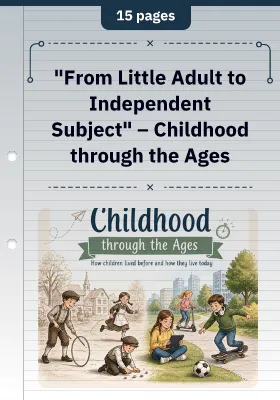
"From Little Adult to Independent Subject" – Childhood through the Ages
This worksheet aims to provide trainee teachers with a historically informed and socially critical understanding of the life stage known as ‘childhood’. Learners are to be made aware that childhood is not a rigid, biological state, but is subject to constant social change. They will learn to analyse historical patterns of upbringing and living environments, to contextualise the contemporary view of the child (including the UN Convention on the Rights of the Child), and to draw conclusions for their own professional approach by comparing the past and the present.
Content and methods:
This worksheet combines historical text analysis, the development of empathy, analysis of contemporary issues and research into international law. Following a personal reflection and an analysis of a historical period, the pupils write a fictional diary entry from a child’s perspective and contrast this with the reaction of a child today. They then map out the cornerstones of modern childhood in a practical matrix and compare historical and contemporary living conditions. The activity concludes with research into the UN Convention on the Rights of the Child, including its historical context, and a reflection on their own pedagogical approach.
Competencies:
Learners can...
Explain the concept of childhood as a socially shaped and historically changeable construct.
Analyse children’s historical living environments in terms of educational objectives, work requirements and legal status, guided by specific criteria.
Develop historical empathy through methods of shifting perspectives and reflect on different living conditions from multiple perspectives.
Identify the dimensions of modern childhood (including subject status, institutionalisation and mediatisation) and illustrate them using concrete examples from practice.
Independently research articles of the UN Convention on the Rights of the Child, place them in their historical context and relate them to today’s image of the child.
Use historical insights to critically examine current patterns of upbringing and apply them to one’s own professional approach.
Target group and level:
Adult students or trainees in the field of social pedagogy, particularly aspiring educators.
Note: Internet access is required for the research task
Comprender los orígenes de la historia de España - Nivel B1
This worksheet aims to provide learners with a basic understanding of Spanish history and to practice their written communication skills.
Content and Methods: It covers the origins and key periods of Spanish history, including historical facts and a fictional letter from the past. Methods include listening and reading comprehension, multiple-choice and true/false questions, and a letter-writing task.
Competencies:
Listening and reading comprehension
Historical knowledge of Spain
Written communication
Target audience and level: Spanish learners at B1 level
Migration Part 3 - At the Border
This worksheet aims to provide students with a multifaceted understanding of the historical and emotional complexities of immigration at a border. By combining historical facts with empathetic role-playing, students explore the challenges, legal hurdles, and personal stakes involved in seeking a new life.
Content and methods: The worksheet utilizes a blend of historical reading, audio-based interaction, and creative writing. It provides a text on a country's immigration policies to establish historical context. Methodologically, it shifts from factual comprehension to perspective-taking by prompting students to listen to border official questions, write a reflective essay from the viewpoint of an immigrant, and analyze the internal emotional landscape of those facing interrogation.
Competencies:
Historical Literacy: Understanding historical immigration laws
Empathy and Perspective-Taking: Analyzing the emotional burden and fears of immigrants during the entry process
Listening and Writing Skills: Processing oral questions and articulating detailed personal narratives in an essay format
Critical Reflection: Evaluating the consequences of refusal and the ethical implications of national allegiance and bias
Target group: Grades 9-12 (High School)
Colonialism and its consequences (Learning Stations)
Learners gain an understanding of the consequences of colonialism by focusing on various aspects of a selected (former) colonised nation.
Content and methodology: Learners begin by examining a photograph related to colonialism. Based on this, they acquire basic knowledge about the concept and circumstances. The individual focal points of the station work are: history of a colony, social consequences, political consequences and colonialism in the present day. Based on these focal points, learners acquire comprehensive knowledge about the consequences of colonialism and its effects on the perception and living environment of a selected (formerly) colonised nation.
Competencies:
Explaining and examining one's own and others' value orientations
Reconstructing historical facts (reconstruction)
Explaining the effects of political, economic and social structures and processes on people's lives and experiences
Target group and level: 8th - 10th grade
Note: Due to the volume, creation takes longer.
New content and sources
Published videos and images for History.