

Autumn
7

My body belongs to me
8

The world of Start Ups
5

AI skills
26

Substitute Lessons
16

Countdown to Summer
9

Focus on women
6
Filters
Worksheets
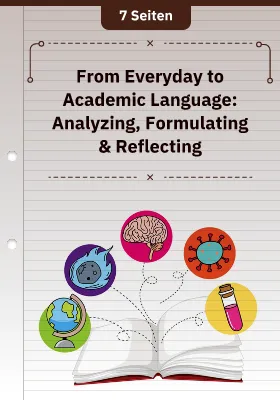
From Everyday to Academic Language: Analyzing, Formulating & Reflecting
This worksheet aims to provide students with a solid understanding of the significance and function of academic language and to help them practice actively using it in subject-specific instruction. Students will recognize that academic language serves as an essential tool for presenting complex topics in an objective, impersonal, and precise manner, and that the ability to switch between everyday language and academic language is a key skill. Through guided practice in translating everyday observations into formal language, they learn to use subject-specific linguistic tools, to put their own thoughts into writing in a structured manner, and to reflectively evaluate their own learning process and linguistic expression.
Content and Methods:
The worksheet combines cognitive awareness, guided writing practice, independent text production, and self-evaluation. After an introductory informational text on the distinction between everyday language and academic language, as well as an introduction to subject-specific language tools (e.g., for cause-and-effect relationships, hypothesis formation, or evaluations), learners gradually translate given everyday statements into logically structured academic language. They then apply this translation technique to their own current course material and reflect on the advantages and challenges of academic language formulation. The module concludes with a structured self-assessment matrix designed to evaluate their own language competencies and identify remaining learning needs.
Competencies:
Learners can...
- identify the difference between everyday language and academic language and explain the importance of precise technical language for subject-matter understanding.
- identify and purposefully apply specific subject-specific language tools (e.g., phrasing guides for descriptions, justifications, and analyses).
- systematically translate colloquial observations into precise, factual, and logically structured sentences using formal language.
- structure their own conceptual ideas derived from current classroom activities and independently put them into writing using appropriate technical terms.
- critically reflect on their own language translation process and evaluate their individual strengths and areas for development in the use of formal language.
Target Audience and Level:
Grade 8 and above
Fundamentals of Arithmetic
Objective:This worksheet aims to assess and strengthen pupils mathematical skills in various areas. By completing the exercises, pupils will consolidate their knowledge of fundamental mathematical operations such as powers, roots and exponents, fractions and logarithms, and identify the areas where they still need further practice.
Content and methods: The worksheet contains 20 exercises on various mathematical topics, including powers, roots and exponents. The exercises are designed as multiple-choice questions, in which pupils must select the correct answer. The exercises are to be solved without a calculator in order to promote an understanding of fundamental mathematical concepts.
Skills:
- Understanding of powers, roots and exponents, fractions, logarithms, etc.
- Ability to solve mathematical problems without aids.
Target group and level: Middle School
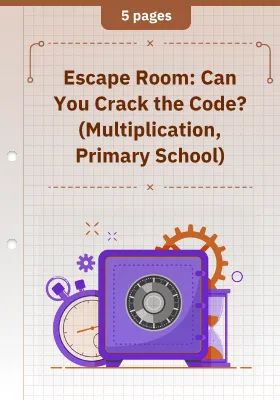
Escape Room: Can You Crack the Code? (Multiplication, Primary School)
Students consolidate their multiplication skills and apply them in a playful problem-solving context.
Content and Methods: The worksheet is designed as an escape-room activity. Students solve several multiplication problems, count how often certain results occur, and use this information to determine individual digits of a numerical code. At the end, they combine the digits to form the complete code and “open” the chest.
Skills:
- Solve multiplication problems accurately
- Compare and evaluate results
Target Group and Level: suitable for primary school students (Grades 2–4)
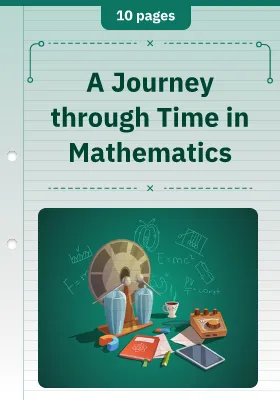
A Journey through Time in Mathematics
The overarching goal of this worksheet is to introduce students to a selected historical numeral system in a hands-on and historically contextualized manner.
Content and Methods:
This worksheet teaches the basics of the numeral system of a selected advanced civilization or historical period through a fictional story told from a child’s perspective. Methodologically, the document combines a true/false comprehension quiz with illustrated arithmetic examples. Students actively apply the principles by solving historical word problems drawn from the child’s everyday life. The worksheet concludes with open-ended reflection and application questions that bridge the gap to the modern mathematical number system and the present day.
Competencies:
- Arithmetic Competence
- Text and Language Competence: Extracting information from a narrative and describing mathematical phenomena in one’s own words
- Cultural and Historical Competence: Reflecting on the evolution of global arithmetic symbols and systems
Target Audience and Level: Grade 5 and above
Note: Due to the background research on ancient forms of calculation, creating this worksheet takes longer.
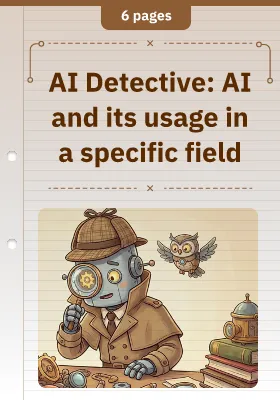
AI Detective: AI and its usage in a specific field
Students investigate how artificial intelligence is transforming a specific field, gaining an understanding of both the benefits and challenges of AI. The goal is to develop critical awareness of AI’s capabilities, ethical issues, and the ongoing need for human judgment in decision-making.
Content and Methods:
The worksheet guides students through an exploration of AI in a specific field by examining real-world examples. Students analyze ethical concerns. Methods include comprehension questions, multiple-choice tasks, comparison of benefits and risks, open-ended reflection questions, and a short argumentative essay about AI’s role in that field.
Competencies:
- Understanding technological applications of AI in a real-world professional field
- Critical evaluation of the benefits and risks of AI in that field
- Ethical reasoning about data privacy, bias, and human–machine interaction
- Analytical thinking about the balance between AI capabilities and human expertise
- Argumentative and reflective writing skills
Target Group and Level:
Grade 8 and up.
Films in the classroom: Brochure
With the help of the worksheet, learners engage with a film in a structured way in order to develop a deeper understanding and to reflect on and transfer what they have seen.
Contents and methods:
The worksheet is structured like a brochure and asks questions about the content and further questions about the film. The worksheet ends with a personal evaluation of the film.
Skills:
- Concentrated extraction of information from a visual medium
- Analysis, reflection and transfer of film content
Target group and level:
Grade 7 and above
Smartphone Puzzle
Students learn to analyze information from various digital sources and link it logically in order to draw conclusions.
Content and Methodology: The worksheet offers an interactive puzzle task based around a found smartphone. The students analyze chat histories, pictures and an audio file to identify the owner of the smartphone.
Skills:
- Critical analysis of texts and media
- Logical thinking and reasoning
- Understanding historical and/or scientific contexts
Target Audience and Level: Suitable for teaching at lower secondary level.
Exit Ticket: Real World Connection
Objective: This worksheet aims to reinforce students' understanding of the given topic while prompting them to transfer and apply theoretical concepts to real-world scenarios.
Content and methods: The worksheet addresses the given topic through an exit ticket format. Students answer targeted recall and open-ended conceptual questions assessing factual comprehension and cause-and-effect reasoning. Finally, they engage in applied writing prompts requiring them to analyze practical real-world applications in navigation, agriculture, and daily life, before formulating an original application example.
Competencies:
- Scientific explanation and causal reasoning
- Knowledge transfer and real-world application
- Critical thinking and hypothesis formation
- Written communication and conceptual synthesis
Target group: Middle School

Multiplication - Shopping Receipt
This worksheet aims to help students practice multiplication and basic multi-step arithmetic using real-world item pricing and shopping scenarios.
Content and methods: The worksheet features a mock store receipt with item quantities and unit prices for video games and consoles. Students apply multiplication and basic addition to solve word problems based on purchase details from the receipt.
Competencies:
- Mathematical problem-solving
- Basic multiplication and arithmetic reasoning
- Applied numeracy in everyday context (financial literacy)
Target group: Grades 3–5

Exit Ticket
Objective: This worksheet aims to facilitate formative assessment and student self-reflection, enabling learners to evaluate their emotional engagement, identify strengths and difficulties, and consolidate key lesson takeaways.
Content and methods: The worksheet covers end-of-lesson reflection and self-evaluation. It utilizes visual self-assessment scales alongside short open-ended reflection prompts for students to record individual successes, lingering questions, and core learning outcomes.
Competencies:
- Self-reflection and metacognition
- Self-assessment and identifying areas for growth
- Written self-expression
- Synthesizing and prioritizing key information
Target group: Middle School
From Art to Science: A Comprehensive Tool for All Your Worksheet Needs
Create worksheets for any subject and topic of your choice, using texts from our AI or your own sources.