
Turn a YouTube video into a supporting classroom reading
A supporting reading gives pupils another way to work with a video's ideas after watching. In to teach, add the YouTube video as a source, choose Simplify texts and specify the ideas the reading must preserve. Keep the original video alongside the result so pupils can connect the written explanation to what they saw.
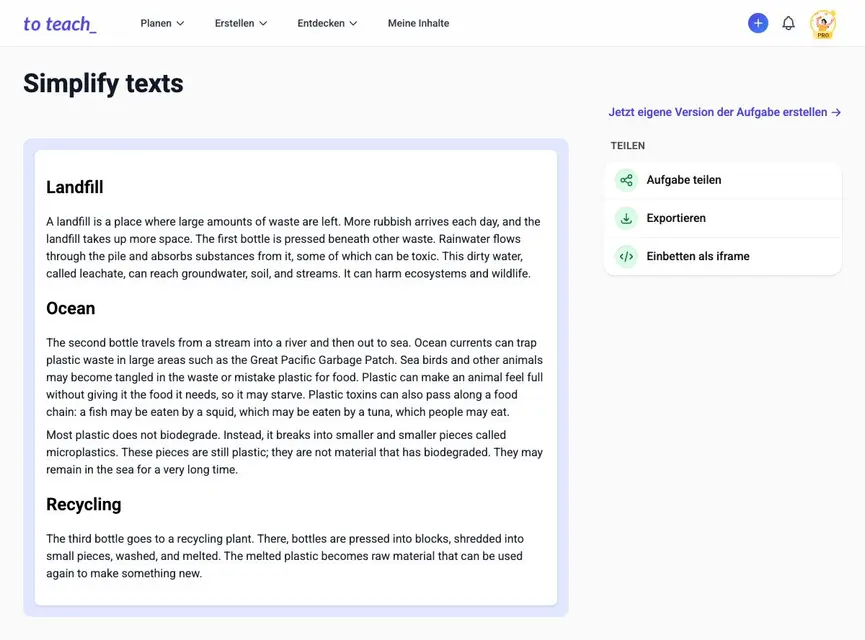
This example uses TED-Ed's What really happens to the plastic you throw away, by Emma Bryce. The 4:07 animation follows three plastic bottles to landfill, the ocean and a recycling plant. The reading keeps those three routes separate, ready for pupils to compare.
Watch the original TED-Ed video
Read the finished three-path example — full view
Decide what pupils should explain after watching
For this lesson, the question is: how can three similar bottles end up in different places? Before watching, ask pairs to predict possible destinations. During the video, they note the three routes. The reading then helps them put each route into a short explanation.
This is different from checking the speaker's exact words. The generated reading rewrites and condenses the explanation. Use it after viewing, when pupils can pause over a paragraph and return to the corresponding part of the video.
Add the video and check both language settings
Open Material Tools and add a source. Choose Video, paste the YouTube URL and choose the language spoken in the video. Save it and check the displayed title. In our example, the source is English and the selected range runs from 00:00 to 04:07.
The source panel provides start and end controls. For a longer video, select a coherent section that answers your lesson question. Avoid cutting away the explanation a later example depends on.
Choose Simplify texts and the desired difficulty. Set the output language separately. We used the simple setting and English for a class aged 11–12. The age range describes our intended class; the instruction field lets you explain the particular support your pupils need.
Create a supporting reading in to teach
Give the reading a clear brief
Our brief asked for short sentences, three distinct bottle routes, and explanations of landfill, microplastics and recycling. It also specified that breaking into smaller pieces must not be presented as biodegrading. These choices come from the classroom question and the source, rather than a general request to make everything easier.
Try this instruction with the same video: “Write a short English supporting reading for pupils aged 11–12 after watching. Use three headings: Landfill, Ocean, Recycling. Explain each route in short sentences. Explain microplastics and preserve the difference between breaking into smaller pieces and biodegrading. Use information from the video.”
Remove background that does not support the comparison
Our first result included a separate section about manufacturing the bottles before describing their destinations. That information belonged to the video, but it distracted from the comparison task. We used the AI revision control to remove the manufacturing section and requested a shorter reading with the three destination headings.
We also removed the specific decomposition timeline from the first result. The task asks pupils to compare destinations and processes, not memorise a number. The revised reading still explains that the pieces remain plastic. Its ocean section says: “These pieces are still plastic; they are not material that has biodegraded.”
Check the whole revised reading against the video. In particular, make sure that waste entering landfill, plastic travelling to the sea, and plastic being processed for reuse have not become one sequence. They are three different paths.
Use the reading to build a comparison
Give each pair three columns labelled Landfill, Ocean and Recycling. Ask them to record where the bottle goes, what happens there, and one consequence or next use. Pupils can underline the sentence that supports each note before explaining the route in their own words.
For language support, provide the frames “The bottle reaches …”, “There, it …” and “This means …”. For a further question, ask why a bottle breaking into small pieces does not mean the plastic has disappeared. Return to the ocean paragraph and the corresponding video explanation.
If you want a short vocabulary retrieval activity afterwards, use the existing five-gap exercise based on the same video. Keep the reading for explanation and the cloze for recalling key terms; the two materials serve different parts of the lesson.
Ready to turn this idea into your own lesson material?
Join thousands of teachers who use AI to prep faster, differentiate more easily, and teach more creatively.
GDPR compliant · Ready in 30 sec · No credit card required
Interested in a school license? Book a consultation