
Where does AI get its information?
Preview
Introduction
Artificial intelligence (AI) is part of our everyday lives, for example in voice assistants, translation programs, and chatbots. But how does AI actually know so much?
Look at the picture and answer the questions.
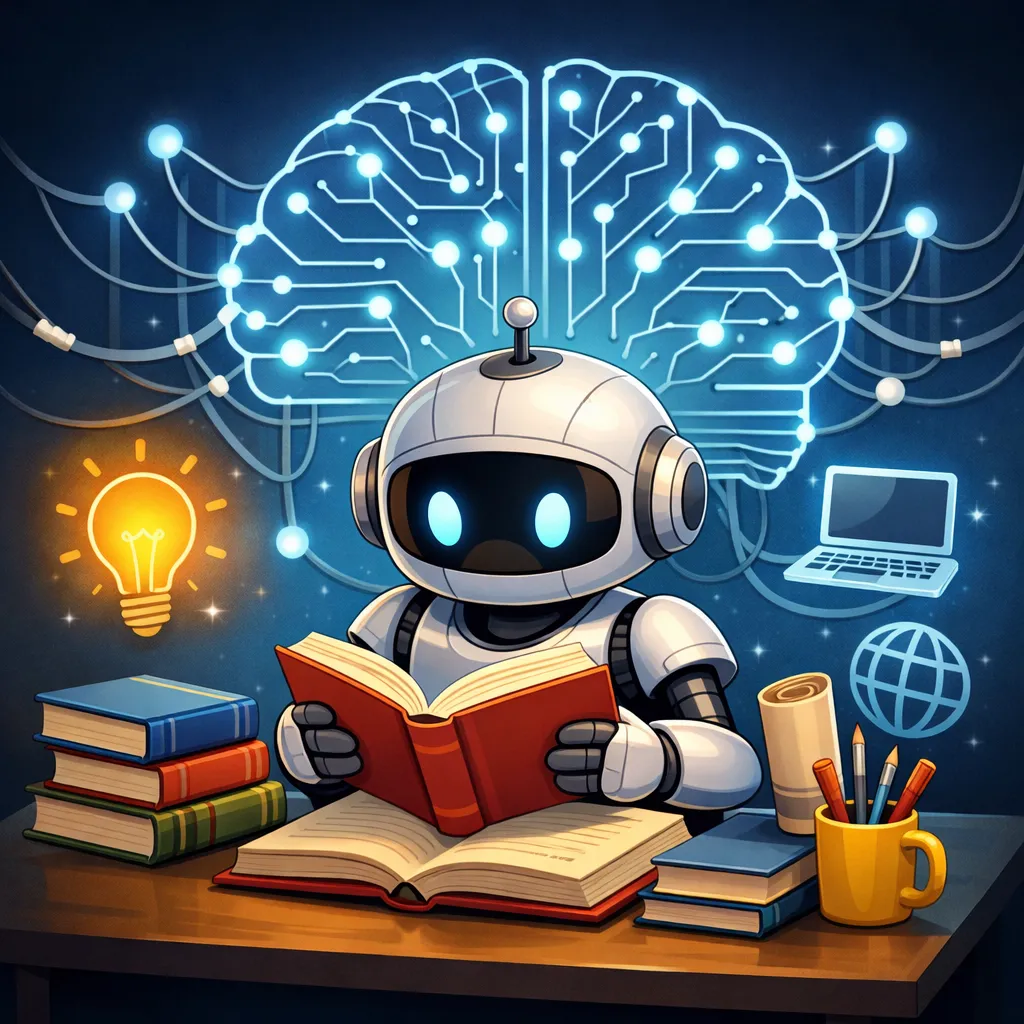

Right or wrong?
Decide and justify whether the statements are true or false.
🤖 Statements about artificial intelligence
Check the box and explain your decision:
| Statement | Correct | Incorrect | Reason |
|---|---|---|---|
| AI reads books independently, just like a human being. | |||
| AI is trained with large amounts of data. | |||
| AI can have its own feelings. | |||
| AI always selects the most truthful information from the internet. | |||
| AI can reflect the same prejudices found in human-written texts. | |||
| AI recognizes patterns in data. |

Assignment
Read the information text and select the correct statement in each case.
Where does AI like "Gemini" get its information?
Artificial Intelligence such as "Gemini" can answer questions, write texts, and analyze images. But where does Gemini get its information? First, Gemini is trained with a large amount of data, including texts, articles, books, and images. This training helps the AI learn to recognize patterns and connections in language and visuals, calculating probabilities to provide suitable answers.
For queries requiring up-to-date information, Gemini can access external sources. This includes databases, news archives, or linked information systems. This capability enables Gemini to deliver information created after its initial training period.
When a user interacts with Gemini, the AI processes the query using its training data and available external sources. The query is temporarily used to generate the quickest and most accurate response, ensuring user privacy and data protection.
Despite its advanced abilities, Gemini has clear limitations. It does not possess consciousness, cannot think or feel, and cannot form personal opinions. Its knowledge is strictly based on the data it was trained with and the external sources it accesses.

Mind map
Create a mind map in which you clearly present the most important information from the text.
1. Write "AI – Where does the information come from?" in the center of your mind map.
2. Create at least three main branches.
3. Add 2–3 keywords or short explanations from the text to each main branch.
Use:
• Keywords instead of whole sentences.
• Arrows, colors, or symbols to make connections visible.
Lade Zeichenfeld...

Discussion cards
The class works in small groups (2–4 people). Each group receives cards with AI scenarios.
1. Each person receives their own card with an AI scenario.
2. First, read your card quietly to yourself.
3. Then, each person briefly presents their scenario to the group.
4. Finally, discuss the questions together as a group.
⏱️ Time for group discussion: 15 minutes.
Important:
• Each person must express at least one opinion.
• Answers should refer to the information text.
Results are presented briefly in a plenary session or voted on by a show of hands.
Scenario: Analyzing Incorrect AI Responses

Scenario: Trusting AI Understanding

Scenario: AI's Limitations

Scenario: AI Data Sources

Write down your collected opinions on the scenarios here.

Reflection
Answer the following questions.

The “Western Bias”
Much of the training data on the internet comes from Europe and North America.
Discuss in your group:
- What impact does this have on AI responses when asked about the traditions, values, or history of countries in the Global South?
Give a specific example of a possible biased perspective.