Historische Bildmanipulation verstehen

TT
by to-teach Team
10 pagesab Klasse 10History, non-subject specific content
Template

Loading preview…

Your worksheet

Include a historical event; an image that is as realistic as possible will then be generated for it, and the students will evaluate it. The rest of the content follows the template.

Need an idea?

Popular topics from other teachers

How our AI templates work

  • Content gets adapted

    Examples, texts and tasks match your focus.

  • Method & structure stay

    The didactically reviewed structure of the template won't change.

Description

Zielsetzung: Das Arbeitsblatt verfolgt das übergeordnete Lernziel, Lernende für die Mechanismen, historischen Ursprünge und politischen Absichten von Bildmanipulationen zu sensibilisieren. Durch die Analyse historischer Fallbeispiele sollen sie ein kritisches Bewusstsein im Umgang mit visuellen Medien entwickeln und die Fähigkeit erlangen, die Authentizität von Bildquellen eigenständig zu hinterfragen.

Inhalte und Methoden: Die inhaltlichen Schwerpunkte des Materials liegen auf der historischen Rekonstruktion analoger Manipulationstechniken in der Dunkelkammer sowie der Analyse von propagandistischer Bildretusche in autokratischen Systemen des 20. Jahrhunderts. Methodisch kombiniert das Arbeitsblatt einen visuellen Einstieg durch den direkten Vergleich zweier historischer Fotografien mit vertiefenden Informationstexten und darauf abgestimmten Multiple-Choice-Fragen. Ein eingebundenes Erklärvideo dient als zusätzlicher digitaler Impuls. Abschließend werden die Lernenden durch praxisnahe Analyse- und Erörterungsaufgaben dazu angeregt, ein historisches Ereignis auf Retuschespuren zu prüfen und die damaligen Beweggründe mit heutigen Motiven der Bildbearbeitung zu vergleichen.

Kompetenzen:

  • Quellen- und Dekonstruktionskompetenz: Fähigkeit, historische Bildquellen detailliert zu analysieren, Manipulationstechniken (wie Retusche, Kombinationsdruck oder Fotomontage) zu identifizieren und deren verfälschende Wirkung zu entlarven
  • Historische Urteilskompetenz: Befähigung, die politische und ideologische Funktion von Bildzensur im Kontext von Diktaturen und Machtkämpfen (z. B. unter Stalin) kritisch zu bewerten und einzuordnen
  • Medienreflexionskompetenz: Vermögen, Parallelen zwischen analogen Fälschungsmethoden der Geschichte und digitalen Bildbearbeitungen der Gegenwart zu ziehen, um ein geschärftes Bewusstsein für Fake News und mediale Beeinflussung zu entwickeln

Zielgruppe und Niveau: Ab der 10. Klasse (Sekundarstufe II)

Hinweis: Das Arbeitsblatt "Bildmanipulation verstehen - Schwerpunkt: Social Media" kann als Fortsetzung genutzt werden.
Similar worksheets

What is artificial intelligence and how does it work? (Upper secondary level)

What is artificial intelligence and how does it work? (Upper secondary level)

Objective: This worksheet provides an in-depth understanding of the technical fundamentals and ethical implications of artificial intelligence at the upper secondary level. The aim is to go beyond mere application and understand the underlying mechanisms (such as neural networks and machine learning) and critically reflect on their social implications.


Content and methods: The content covers fundamental technical concepts of artificial intelligence such as machine learning, deep learning, and neural networks, the distinction between weak and strong AI, and the analysis of everyday digital applications according to criteria such as data volume, algorithms, and learning ability. This is supplemented by practical case studies on personalized learning systems and ethical and social issues such as bias, responsibility, and the impact on learning and creativity. The methods include technical term explanations, comparative classification tasks, scenario-based case analyses, multi-perspective role-plays from different points of interest, and stimulating discussion and position exercises in the classroom, in which learners justify and reflect on their attitudes.


Competencies:

  • Technical expertise: Confident use of technical terms such as algorithms, training data, and artificial neurons.
  • Analytical skills: Ability to identify the role of training data and bias in AI models.
  • Ethical judgment: Reflection on data protection and discrimination risks.
  • Discussion and argumentation skills: Ability to represent complex positions within a role-play and in a plenary discussion


Target group and level: From grade 10 onwards

non-subject specific content
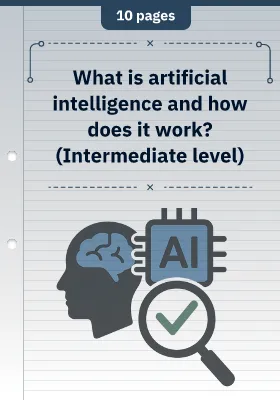
What is artificial intelligence and how does it work? (Intermediate level)

What is artificial intelligence and how does it work? (Intermediate level)

Objective: The worksheet provides a basic understanding of how artificial intelligence (AI) works at an intermediate level. Learners should be able to distinguish AI applications from classic programs, understand the technical learning process, and critically question algorithms in everyday life.


Content and methods: The content covers the basic definition of artificial intelligence, the distinction between static programs and adaptive systems, the three-step model of how AI works (data collection, pattern recognition, application), and the opportunities and risks of recommendation algorithms, such as filter bubbles and data bias. This is supplemented by practical case studies and the transfer of knowledge to school application scenarios. The methods include explanatory text work, tabular classifications, visual process diagrams to illustrate technical processes, analytical case studies, and creative transfer tasks in which learners take on developer roles to design their own AI ideas for everyday life.


Competencies:

  • Technical understanding: Understanding the logic of algorithms and machine learning
  • Judgment: Reflection on the limitations and error susceptibility of AI systems
  • Design skills: Development of innovative solutions for one's own environment (school)
  • Analytical skills: Distinguishing between different phases of the learning process using practical examples


Target group and level: From grade 8 onwards

non-subject specific content
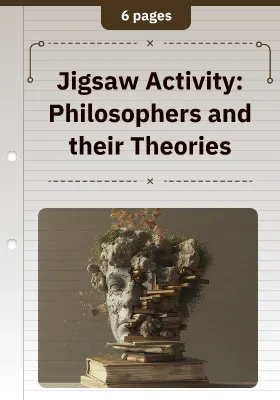
Jigsaw Activity: Philosophers and their Theories

Jigsaw Activity: Philosophers and their Theories

Objectives

The goal is to learn the Jigsaw method as a way to independently explore complex philosophical models of thought. Participants engage objectively and critically with fundamental questions of existence and evaluate them through academic discussion. The sample content serves as a flexible template for systematic method training.

Content and Methods

This Worksheet uses a cooperative Jigsaw structure to explore core philosophical ideas. After an individual specialization phase, students deepen their knowledge in expert groups and then share it in home groups. Results are organized in a table that highlights major works and key theses. A short, fictional role-play at the end places each position in a contemporary context. All content choices - both the selection of philosophers and the theories - are designed to be interchangeable.

Competencies

  • Subject Knowledge: Understanding central philosophical movements and the ability to concisely summarize complex models of thought.
  • Methodological Skills: Confident use of the Jigsaw method as a cooperative learning approach and proficiency in focused academic research.
  • Critical Judgment: Objective engagement with differing worldviews and their relevance for contemporary epistemology.
  • Social and Communication Skills: Responsible peer-to-peer knowledge sharing and facilitation of perspective-taking through role-play.

Target Group and Level

Middle and upper secondary

Englishnon-subject specific contentPhilosophyEthics