to teach logo
Sign up

Öffentliche Feste: Zwischen Tradition und Trubel

TT
by to-teach Team
5 pagesOberstufenon-subject specific content, Ethics, Philosophy, Politics
Template

Loading preview…

Your worksheet

Choose a public festival where your students can learn about its negative and positive aspects.

Need an idea?

Popular topics from other teachers

How our AI templates work

  • Content gets adapted

    Examples, texts and tasks match your focus.

  • Method & structure stay

    The didactically reviewed structure of the template won't change.

Description

Zielsetzung: Das übergeordnete Lernziel ist die kritische Analyse des Spannungsfelds zwischen Tradition und Kommerzialisierung bei öffentlichen Großveranstaltungen. Die Lernenden sollen befähigt werden, die gesellschaftlichen, wirtschaftlichen und ökologischen Auswirkungen von Festen zu bewerten und eigene Lösungsansätze zur Bewahrung kultureller Werte bei gleichzeitiger Modernisierung zu entwickeln.

Inhalte und Methoden: Das Arbeitsblatt nutzt eine variable Thematik als Grundlage für eine multiperspektivische Untersuchung. Die inhaltlichen Schwerpunkte liegen auf der Differenzierung zwischen authentischem Brauchtum und moderner "Event-Kultur".

  • Methoden:
  • Mindmapping: Gegenüberstellung von traditionellen Kernwerten (Werte, Geschichte) und modernen Begleiterscheinungen (Tourismus, Social Media)
  • Recherchearbeit: Strukturierte Analyse der Auswirkungen auf Dimensionen wie Gesellschaft, Wirtschaft, Ökologie und Kultur
  • Perspektivwechsel (Kreatives Schreiben): Verfassen eines Leserbriefs aus Sicht eines "Traditionsbewahrers" oder eines Instagram-Posts aus Sicht eines "Event-Managers"
  • Projektorientierte Gruppenarbeit: Entwicklung eines "Zukunftskonzepts" mit konkreten Maßnahmen zur Minimierung negativer Effekte (z. B. Müllvermeidung, Obergrenzen)

Kompetenzen:

  • Analyse- und Bewertungskompetenz: Untersuchung komplexer öffentlicher Phänomene hinsichtlich ihrer Tradition und wirtschaftlichen Bedeutung sowie Bildung einer fundierten eigenen Meinung
  • Medien- und Schreibkompetenz: Zielgruppengerechte Aufbereitung von Informationen für verschiedene Kanäle (Printmedien vs. Social Media)
  • Gestaltungskompetenz: Erarbeitung innovativer Konzepte zur Lösung realer gesellschaftlicher Probleme (Nachhaltigkeit bei Großevents)
  • Sozialkompetenz: Kooperative Problemlösung und Aushandlung von Kompromissen in der Gruppenarbeit

Zielgruppe und Niveau:

Oberstufe

Hinweis: Zur Bearbeitung der Tabelle wird der Zugang zum Internet benötigt.

Similar worksheets

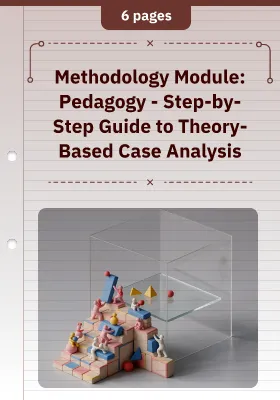
Methodology Module: Pedagogy - Step-by-Step Guide to Theory-Based Case Analysis

Methodology Module: Pedagogy - Step-by-Step Guide to Theory-Based Case Analysis

Objective: This worksheet aims to teach students a methodologically sound approach to exploring and applying educational theories. Students will recognize that simply memorizing theoretical concepts is not enough; rather, it is only by applying them to concrete practical examples that they can develop a deep professional understanding. Through guided case analysis, they learn to link abstract theoretical constructs and dense technical terminology to real-world educational situations (e.g., in schools, daycare centers, or group homes). They practice explaining theory-based connections using sound technical language, thereby bridging the gap between academic theory and practical application.

Content and Methods:

The worksheet combines targeted reading practice, theoretical text analysis, and practical case studies. At the beginning, students are provided with specific strategies for effectively reading complex educational texts. In the main section, they first work through the fundamentals of a specific educational theory based on an informational text. They then apply this knowledge to a relevant, real-life case study. Using a structured, three-column case matrix, they identify key theoretical aspects in three systematic steps, assign corresponding sequences of actions by the actors in the case study to these aspects, and finally explain the theory-based connection using precise technical terminology.

Competencies: Learners can...

  • apply goal-oriented reading strategies (such as structuring, targeted highlighting, and paraphrasing) to systematically analyze complex educational texts
  • identify and define key terms, core statements, and subprocesses of an educational theory from an informational text
  • analyze an educational case study and identify behaviors or actions of the individuals described that are relevant to the theory
  • structuredly link theoretical constructs to concrete practical examples in a case matrix (mapping skill)
  • coherently justify the connection between theoretical principles and concrete behavior in a theory-driven manner and using correct technical terminology

Target Audience and Level: Trainees in the social education sector


Note: Using the Internet can be helpful when working on some of the exercises.

PedagogySocial PedagogyEthicsPsychologyHealth and Social Care
From Everyday to Academic Language: Analyzing, Formulating & Reflecting

From Everyday to Academic Language: Analyzing, Formulating & Reflecting

This worksheet aims to provide students with a solid understanding of the significance and function of academic language and to help them practice actively using it in subject-specific instruction. Students will recognize that academic language serves as an essential tool for presenting complex topics in an objective, impersonal, and precise manner, and that the ability to switch between everyday language and academic language is a key skill. Through guided practice in translating everyday observations into formal language, they learn to use subject-specific linguistic tools, to put their own thoughts into writing in a structured manner, and to reflectively evaluate their own learning process and linguistic expression.

Content and Methods:

The worksheet combines cognitive awareness, guided writing practice, independent text production, and self-evaluation. After an introductory informational text on the distinction between everyday language and academic language, as well as an introduction to subject-specific language tools (e.g., for cause-and-effect relationships, hypothesis formation, or evaluations), learners gradually translate given everyday statements into logically structured academic language. They then apply this translation technique to their own current course material and reflect on the advantages and challenges of academic language formulation. The module concludes with a structured self-assessment matrix designed to evaluate their own language competencies and identify remaining learning needs.

Competencies:

Learners can...

  • identify the difference between everyday language and academic language and explain the importance of precise technical language for subject-matter understanding.
  • identify and purposefully apply specific subject-specific language tools (e.g., phrasing guides for descriptions, justifications, and analyses).
  • systematically translate colloquial observations into precise, factual, and logically structured sentences using formal language.
  • structure their own conceptual ideas derived from current classroom activities and independently put them into writing using appropriate technical terms.
  • critically reflect on their own language translation process and evaluate their individual strengths and areas for development in the use of formal language.

Target Audience and Level:

Grade 8 and above

non-subject specific contentChemistryBiologyGeographyGerman
Adolescence: When Emotions Outpace Reason—Understanding Behavior and Providing Professional Guidance

Adolescence: When Emotions Outpace Reason—Understanding Behavior and Providing Professional Guidance

This worksheet introduces future professionals to the biopsychological foundations of adolescence. Learners should recognize that challenging behavior often results from neurological changes and is not a deliberate act of aggression. The goal is to distinguish between the person and their actions in order to act in a way that de-escalates situations, provides support, and maintains positive relationships in their daily professional practice.


Content and Methods:

The material combines theoretical input from developmental psychology with practical case studies and self-reflection. After exploring the neurological foundations, learners “decode” typical behaviors. In a subsequent case analysis, they critically evaluate educational interventions and develop alternative professional approaches. A concluding reflection on their own emotional “triggers” reinforces their professional attitude.


Competencies:

Learners can...

  • explain the neurological and psychological changes that occur during adolescence (particularly the interaction between the limbic system and the prefrontal cortex).
  • psychologically interpret observable, challenging adolescent behavior (such as provocation, rule-breaking, or shame) and classify it as an age-typical developmental task.
  • critically analyze the actions of professionals in acute crisis situations (e.g., in cases of extreme risk-taking behavior) with regard to de-escalation, the duty to protect, and relationship-building.
  • Develop professional and practical alternative courses of action that simultaneously set clear boundaries and preserve the adolescents’ emotional safety.
  • Reflect on one’s own emotional “triggers” when interacting with adolescents in order to maintain professional distance and composure in everyday work.


Target group and level:

Adult students or trainees in the field of social pedagogy, particularly aspiring educators.

Social PedagogyPedagogyEthicsHealth and Social Care
The Challenge of Youth– Understanding and Providing Educational Support for Developmental Tasks According to Hurrelmann

The Challenge of Youth– Understanding and Providing Educational Support for Developmental Tasks According to Hurrelmann

This worksheet aims to provide aspiring educators with a solid sociological understanding of the “adolescence” life stage based on Klaus Hurrelmann’s model of developmental tasks. Learners will gain an awareness of the specific challenges, areas of conflict, and identity-formation processes that adolescents must navigate. They will learn to apply theoretical developmental tasks to concrete everyday situations faced by adolescents, analyze critical factors such as school-related pressure to perform, and develop strategies to alleviate these pressures in educational practice.


Content and Methods: This worksheet addresses the specific characteristics and challenges of adolescence, the four central developmental tasks identified by Klaus Hurrelmann (acquiring skills, forming bonds, consuming, and participating), as well as the tension between various societal influences and the development of identity in children and adolescents. Methodologically, the worksheet employs a combination of personal reflection and partner discussions to define concepts, an informative academic text with a tabular classification of everyday examples, and a small-group problem analysis to develop practical, stress-reducing approaches for educational practice.


Competencies:

Learners can...

  • describe the characteristics of adolescence and distinguish it from childhood and adulthood, providing reasons for their distinctions.
  • explain the four developmental tasks identified by Klaus Hurrelmann (acquiring skills, forming bonds, consuming, participating) and classify everyday situations according to these criteria.
  • critically reflect on the causes and consequences of academic pressure on adolescents’ identity and personality development.
  • design and justify action-oriented approaches and strategies to alleviate pressure in schools and educational settings.


Target group and level:

Adult students or trainees in the field of social pedagogy, particularly aspiring educators.

PedagogyEthicsSocial PedagogyHealth and Social Care
Understanding Development: The Phases of Childhood

Understanding Development: The Phases of Childhood

This worksheet aims to provide aspiring educators with a solid understanding of the stages of child development (early, middle, and late childhood). Learners should be made aware of how to correctly classify developmental phenomena and milestones in the areas of motor skills, cognition, language, and emotional/social development. They will learn to critically compare their own everyday experiences with scientific findings, to analyze everyday observations from a professional perspective, and to design needs-based educational interventions based on a needs assessment.

Content and Methods:

The worksheet combines visual stimuli, prior knowledge, academic texts, social media analyses, and case studies. After assessing their prior knowledge of the three stages of childhood, students explore the developmental characteristics of each stage in terms of motor skills, cognition, language, and social behavior. Using fictional tweets from professional practice, they classify developmental phenomena according to academic categories. The unit concludes with a case study from a selected stage of childhood, for which students conduct a needs assessment and develop a well-reasoned practical plan.

Competencies:

Learners can...

  • describe and distinguish between the developmental stages of early, middle, and late childhood in terms of their motor, cognitive, and social-emotional dimensions,
  • identify key developmental phenomena (e.g., the emergence of self-awareness, magical thinking, acquisition of cultural skills) in observational data and explain them using specialized terminology,
  • systematically compare their own practical observations with expert knowledge of developmental theory,
  • conduct a pedagogical needs assessment for a specific case study and, based on this, develop and justify tailored pedagogical interventions.

Target group and level:

Adult students or trainees in the field of social pedagogy, particularly aspiring educators.

PedagogySocial PedagogyEthicsHealth and Social Care
Theories - Applying and Exploring Them in Depth

Theories - Applying and Exploring Them in Depth

The worksheet aims to provide students with a deep understanding of a pedagogical theory. Students apply central technical terms, transfer theoretical concepts to pedagogical scenarios, and reflect on the relevance of the theory for practical application.

Content and methods:

The focus is on the application, in-depth exploration, and critical reflection of an educational theory. Methodologically, the worksheet combines the translation of technical terms into everyday language, cooperative group work via an expert group method, the elaboration and presentation of subject-specific content, the development of practical case studies, the analysis of different positions and arguments, as well as a concluding reflection and self-assessment.

Competencies:

  • Apply and explain central terms and concepts of a theory
  • Comprehend, structure, and summarize specialized texts
  • Transfer theoretical content to pedagogical situations and case examples
  • Analyze and evaluate professional positions and arguments
  • Formulate and justify personal judgments
  • Reflect on and assess one's own learning progress

Target group and level:

Adult students or trainees in the field of social pedagogy, particularly aspiring educators.

Note on further work: The worksheet serves to deepen and apply a pedagogical theory. It can build upon an introductory worksheet and forms the foundation for further tasks in which theoretical concepts are applied to more complex practical examples and critically reflected upon. Introductory worksheet on the topic: Theories – Fundamentals


Note: Internet access is required for the group research phase.

PedagogyPhilosophyEthicsSocial PedagogyHealth and Social Care