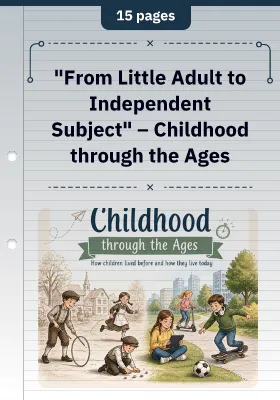
Understanding Development: The Phases of Childhood

TT
by to-teach Team
7 pagesStudents of social educationPedagogy, Social Pedagogy, Ethics, Health and Social Care
Template

Loading preview…

Your worksheet

Specify the stage of childhood or the area of special education that the case study is intended to cover. This defines the specific practical scenario to which the case study and the tasks should relate.

Need an idea?

Popular topics from other teachers

How our AI templates work

  • Content gets adapted

    Examples, texts and tasks match your focus.

  • Method & structure stay

    The didactically reviewed structure of the template won't change.

Description

Objective:

This worksheet aims to provide aspiring educators with a solid understanding of the stages of child development (early, middle, and late childhood). Learners should be made aware of how to correctly classify developmental phenomena and milestones in the areas of motor skills, cognition, language, and emotional/social development. They will learn to critically compare their own everyday experiences with scientific findings, to analyze everyday observations from a professional perspective, and to design needs-based educational interventions based on a needs assessment.

Content and Methods:

The worksheet combines visual stimuli, prior knowledge, academic texts, social media analyses, and case studies. After assessing their prior knowledge of the three stages of childhood, students explore the developmental characteristics of each stage in terms of motor skills, cognition, language, and social behavior. Using fictional tweets from professional practice, they classify developmental phenomena according to academic categories. The unit concludes with a case study from a selected stage of childhood, for which students conduct a needs assessment and develop a well-reasoned practical plan.

Competencies:

Learners can...

  • describe and distinguish between the developmental stages of early, middle, and late childhood in terms of their motor, cognitive, and social-emotional dimensions,
  • identify key developmental phenomena (e.g., the emergence of self-awareness, magical thinking, acquisition of cultural skills) in observational data and explain them using specialized terminology,
  • systematically compare their own practical observations with expert knowledge of developmental theory,
  • conduct a pedagogical needs assessment for a specific case study and, based on this, develop and justify tailored pedagogical interventions.

Target group and level:

Adult students or trainees in the field of social pedagogy, particularly aspiring educators.

Similar worksheets

Adolescence: When Emotions Outpace Reason—Understanding Behavior and Providing Professional Guidance

Adolescence: When Emotions Outpace Reason—Understanding Behavior and Providing Professional Guidance

This worksheet introduces future professionals to the biopsychological foundations of adolescence. Learners should recognize that challenging behavior often results from neurological changes and is not a deliberate act of aggression. The goal is to distinguish between the person and their actions in order to act in a way that de-escalates situations, provides support, and maintains positive relationships in their daily professional practice.


Content and Methods:

The material combines theoretical input from developmental psychology with practical case studies and self-reflection. After exploring the neurological foundations, learners “decode” typical behaviors. In a subsequent case analysis, they critically evaluate educational interventions and develop alternative professional approaches. A concluding reflection on their own emotional “triggers” reinforces their professional attitude.


Competencies:

Learners can...

  • explain the neurological and psychological changes that occur during adolescence (particularly the interaction between the limbic system and the prefrontal cortex).
  • psychologically interpret observable, challenging adolescent behavior (such as provocation, rule-breaking, or shame) and classify it as an age-typical developmental task.
  • critically analyze the actions of professionals in acute crisis situations (e.g., in cases of extreme risk-taking behavior) with regard to de-escalation, the duty to protect, and relationship-building.
  • Develop professional and practical alternative courses of action that simultaneously set clear boundaries and preserve the adolescents’ emotional safety.
  • Reflect on one’s own emotional “triggers” when interacting with adolescents in order to maintain professional distance and composure in everyday work.


Target group and level:

Adult students or trainees in the field of social pedagogy, particularly aspiring educators.

Social PedagogyPedagogyEthicsHealth and Social Care
The Challenge of Youth– Understanding and Providing Educational Support for Developmental Tasks According to Hurrelmann

The Challenge of Youth– Understanding and Providing Educational Support for Developmental Tasks According to Hurrelmann

This worksheet aims to provide aspiring educators with a solid sociological understanding of the “adolescence” life stage based on Klaus Hurrelmann’s model of developmental tasks. Learners will gain an awareness of the specific challenges, areas of conflict, and identity-formation processes that adolescents must navigate. They will learn to apply theoretical developmental tasks to concrete everyday situations faced by adolescents, analyze critical factors such as school-related pressure to perform, and develop strategies to alleviate these pressures in educational practice.


Content and Methods: This worksheet addresses the specific characteristics and challenges of adolescence, the four central developmental tasks identified by Klaus Hurrelmann (acquiring skills, forming bonds, consuming, and participating), as well as the tension between various societal influences and the development of identity in children and adolescents. Methodologically, the worksheet employs a combination of personal reflection and partner discussions to define concepts, an informative academic text with a tabular classification of everyday examples, and a small-group problem analysis to develop practical, stress-reducing approaches for educational practice.


Competencies:

Learners can...

  • describe the characteristics of adolescence and distinguish it from childhood and adulthood, providing reasons for their distinctions.
  • explain the four developmental tasks identified by Klaus Hurrelmann (acquiring skills, forming bonds, consuming, participating) and classify everyday situations according to these criteria.
  • critically reflect on the causes and consequences of academic pressure on adolescents’ identity and personality development.
  • design and justify action-oriented approaches and strategies to alleviate pressure in schools and educational settings.


Target group and level:

Adult students or trainees in the field of social pedagogy, particularly aspiring educators.

PedagogyEthicsSocial PedagogyHealth and Social Care
Theories - Applying and Exploring Them in Depth

Theories - Applying and Exploring Them in Depth

The worksheet aims to provide students with a deep understanding of a pedagogical theory. Students apply central technical terms, transfer theoretical concepts to pedagogical scenarios, and reflect on the relevance of the theory for practical application.

Content and methods:

The focus is on the application, in-depth exploration, and critical reflection of an educational theory. Methodologically, the worksheet combines the translation of technical terms into everyday language, cooperative group work via an expert group method, the elaboration and presentation of subject-specific content, the development of practical case studies, the analysis of different positions and arguments, as well as a concluding reflection and self-assessment.

Competencies:

  • Apply and explain central terms and concepts of a theory
  • Comprehend, structure, and summarize specialized texts
  • Transfer theoretical content to pedagogical situations and case examples
  • Analyze and evaluate professional positions and arguments
  • Formulate and justify personal judgments
  • Reflect on and assess one's own learning progress

Target group and level:

Adult students or trainees in the field of social pedagogy, particularly aspiring educators.

Note on further work: The worksheet serves to deepen and apply a pedagogical theory. It can build upon an introductory worksheet and forms the foundation for further tasks in which theoretical concepts are applied to more complex practical examples and critically reflected upon. Introductory worksheet on the topic: Theories – Fundamentals


Note: Internet access is required for the group research phase.
PedagogyPhilosophyEthicsSocial PedagogyHealth and Social Care
Jigsaw Activity: Philosophers and their Theories

Jigsaw Activity: Philosophers and their Theories

Objectives

The goal is to learn the Jigsaw method as a way to independently explore complex philosophical models of thought. Participants engage objectively and critically with fundamental questions of existence and evaluate them through academic discussion. The sample content serves as a flexible template for systematic method training.

Content and Methods

This Worksheet uses a cooperative Jigsaw structure to explore core philosophical ideas. After an individual specialization phase, students deepen their knowledge in expert groups and then share it in home groups. Results are organized in a table that highlights major works and key theses. A short, fictional role-play at the end places each position in a contemporary context. All content choices - both the selection of philosophers and the theories - are designed to be interchangeable.

Competencies

  • Subject Knowledge: Understanding central philosophical movements and the ability to concisely summarize complex models of thought.
  • Methodological Skills: Confident use of the Jigsaw method as a cooperative learning approach and proficiency in focused academic research.
  • Critical Judgment: Objective engagement with differing worldviews and their relevance for contemporary epistemology.
  • Social and Communication Skills: Responsible peer-to-peer knowledge sharing and facilitation of perspective-taking through role-play.

Target Group and Level

Middle and upper secondary

Englishnon-subject specific contentPhilosophyEthics