
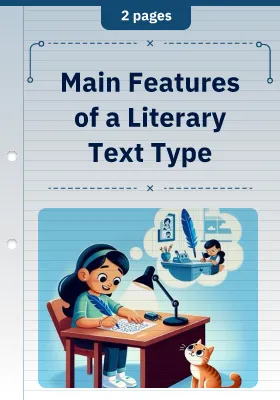
Main Features of a Literary Text Type
Learners create profiles for specific literary text types
Content and methods:
Students read an informative text about the given text type and extract information.
Competencies:
- reading comprehension
- summarizing
Target group and level:
Middle school
Understanding and Analyzing different Text Types
The objective of this worksheet is to enable students to distinguish between various text types and to master the specific structural and stylistic requirements of writing a text in the style of a specific text type. Students learn to analyze professional texts and apply these insights to their own research-based writing.
Content and methods: The worksheet begins with a theoretical overview of different text types (narrative, expository, procedural, argumentative) and their respective features. It then uses a multiple-choice section to test knowledge of article-specific components like hooks, subheadings, and expert quotes. Students perform a deep-dive analysis of a sample text regarding social media and mental health, identifying evidence and evaluating the author’s tone. Finally, a guided six-step process leads students through choosing a topic, conducting research, and drafting their own informative article.
Competencies:
- Textual Analysis: Identifying and categorizing different text types and their functional elements
- Reading Comprehension: Extracting evidence and evaluating the logical flow and balance of a non-fiction text
- Writing & Composition: Drafting a structured article using subheadings, engaging language, and formal tone
- Research & Information Literacy: Gathering data from credible sources and correctly citing references
- Critical Evaluation: Analyzing the role of expert opinions and the effectiveness of examples in persuasive or informative writing
Target group: Grade 8 and above
Comparing Text Types (Advanced)
Objective
The primary objective of this advanced worksheet is to develop a nuanced understanding of how different text types influence the delivery and impact of a message. It aims to teach students to match specific communicative goals—such as persuading, informing, or advocating—with the most effective linguistic structure, tone, and format.
Content and Methods
- Content: The worksheet explores complex issues.
- It provides three distinct mentor texts for analysis.
- Methods: The material uses a categorization task where students must select the most suitable text type for various scenarios, such as choosing between an opinion column or a formal proposal.
- It employs a structural analysis approach using a comparison table to evaluate differences in structure, tone, audience, and purpose across genres.
- The worksheet includes evidence-based questions requiring students to find proof within the texts to explain why specific formats are effective.
- A final comparative writing task requires a detailed analysis of suitability and commonalities between text types.
Competencies
- Genre Awareness: Identifying and marking specific markers for different text types like articles, letters, and speeches.
- Critical Analysis: Evaluating how the format (such as an article's use of data) impacts the presentation of a topic compared to more personal formats like letters.
- Rhetorical Knowledge: Understanding the effectiveness of direct engagement and rhetorical devices within a speech format.
- Communication Strategy: Determining how to use formal language and direct appeals to authority figures to create urgency in a letter.
Target Group and Level
- Grade 10 and above
Complex Source Integration - Practice evidence-based writing
Practice writing a report or essay based on different sources. Practice synthesizing, evidence-based writing and citing sources.
The students know how to integrate a variety of sources into their writing.
Content and Methodology: This teaching material introduces different types of source integration and provides exercises and information on citing sources correctly. In the end, students put what they've learnt into practice.
Skills:
- reading comprehension
- knowledge transfer
- academic writing
Target Audience and Level: Grade 10 and higher