to teach logo
Sign up

4 Schritte zur Analyse diskontinuierlicher Texte

TT
by to-teach Team
11 pagesAb Klasse 8non-subject specific content, Biology, Chemistry, Mathematics, Geography, German
Template

Loading preview…

Your worksheet

Enter the type of non-continuous text (e.g., diagram, table, or infographic) to be covered in the worksheet. This entry determines the type of text that the material and the associated orientation, analysis, interpretation, and evaluation tasks will be based on.

Need an idea?

Popular topics from other teachers

How our AI templates work

  • Content gets adapted

    Examples, texts and tasks match your focus.

  • Method & structure stay

    The didactically reviewed structure of the template won't change.

Description

Zielsetzung:

Das Arbeitsblatt zielt darauf ab, den Lernenden ein verlässliches methodisches Werkzeug an die Hand zu geben, um diskontinuierliche Texte – wie Diagramme, Tabellen, Infografiken und Schaubilder – fächerübergreifend und systematisch zu entschlüsseln. Die Lernenden erkennen, dass diese Formate im Gegensatz zu klassischen Fließtexten nicht einfach linear gelesen werden können, sondern dass einzelne Bildelemente, Zahlen und Textbausteine aktiv miteinander verknüpft werden müssen. Durch die schrittweise Anwendung eines 4-Schritte-Plans entwickeln sie die Fähigkeit, komplexe Daten aus verschiedensten Themenfeldern nicht nur sachlich richtig zu erfassen, sondern auch fachlich fundiert zu interpretieren und die visuelle Darstellung kritisch auf ihre Aussagekraft zu prüfen.

Inhalte und Methoden:

Das Arbeitsblatt verbindet methodische Anleitung mit strukturierter, kleinschrittiger Erarbeitung. Nach einer kurzen Einführung in die Vielfalt diskontinuierlicher Texte (u. a. Linien-, Säulen-, Kreisdiagramme, Messreihen in Tabellen, thematische Karten oder komplexe Schaubilder) erarbeiten sich die Lernenden einen systematischen 4-Schritte-Plan. Dieser führt sie wie ein Detektiv durch den Analyseprozess:

  • Schritt 1: Orientieren & beschreiben: Die Lernenden erfassen Thema, Darstellungsart (Diagramm, Tabelle, etc.), Achsenbeschriftungen und verwendete Symbole.
  • Schritt 2: Analysieren & ablesen: Es geht um das Erkennen von Mustern und Entwicklungen, das genaue Ablesen von Werten (inklusive Maxima und Minima) unter Nennung der Einheiten sowie den Vergleich verschiedener Daten.
  • Schritt 3: Erklären & interpretieren: Hier steht die kontext- oder theoriegeleitete Deutung im Fokus; die Lernenden verknüpfen Auffälligkeiten mit ihrem jeweiligen Vor- und Fachwissen und lernen, strikt zwischen reiner Beobachtung und Interpretation zu trennen.
  • Schritt 4: Kritisches Hinterfragen: Im letzten Schritt bewerten die Lernenden die Gestaltung der Darstellung, wie beispielsweise die Datenauswahl, optische Verzerrungen durch verkürzte Skalen oder das Verhältnis von Prozentwerten zu absoluten Zahlen. Den Abschluss bildet ein visuell aufbereitetes „Cheat Sheet“, das die vier Analyseschritte kompakt für die zukünftige Bearbeitung weiterer diskontinuierlicher Texte zusammenfasst.

Kompetenzen:

Die Lernenden können...

  • verschiedene Arten diskontinuierlicher Texte (z. B. unterschiedliche Diagrammtypen, Tabellen, Schaubilder) benennen und erklären, dass deren Informationen vom Leser / von der Leserin selbstständig verknüpft werden müssen.
  • sich fächerübergreifend in komplexen grafischen und tabellarischen Darstellungen orientieren, indem sie wesentliche Elemente wie Titel, Achsen, Einheiten, Farben und Symbole zielgerichtet erfassen und beschreiben.
  • dargestellte Muster, Entwicklungen und Extremwerte (Maximum/Minimum) sachlich analysieren, Gruppen miteinander vergleichen und Werte einheitenbezogen präzise ablesen.
  • ausgewählte Datenentwicklungen fachlich interpretieren, theoriegeleitete Ursachen dafür ableiten und in ihren Formulierungen klar zwischen objektiver Beobachtung und eigener Deutung unterscheiden.
  • die Gestaltung von Diagrammen, Tabellen oder Infografiken kritisch bewerten, indem sie Aspekte wie Datenauswahl, manipulativ wirkende Achsenskalierungen oder die Aussagekraft von absoluten gegenüber prozentualen Zahlen hinterfragen.

Zielgruppe und Niveau: Ab Klasse 8


Hinweis: Dieses Arbeitsblatt ist als universeller Methodenbaustein konzipiert. Es vermittelt den Schüler:innen ein fachunabhängiges 4-Schritte-Schema zur Erschließung diskontinuierlicher Texte. Zur Verwendung dieses Arbeitsblattes wird ein diskontinuierlicher Text benötigt.

Similar worksheets

From Everyday to Academic Language: Analyzing, Formulating & Reflecting

From Everyday to Academic Language: Analyzing, Formulating & Reflecting

This worksheet aims to provide students with a solid understanding of the significance and function of academic language and to help them practice actively using it in subject-specific instruction. Students will recognize that academic language serves as an essential tool for presenting complex topics in an objective, impersonal, and precise manner, and that the ability to switch between everyday language and academic language is a key skill. Through guided practice in translating everyday observations into formal language, they learn to use subject-specific linguistic tools, to put their own thoughts into writing in a structured manner, and to reflectively evaluate their own learning process and linguistic expression.

Content and Methods:

The worksheet combines cognitive awareness, guided writing practice, independent text production, and self-evaluation. After an introductory informational text on the distinction between everyday language and academic language, as well as an introduction to subject-specific language tools (e.g., for cause-and-effect relationships, hypothesis formation, or evaluations), learners gradually translate given everyday statements into logically structured academic language. They then apply this translation technique to their own current course material and reflect on the advantages and challenges of academic language formulation. The module concludes with a structured self-assessment matrix designed to evaluate their own language competencies and identify remaining learning needs.

Competencies:

Learners can...

  • identify the difference between everyday language and academic language and explain the importance of precise technical language for subject-matter understanding.
  • identify and purposefully apply specific subject-specific language tools (e.g., phrasing guides for descriptions, justifications, and analyses).
  • systematically translate colloquial observations into precise, factual, and logically structured sentences using formal language.
  • structure their own conceptual ideas derived from current classroom activities and independently put them into writing using appropriate technical terms.
  • critically reflect on their own language translation process and evaluate their individual strengths and areas for development in the use of formal language.

Target Audience and Level:

Grade 8 and above

non-subject specific contentChemistryBiologyGeographyGerman
Recognizing Greenwashing

Recognizing Greenwashing

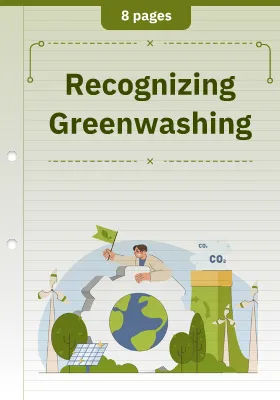
The goal of this worksheet is to enable students to independently identify and critically examine manipulative marketing strategies in retail. Using a specific case study, they will develop the theoretical foundation needed to distinguish between genuine sustainability promises and deliberate consumer deception, so they can make informed, independent consumer decisions in their daily lives.

Content and Methods: The content focuses on the definition and strategic characteristics of greenwashing, its psychological impact, and an analysis of legal consequences. Methodologically, the worksheet combines an image-based case analysis with in-depth journalistic text analysis. A video-based summary of theoretical categories of deception and a practical, criteria-based checklist serve to reinforce knowledge and facilitate active application to students’ own consumer behavior.

Competencies:

Analytical Competence: Students can systematically deconstruct visual design elements, price placements, and advertising messages in digital user interfaces.

Substantive Competence: They understand the definition of the technical term “greenwashing” and can distinguish between vague marketing phrases and verifiable sustainability labels.

Critical thinking skills: Students are able to critically evaluate the discrepancy between corporate sustainability reports and actual environmental impacts.

Reflective thinking skills: They can critically examine their own susceptibility to manipulative sales strategies and identify alternative courses of action.

Target audience and grade level: Intermediate (8th-10th grade)


EconomicsGeography
Group Puzzle for Chemistry Class

Group Puzzle for Chemistry Class

Objective: This worksheet uses the cooperative learning method known as the “group puzzle” to teach complex concepts in chemistry and atomic physics. The goal is for students to gain a deep understanding of the selected topic through self-directed learning and peer teaching.


Content and Methods: The content is taught using a structured five-phase model that combines cooperative and independent learning: In home groups, each member takes on a specific subtopic, which is then explored in a subsequent “expert phase” in groups of students with the same subtopic, using informational texts and in-depth tasks. Afterward, the students return to their core groups, share their knowledge with one another, and consolidate their findings together before moving on to a cooperative work phase in which they solve complex tasks that can only be mastered by combining all the individual aspects. The process concludes with a joint evaluation in a plenary session and a reflection on the learning process.


Competencies:

  • Subject-Specific Competence: Acquiring in-depth knowledge of a topic in chemistry
  • Social Competence: Fostering teamwork and communication skills through the “expert” model
  • Methodological Competence: Applying cooperative learning methods to independently process information and convey knowledge
  • Transferability: Applying expert knowledge to hypothetical scenarios, such as the discovery of new elements


Target Audience and Level: High School


Chemistry
The Secrets of Milk

The Secrets of Milk

Objective: This workbook explores a historical and materials-science phenomenon: the production of casein, an early milk-based bioplastic. Students work as a team of researchers to investigate how the organic components of liquid cow’s milk can be transformed into a solid plastic through the action of acid.


Content and Methods: The content is conveyed through a combination of historical contextualization, experimental laboratory work, and material analysis: Starting with the question of how a solid material can be produced from milk, students explore the composition of milk and the effect of acids on proteins. They then experimentally extract casein, document the course of the reaction, and examine the properties of the resulting bioplastic. Finally, the results are used in a scientific application to evaluate the historical significance and material properties of casein as an alternative to plastic.


Competencies:

  • Technical expertise: Understanding of protein denaturation (acid precipitation of milk protein/casein) and the classification of galalith as a historical bioplastic
  • Knowledge acquisition: Planning, conducting, and systematically documenting a preparative organic chemistry experiment (filtration, solid isolation)
  • Materials and testing skills: Criteria-based analysis of the physical properties of a self-produced solid
  • Argumentation and language skills: Writing a technically sound report using precise scientific explanations


Target audience and level: Middle school

BiologyChemistry
The Green Battery

The Green Battery

Objective: This worksheet explores the electrochemical fundamentals of galvanic cells and how a lemon battery works in the context of modern, sustainable technology development. Students take on the role of a startup research team to experimentally and ecologically evaluate the suitability of a lemon as an environmentally friendly electrolyte, as well as the efficiency of various electrode pairings.


Content and Methods: The content is taught by combining theoretical fundamentals, experimental data collection, error analysis, and sustainability assessment: First, students explore the structure and functioning of electrochemical cells as well as the underlying redox reactions. They then test their hypotheses in an experiment, document measurement data, and analyze typical sources of error in the laboratory. Finally, they evaluate the performance and sustainability of various materials before summarizing their results in a technical report and a persuasive presentation.


Competencies:

  • Technical Competence: Understanding of redox reactions, electrode potentials, and the role of electrolytes in generating electrical power
  • Data Analysis: Conducting quantitative electrochemical measurements, systematically comparing variables, and identifying sources of methodological error
  • Evaluation Competence: Balancing maximum technical performance with environmental factors (extraction, recycling, toxicity) in the context of sustainable chemistry
  • Communication skills: Targeted, audience-oriented presentation of laboratory data for a business analysis or an investor pitch


Target audience and level: Middle School

BiologyChemistry