to teach logo
Sign up

Basic knowledge of history (high school)

TT
by to-teach Team
3 pagesUpper levels (11th - 13th grade)History
Template

Loading preview…

Your worksheet

Create teaching material on basic knowledge of history. Enter the basic topic.

Need an idea?

Popular topics from other teachers

How our AI templates work

  • Content gets adapted

    Examples, texts and tasks match your focus.

  • Method & structure stay

    The didactically reviewed structure of the template won't change.

Description

Objective: Learners acquire basic knowledge of a selected historical topic.

Content and methodology: Learners read a basic text and are able to answer historical comprehension questions based on it.

Competences:

  • Promoting reading skills
  • Assessing and explaining historical contexts

Level: Upper levels (11th - 13th grade)

Similar worksheets

Subject specific written language - linguistic devices

Subject specific written language - linguistic devices

Learning Objectives

The overarching learning objective is to develop students’ awareness and mastery of the characteristics of academic and subject-specific language, as well as to strengthen their ability to transform language. Students should learn to analyse typical features of academic texts (technical terminology, passive voice, and nominal style) according to defined criteria, reflect on their functional effects in terms of objectivity and how they guide the reader, and purposefully translate dense, nominalised academic language into clear, accessible verbal style using active voice.

Content and Methods

The worksheet introduces the key characteristics of academic non-fiction texts (technical terminology, passive voice, and nominal style) and combines text analysis with practical language exercises. Working with a subject-specific text, students first compile a glossary of technical terms with context-based definitions and distinguish between passive constructions and nominal style using a two-colour highlighting technique.

Building on this, they conduct a functional stylistic analysis to examine the intended effects of linguistic density and the author’s conveyed stance towards the subject matter. The worksheet concludes with an active language transformation task in which students rewrite a highly nominalised example sentence that omits the agent, turning it into dynamic active-voice sentences. This involves breaking down complex verb-noun constructions and explicitly introducing the actors performing the actions.

Competencies

  • Linguistic and grammatical analysis: Confidently identifying and clarifying technical terminology, as well as recognising syntactic forms of linguistic compression (nominal style and passive constructions).
  • Functional and stylistic judgement: Reflecting on the rhetorical effects and functions of linguistic distance, objectivity, and impersonal presentation in academic texts.
  • Language transformation: Purposefully translating complex, agentless nominal constructions into clear, action-oriented active sentences using verbal style.
  • Lexical comprehension: Deriving the meaning of unfamiliar or highly specialised technical terms from context and formulating concise definitions (glossary work).

Target Group and Level

Upper secondary school (advanced level).

GeographyBiologyPoliticsChemistryHistory
From Everyday to Academic Language: Analyzing, Formulating & Reflecting

From Everyday to Academic Language: Analyzing, Formulating & Reflecting

This worksheet aims to provide students with a solid understanding of the significance and function of academic language and to help them practice actively using it in subject-specific instruction. Students will recognize that academic language serves as an essential tool for presenting complex topics in an objective, impersonal, and precise manner, and that the ability to switch between everyday language and academic language is a key skill. Through guided practice in translating everyday observations into formal language, they learn to use subject-specific linguistic tools, to put their own thoughts into writing in a structured manner, and to reflectively evaluate their own learning process and linguistic expression.

Content and Methods:

The worksheet combines cognitive awareness, guided writing practice, independent text production, and self-evaluation. After an introductory informational text on the distinction between everyday language and academic language, as well as an introduction to subject-specific language tools (e.g., for cause-and-effect relationships, hypothesis formation, or evaluations), learners gradually translate given everyday statements into logically structured academic language. They then apply this translation technique to their own current course material and reflect on the advantages and challenges of academic language formulation. The module concludes with a structured self-assessment matrix designed to evaluate their own language competencies and identify remaining learning needs.

Competencies:

Learners can...

  • identify the difference between everyday language and academic language and explain the importance of precise technical language for subject-matter understanding.
  • identify and purposefully apply specific subject-specific language tools (e.g., phrasing guides for descriptions, justifications, and analyses).
  • systematically translate colloquial observations into precise, factual, and logically structured sentences using formal language.
  • structure their own conceptual ideas derived from current classroom activities and independently put them into writing using appropriate technical terms.
  • critically reflect on their own language translation process and evaluate their individual strengths and areas for development in the use of formal language.

Target Audience and Level:

Grade 8 and above

non-subject specific contentChemistryBiologyGeographyGerman
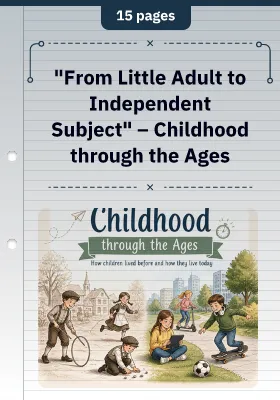
"From Little Adult to Independent Subject" – Childhood through the Ages

"From Little Adult to Independent Subject" – Childhood through the Ages

This worksheet aims to provide trainee teachers with a historically informed and socially critical understanding of the life stage known as ‘childhood’. Learners are to be made aware that childhood is not a rigid, biological state, but is subject to constant social change. They will learn to analyse historical patterns of upbringing and living environments, to contextualise the contemporary view of the child (including the UN Convention on the Rights of the Child), and to draw conclusions for their own professional approach by comparing the past and the present.

Content and methods:

This worksheet combines historical text analysis, the development of empathy, analysis of contemporary issues and research into international law. Following a personal reflection and an analysis of a historical period, the pupils write a fictional diary entry from a child’s perspective and contrast this with the reaction of a child today. They then map out the cornerstones of modern childhood in a practical matrix and compare historical and contemporary living conditions. The activity concludes with research into the UN Convention on the Rights of the Child, including its historical context, and a reflection on their own pedagogical approach.


Competencies:

Learners can...

  • Explain the concept of childhood as a socially shaped and historically changeable construct.
  • Analyse children’s historical living environments in terms of educational objectives, work requirements and legal status, guided by specific criteria.
  • Develop historical empathy through methods of shifting perspectives and reflect on different living conditions from multiple perspectives.
  • Identify the dimensions of modern childhood (including subject status, institutionalisation and mediatisation) and illustrate them using concrete examples from practice.
  • Independently research articles of the UN Convention on the Rights of the Child, place them in their historical context and relate them to today’s image of the child.
  • Use historical insights to critically examine current patterns of upbringing and apply them to one’s own professional approach.


Target group and level:

Adult students or trainees in the field of social pedagogy, particularly aspiring educators.


Note: Internet access is required for the research task

PedagogySocial PedagogyHistoryHealth and Social Care