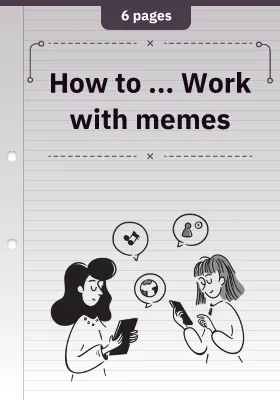
The worksheet provides students with basic information about memes, their characteristics, their popularity, and how they function in online communication. It encourages the analysis and interpretation of memes as well as creative engagement with this medium.
Content and methods: The worksheet covers the definition of memes, their typical characteristics, the reasons for their popularity, and their role in online communication. Multiple-choice questions are used to test understanding, open-ended questions are used to analyze a specific meme, and a creative assignment is used to create students' own memes.
Skills:
- Subject-specific skills
- Analytical skills: Students learn to analyze and interpret memes.
- Creativity: Students are encouraged to create their own memes.
- Media literacy: Students reflect on the meaning and impact of memes as part of digital culture.
Target group and level: Grade 8 and above