to teach logo
Sign up

Character Types (Basics)

TT
by to-teach Team
1 pageMiddle SchoolEnglish
Template

Loading preview…

Your worksheet

Enter the English title of the book, film or story. This establishes the thematic context of the cloze text and provides the framework for the open-ended analysis questions at the end of the worksheet.

Need an idea?

Popular topics from other teachers

How our AI templates work

  • Content gets adapted

    Examples, texts and tasks match your focus.

  • Method & structure stay

    The didactically reviewed structure of the template won't change.

Description

Objective: This worksheet aims to introduce students to essential literary character types, enabling them to identify standard narrative roles and analyze character functions within storytelling.

Content and methods: The worksheet covers conventional character types and narrative functions through an introductory reference guide. It utilizes a matching exercise pairing terms with definitions, followed by a fill-in-the-blank contextual application text. Finally, open-ended analytical questions guide students in examining specific character roles and relationships within a familiar story.

Competencies:

  • Literary analysis and character type identification
  • Conceptual understanding and definition matching
  • Reading comprehension and contextual application
  • Critical thinking and narrative analysis

Target group: Middle School

Similar worksheets

📖 Reading Time: Grade 2 with Coloring Page

📖 Reading Time: Grade 2 with Coloring Page

The primary learning objective is advancing early English reading instruction, enhancing word- and sentence-level decoding fluency, expanding thematic vocabulary, and supporting multisensory cognitive consolidation through integrated visual-motor tasks.

Contents and Methods: The worksheet combines short, structured declarative sentences with an integrated word search puzzle and a concluding thematic coloring activity. Methodologically, learners first read clear descriptive sentences featuring foundational vocabulary, action verbs, and basic syntactic patterns. They then visually scan for and identify key target words within a letter grid matrix, reinforcing word recognition and orthographic memory. Finally, a detailed coloring page engages fine motor skills and serves as a motivating, multisensory capstone to consolidate lexical associations.

Competencies:

  • Reading & Decoding Skills (English): reliable decoding, fluent reading of short connected sentences, and structural understanding of simple English statements
  • Vocabulary & Language Competence: visual recognition, retention, and semantic grounding of high-frequency words, and descriptive action verbs
  • Visual Perception & Concentration: systematic scanning, visual discrimination, and focused attention through the word search puzzle
  • Fine Motor & Multisensory Learning: hand-eye coordination, creative focus, and multisensory reinforcement through thematic coloring

Target Group: Grade 2 and above

English
📖 Reading Time: Grade 1 with Coloring Page

📖 Reading Time: Grade 1 with Coloring Page

The primary learning objective is foundational early reading instruction in English, strengthening decoding skills at word and simple sentence levels, expanding basic thematic vocabulary, and supporting learner motivation and fine motor development through an integrated creative coloring activity for beginner readers.

Contents and Methods: The worksheet combines short, clearly structured declarative sentences in English centered around an engaging theme with a subsequent thematic coloring exercise. Methodologically, early learners read accessible, single-clause sentences featuring high-frequency sight words, and foundational action verbs. Following the reading phase, learners visually and creatively anchor their learning experience by coloring a detailed illustration corresponding to the topic, which reinforces concentration, haptic-visual coordination, and positive emotional engagement with the foreign language.

Competencies:

  • Reading & Decoding Skills (English): reliable decoding, word recognition of high-frequency vocabulary, and basic comprehension of simple English sentence structures
  • Vocabulary & Language Competence: acquisition and recognition of foundational thematic vocabulary (nouns, verbs, descriptive adjectives) in meaningful sentence contexts
  • Fine Motor Skills & Visual Perception: development of graphomotor control, hand-eye coordination, and sustained visual focus through mindful coloring
  • Motivation & Affective Learning: playful, low-anxiety access to foreign language learning through the combination of text and artistic expression

Target Group: Grade 1 and above

English
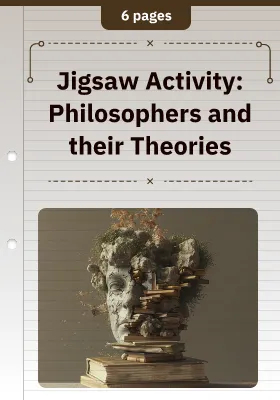
Jigsaw Activity: Philosophers and their Theories

Jigsaw Activity: Philosophers and their Theories

Objectives

The goal is to learn the Jigsaw method as a way to independently explore complex philosophical models of thought. Participants engage objectively and critically with fundamental questions of existence and evaluate them through academic discussion. The sample content serves as a flexible template for systematic method training.

Content and Methods

This Worksheet uses a cooperative Jigsaw structure to explore core philosophical ideas. After an individual specialization phase, students deepen their knowledge in expert groups and then share it in home groups. Results are organized in a table that highlights major works and key theses. A short, fictional role-play at the end places each position in a contemporary context. All content choices - both the selection of philosophers and the theories - are designed to be interchangeable.

Competencies

  • Subject Knowledge: Understanding central philosophical movements and the ability to concisely summarize complex models of thought.
  • Methodological Skills: Confident use of the Jigsaw method as a cooperative learning approach and proficiency in focused academic research.
  • Critical Judgment: Objective engagement with differing worldviews and their relevance for contemporary epistemology.
  • Social and Communication Skills: Responsible peer-to-peer knowledge sharing and facilitation of perspective-taking through role-play.

Target Group and Level

Middle and upper secondary

Englishnon-subject specific contentPhilosophyEthics