to teach logo
Sign up

Das Entscheidungs-Tribunal

TT
by to-teach Team
9 pagesMittelstufenon-subject specific content, History
Template

Loading preview…

Your worksheet

Formulate a decision-making question based on the story. Using this question, the students conduct a tribunal and vote on a decision.

Need an idea?

Popular topics from other teachers

How our AI templates work

  • Content gets adapted

    Examples, texts and tasks match your focus.

  • Method & structure stay

    The didactically reviewed structure of the template won't change.

Description

Zielsetzung:

Das Arbeitsblatt zielt darauf ab, ein tiefgreifendes Verständnis für komplexe, historische oder gesellschaftliche Entscheidungsprozesse und deren langfristige Konsequenzen zu vermitteln. Die Lernenden sollen befähigt werden, multiperspektivische Interessen abzuwägen, kontroverse Positionen argumentativ zu vertreten und eigene Urteile mit den tatsächlichen historischen oder realen Entwicklungen kritisch abzugleichen.

Inhalte und Methoden:

Die inhaltlichen Schwerpunkte umfassen die Aufarbeitung eines spezifischen Entscheidungskonflikts, die Analyse zugrunde liegender Interessenstrukturen sowie die Einordnung der tatsächlichen Abläufe und Nachwirkungen. Methodisch setzt das Material auf einen abwechslungsreichen Mix aus auditiven oder visuellen Einstiegsimpulsen und einer wissensüberprüfenden Erarbeitung. Darauf folgt eine simulationsbasierte Gruppenarbeitsphase in Form eines Entscheidungstribunals mit vorgegebenen Rollenkarten und gewichteten Stimmrechten. Abschließend wird der Lernprozess durch reflektierende Schreibaufgaben und eine strukturierte Ergebnissicherung mittels eines Exit-Tickets abgerundet.

Kompetenzen:

  • Perspektivenübernahme und Empathie: Fähigkeit, sich in vorgegebene Rollen hineinzuversetzen, deren spezifische Interessen zu verstehen und diese argumentativ zu vertreten
  • Urteils- und Argumentationskompetenz: Befähigung, komplexe Sachverhalte aus verschiedenen Blickwinkeln zu bewerten, kriteriengeleitet Abwägungen zu treffen und eigene Entscheidungen begründet zu verteidigen
  • Historische Orientierungs- und Reflexionskompetenz: Eignung, simulierte Handlungsergebnisse mit realen historischen Ereignissen zu vergleichen, Ursache-Wirkungs-Zusammenhänge zu erkennen und eigene Erkenntnisse abstrahierend zu reflektieren

Zielgruppe und Niveau: Mittelstufe (8.-10. Klasse)
Similar worksheets

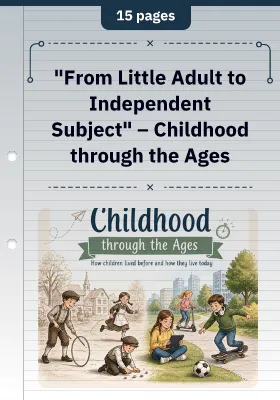
"From Little Adult to Independent Subject" – Childhood through the Ages

"From Little Adult to Independent Subject" – Childhood through the Ages

This worksheet aims to provide trainee teachers with a historically informed and socially critical understanding of the life stage known as ‘childhood’. Learners are to be made aware that childhood is not a rigid, biological state, but is subject to constant social change. They will learn to analyse historical patterns of upbringing and living environments, to contextualise the contemporary view of the child (including the UN Convention on the Rights of the Child), and to draw conclusions for their own professional approach by comparing the past and the present.

Content and methods:

This worksheet combines historical text analysis, the development of empathy, analysis of contemporary issues and research into international law. Following a personal reflection and an analysis of a historical period, the pupils write a fictional diary entry from a child’s perspective and contrast this with the reaction of a child today. They then map out the cornerstones of modern childhood in a practical matrix and compare historical and contemporary living conditions. The activity concludes with research into the UN Convention on the Rights of the Child, including its historical context, and a reflection on their own pedagogical approach.


Competencies:

Learners can...

  • Explain the concept of childhood as a socially shaped and historically changeable construct.
  • Analyse children’s historical living environments in terms of educational objectives, work requirements and legal status, guided by specific criteria.
  • Develop historical empathy through methods of shifting perspectives and reflect on different living conditions from multiple perspectives.
  • Identify the dimensions of modern childhood (including subject status, institutionalisation and mediatisation) and illustrate them using concrete examples from practice.
  • Independently research articles of the UN Convention on the Rights of the Child, place them in their historical context and relate them to today’s image of the child.
  • Use historical insights to critically examine current patterns of upbringing and apply them to one’s own professional approach.


Target group and level:

Adult students or trainees in the field of social pedagogy, particularly aspiring educators.


Note: Internet access is required for the research task

PedagogySocial PedagogyHistoryHealth and Social Care
What is artificial intelligence and how does it work? (Upper secondary level)

What is artificial intelligence and how does it work? (Upper secondary level)

Objective: This worksheet provides an in-depth understanding of the technical fundamentals and ethical implications of artificial intelligence at the upper secondary level. The aim is to go beyond mere application and understand the underlying mechanisms (such as neural networks and machine learning) and critically reflect on their social implications.


Content and methods: The content covers fundamental technical concepts of artificial intelligence such as machine learning, deep learning, and neural networks, the distinction between weak and strong AI, and the analysis of everyday digital applications according to criteria such as data volume, algorithms, and learning ability. This is supplemented by practical case studies on personalized learning systems and ethical and social issues such as bias, responsibility, and the impact on learning and creativity. The methods include technical term explanations, comparative classification tasks, scenario-based case analyses, multi-perspective role-plays from different points of interest, and stimulating discussion and position exercises in the classroom, in which learners justify and reflect on their attitudes.


Competencies:

  • Technical expertise: Confident use of technical terms such as algorithms, training data, and artificial neurons.
  • Analytical skills: Ability to identify the role of training data and bias in AI models.
  • Ethical judgment: Reflection on data protection and discrimination risks.
  • Discussion and argumentation skills: Ability to represent complex positions within a role-play and in a plenary discussion


Target group and level: From grade 10 onwards

non-subject specific content
What is artificial intelligence and how does it work? (Intermediate level)

What is artificial intelligence and how does it work? (Intermediate level)

Objective: The worksheet provides a basic understanding of how artificial intelligence (AI) works at an intermediate level. Learners should be able to distinguish AI applications from classic programs, understand the technical learning process, and critically question algorithms in everyday life.


Content and methods: The content covers the basic definition of artificial intelligence, the distinction between static programs and adaptive systems, the three-step model of how AI works (data collection, pattern recognition, application), and the opportunities and risks of recommendation algorithms, such as filter bubbles and data bias. This is supplemented by practical case studies and the transfer of knowledge to school application scenarios. The methods include explanatory text work, tabular classifications, visual process diagrams to illustrate technical processes, analytical case studies, and creative transfer tasks in which learners take on developer roles to design their own AI ideas for everyday life.


Competencies:

  • Technical understanding: Understanding the logic of algorithms and machine learning
  • Judgment: Reflection on the limitations and error susceptibility of AI systems
  • Design skills: Development of innovative solutions for one's own environment (school)
  • Analytical skills: Distinguishing between different phases of the learning process using practical examples


Target group and level: From grade 8 onwards

non-subject specific content