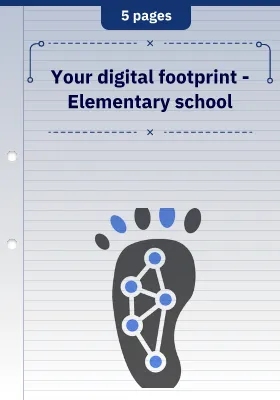
Dein digitaler Fußabdruck - Grundschule
Loading preview…
Add an example of a type of information. The person Lin accidentally shares this information. The students then consider what Lin can do now.
How our AI templates work
Content gets adapted
Examples, texts and tasks match your focus.
Method & structure stay
The didactically reviewed structure of the template won't change.
Description
Zielsetzung:
Die Lernenden sollen ein Bewusstsein für den digitalen Fußabdruck entwickeln und die Wichtigkeit des verantwortungsvollen Handelns im Internet verstehen.
Inhalte und Methoden:
Das Arbeitsblatt erklärt, was ein digitaler Fußabdruck ist, welche Spuren man im Internet hinterlässt (z. B. angesehene Videos, geteilte Fotos, Spitznamen, E-Mail-Adressen) und dass diese Spuren dauerhaft sind. Die Definition des digitalen Fußabdrucks wird erklärt. Das Arbeitsblatt nutzt eine bildliche Analogie (Fußspuren) für eine aktive Ideensammlung der Lernenden. Es werden konkrete Beispiele für Spuren genannt (Videos, Fotos, E-Mail-Adressen). Die Dauerhaftigkeit der Spuren und die damit verbundenen Gefahren (z. B. Klauen von Passwörtern) werden thematisiert. Das Wissen wird durch Multiple-Choice-Fragen und eine Fallstudie zur Anwendung von Sicherheitsregeln (Rücksprache mit Eltern) überprüft.
Kompetenzen:
- Medienkompetenz und Bewusstsein für den digitalen Fußabdruck
- Risikobewusstsein im Umgang mit persönlichen Daten und geteilten Inhalten
- Kritisches Denken bei der Auswahl sicherer Handlungen im Internet
Zielgruppe und Niveau:
3.-4. Klasse
Similar worksheets


Theories - Applying and Exploring Them in Depth
The worksheet aims to provide students with a deep understanding of a pedagogical theory. Students apply central technical terms, transfer theoretical concepts to pedagogical scenarios, and reflect on the relevance of the theory for practical application.
Content and methods:
The focus is on the application, in-depth exploration, and critical reflection of an educational theory. Methodologically, the worksheet combines the translation of technical terms into everyday language, cooperative group work via an expert group method, the elaboration and presentation of subject-specific content, the development of practical case studies, the analysis of different positions and arguments, as well as a concluding reflection and self-assessment.
Competencies:
- Apply and explain central terms and concepts of a theory
- Comprehend, structure, and summarize specialized texts
- Transfer theoretical content to pedagogical situations and case examples
- Analyze and evaluate professional positions and arguments
- Formulate and justify personal judgments
- Reflect on and assess one's own learning progress
Target group and level:
Adult students or trainees in the field of social pedagogy, particularly aspiring educators.
Note on further work: The worksheet serves to deepen and apply a pedagogical theory. It can build upon an introductory worksheet and forms the foundation for further tasks in which theoretical concepts are applied to more complex practical examples and critically reflected upon. Introductory worksheet on the topic: Theories – Fundamentals
Note: Internet access is required for the group research phase.