to teach logo
Sign up

Diseases That Changed the World

TT
by to-teach Team
1 pageGrade 8 and aboveBiology, English, History
Template

Loading preview…

Your worksheet

Choose an infectious disease.

Need an idea?

Popular topics from other teachers

How our AI templates work

  • Content gets adapted

    Examples, texts and tasks match your focus.

  • Method & structure stay

    The didactically reviewed structure of the template won't change.

Description

Objective: This worksheet aims to familiarize students with the medical terminology and historical impact of infectious diseases.


Content and methods: The worksheet employs a vocabulary-building matching exercise to define key epidemiological terms. This is followed by an informative text detailing the origins, specific types, and historical outbreaks of the disease, including its impact on war and famine. Methodologically, it uses a visual timeline for chronological organization and concludes with a creative role-play task—preparing a conference speech—to encourage synthesis and application of the material.


Competencies:

  • Medical Literacy: Mastering terminology such as "pathogen," "vector," and "incubation period"
  • Historical Analysis: Understanding the social and historical consequences of disease outbreaks
  • Scientific Classification: Distinguishing between different strains of bacteria and their transmission methods
  • Communication Skills: Synthesizing complex information into a structured speech for a specific audience


Target group:

Grade 8 and above

Similar worksheets

📖 Reading Time: Grade 2 with Coloring Page

📖 Reading Time: Grade 2 with Coloring Page

The primary learning objective is advancing early English reading instruction, enhancing word- and sentence-level decoding fluency, expanding thematic vocabulary, and supporting multisensory cognitive consolidation through integrated visual-motor tasks.

Contents and Methods: The worksheet combines short, structured declarative sentences with an integrated word search puzzle and a concluding thematic coloring activity. Methodologically, learners first read clear descriptive sentences featuring foundational vocabulary, action verbs, and basic syntactic patterns. They then visually scan for and identify key target words within a letter grid matrix, reinforcing word recognition and orthographic memory. Finally, a detailed coloring page engages fine motor skills and serves as a motivating, multisensory capstone to consolidate lexical associations.

Competencies:

  • Reading & Decoding Skills (English): reliable decoding, fluent reading of short connected sentences, and structural understanding of simple English statements
  • Vocabulary & Language Competence: visual recognition, retention, and semantic grounding of high-frequency words, and descriptive action verbs
  • Visual Perception & Concentration: systematic scanning, visual discrimination, and focused attention through the word search puzzle
  • Fine Motor & Multisensory Learning: hand-eye coordination, creative focus, and multisensory reinforcement through thematic coloring

Target Group: Grade 2 and above

English
📖 Reading Time: Grade 1 with Coloring Page

📖 Reading Time: Grade 1 with Coloring Page

The primary learning objective is foundational early reading instruction in English, strengthening decoding skills at word and simple sentence levels, expanding basic thematic vocabulary, and supporting learner motivation and fine motor development through an integrated creative coloring activity for beginner readers.

Contents and Methods: The worksheet combines short, clearly structured declarative sentences in English centered around an engaging theme with a subsequent thematic coloring exercise. Methodologically, early learners read accessible, single-clause sentences featuring high-frequency sight words, and foundational action verbs. Following the reading phase, learners visually and creatively anchor their learning experience by coloring a detailed illustration corresponding to the topic, which reinforces concentration, haptic-visual coordination, and positive emotional engagement with the foreign language.

Competencies:

  • Reading & Decoding Skills (English): reliable decoding, word recognition of high-frequency vocabulary, and basic comprehension of simple English sentence structures
  • Vocabulary & Language Competence: acquisition and recognition of foundational thematic vocabulary (nouns, verbs, descriptive adjectives) in meaningful sentence contexts
  • Fine Motor Skills & Visual Perception: development of graphomotor control, hand-eye coordination, and sustained visual focus through mindful coloring
  • Motivation & Affective Learning: playful, low-anxiety access to foreign language learning through the combination of text and artistic expression

Target Group: Grade 1 and above

English
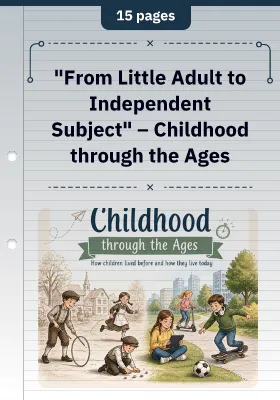
"From Little Adult to Independent Subject" – Childhood through the Ages

"From Little Adult to Independent Subject" – Childhood through the Ages

This worksheet aims to provide trainee teachers with a historically informed and socially critical understanding of the life stage known as ‘childhood’. Learners are to be made aware that childhood is not a rigid, biological state, but is subject to constant social change. They will learn to analyse historical patterns of upbringing and living environments, to contextualise the contemporary view of the child (including the UN Convention on the Rights of the Child), and to draw conclusions for their own professional approach by comparing the past and the present.

Content and methods:

This worksheet combines historical text analysis, the development of empathy, analysis of contemporary issues and research into international law. Following a personal reflection and an analysis of a historical period, the pupils write a fictional diary entry from a child’s perspective and contrast this with the reaction of a child today. They then map out the cornerstones of modern childhood in a practical matrix and compare historical and contemporary living conditions. The activity concludes with research into the UN Convention on the Rights of the Child, including its historical context, and a reflection on their own pedagogical approach.


Competencies:

Learners can...

  • Explain the concept of childhood as a socially shaped and historically changeable construct.
  • Analyse children’s historical living environments in terms of educational objectives, work requirements and legal status, guided by specific criteria.
  • Develop historical empathy through methods of shifting perspectives and reflect on different living conditions from multiple perspectives.
  • Identify the dimensions of modern childhood (including subject status, institutionalisation and mediatisation) and illustrate them using concrete examples from practice.
  • Independently research articles of the UN Convention on the Rights of the Child, place them in their historical context and relate them to today’s image of the child.
  • Use historical insights to critically examine current patterns of upbringing and apply them to one’s own professional approach.


Target group and level:

Adult students or trainees in the field of social pedagogy, particularly aspiring educators.


Note: Internet access is required for the research task

PedagogySocial PedagogyHistoryHealth and Social Care
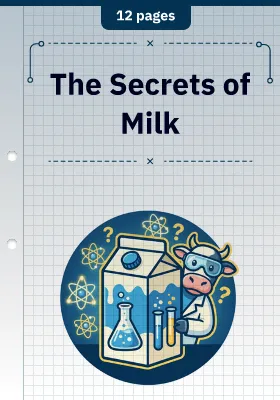
The Secrets of Milk

The Secrets of Milk

Objective: This workbook explores a historical and materials-science phenomenon: the production of casein, an early milk-based bioplastic. Students work as a team of researchers to investigate how the organic components of liquid cow’s milk can be transformed into a solid plastic through the action of acid.


Content and Methods: The content is conveyed through a combination of historical contextualization, experimental laboratory work, and material analysis: Starting with the question of how a solid material can be produced from milk, students explore the composition of milk and the effect of acids on proteins. They then experimentally extract casein, document the course of the reaction, and examine the properties of the resulting bioplastic. Finally, the results are used in a scientific application to evaluate the historical significance and material properties of casein as an alternative to plastic.


Competencies:

  • Technical expertise: Understanding of protein denaturation (acid precipitation of milk protein/casein) and the classification of galalith as a historical bioplastic
  • Knowledge acquisition: Planning, conducting, and systematically documenting a preparative organic chemistry experiment (filtration, solid isolation)
  • Materials and testing skills: Criteria-based analysis of the physical properties of a self-produced solid
  • Argumentation and language skills: Writing a technically sound report using precise scientific explanations


Target audience and level: Middle school

BiologyChemistry