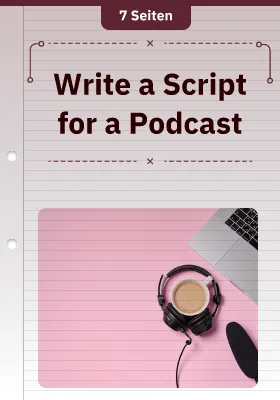
This worksheet aims to guide students through the process of creating their own podcast script for a school project, focusing on planning, researching, structuring, and writing.
Content and methods: The worksheet begins by asking students to brainstorm podcasts they know and their topics, encouraging initial engagement with the medium. It then prompts students to think about what is needed to create a school podcast, before presenting a dialogue between two students, Jenny and Aisha, who are planning their podcast, highlighting aspects like introduction, main content segments, and conclusion. Multiple-choice questions assess comprehension of podcast structure and planning. The worksheet provides detailed instructions on "How to write a podcast script," covering researching the topic, outlining the script (introduction, guest introduction, main part with transitions and multiple topics, summary, conclusion, call to action), and writing tips (conversational tone, conciseness, bullet points). It also offers relevant source titles and summaries for research on adolescent leisure activities and well-being. Students are then guided to create their own podcast outline based on the provided structure and subsequently write their full podcast script. The final step involves revising and marking important parts of their script for emphasis or pronunciation. A sample script is included for teachers as an additional resource.
Competencies:
- Understanding of podcast structure and content planning
- Research skills for topic development
- Scriptwriting, including elements of introduction, transitions, and conclusion
- Critical thinking and self-correction through revision
- Creative thinking and content generation
Target group: 7th-12th grade