
Exploring Shakespeare: Language, Culture and Performance
Zielsetzung: Ziel ist die systematische Erschließung dramatischer Texte von Shakespeare. Die Lernenden sollen befähigt werden, Sprache, Struktur und kulturelle Kontexte sachlich zu dekonstruieren und das Spannungsfeld zwischen historischem Text und moderner Performance kritisch zu reflektieren.
Inhalte und Methoden: Das Arbeitsblatt leitet durch einen analytischen Prozess von der inhaltlichen Erfassung bis zur bühnenpraktischen Vision.
Methoden:
- Strukturelle Einordnung: Verortung von Szenen im klassischen Dramenaufbau (z. B. Exposition, Peripetie)
- Sprach- und Formanalyse: Untersuchung von Blankvers vs. Prosa, Metaphorik und rhetorischen Mitteln (z. B. Stichomythie)
- Thematische Vertiefung: Verknüpfung von Szenen mit universellen Motiven (Macht, Schicksal, Schuld)
- Transfer: Wahl zwischen einer Performance-Kritik (Regiekonzept/Bühnenbild) oder einer kritischen Diskussion über menschliche Archetypen: Die Primärtexte für dieses Training werden aus dem Projekt Gutenberg bezogen.
Kompetenzen:
- Literarische Analysekompetenz: Sicherer Umgang mit gattungsspezifischen Merkmalen und Fachbegriffen der Dramenanalyse
- Methodenkompetenz: Anwendung literatur- und theaterwissenschaftlicher Kategorien zur Textentschlüsselung
- Transfer- und Gestaltungskompetenz: Projektion historischer Stoffe auf moderne Inszenierungsideen und aktuelle gesellschaftliche Fragen
- Sprachreflexionskompetenz: Sensibilisierung für die Wirkung von Versmaß und bildhafter Sprache
Zielgruppe: Leistungskurs Englisch
50 other teachers use this template
Target group and level
Leistungskurs
Subjects
Exploring Shakespeare: Language, Culture and Performance
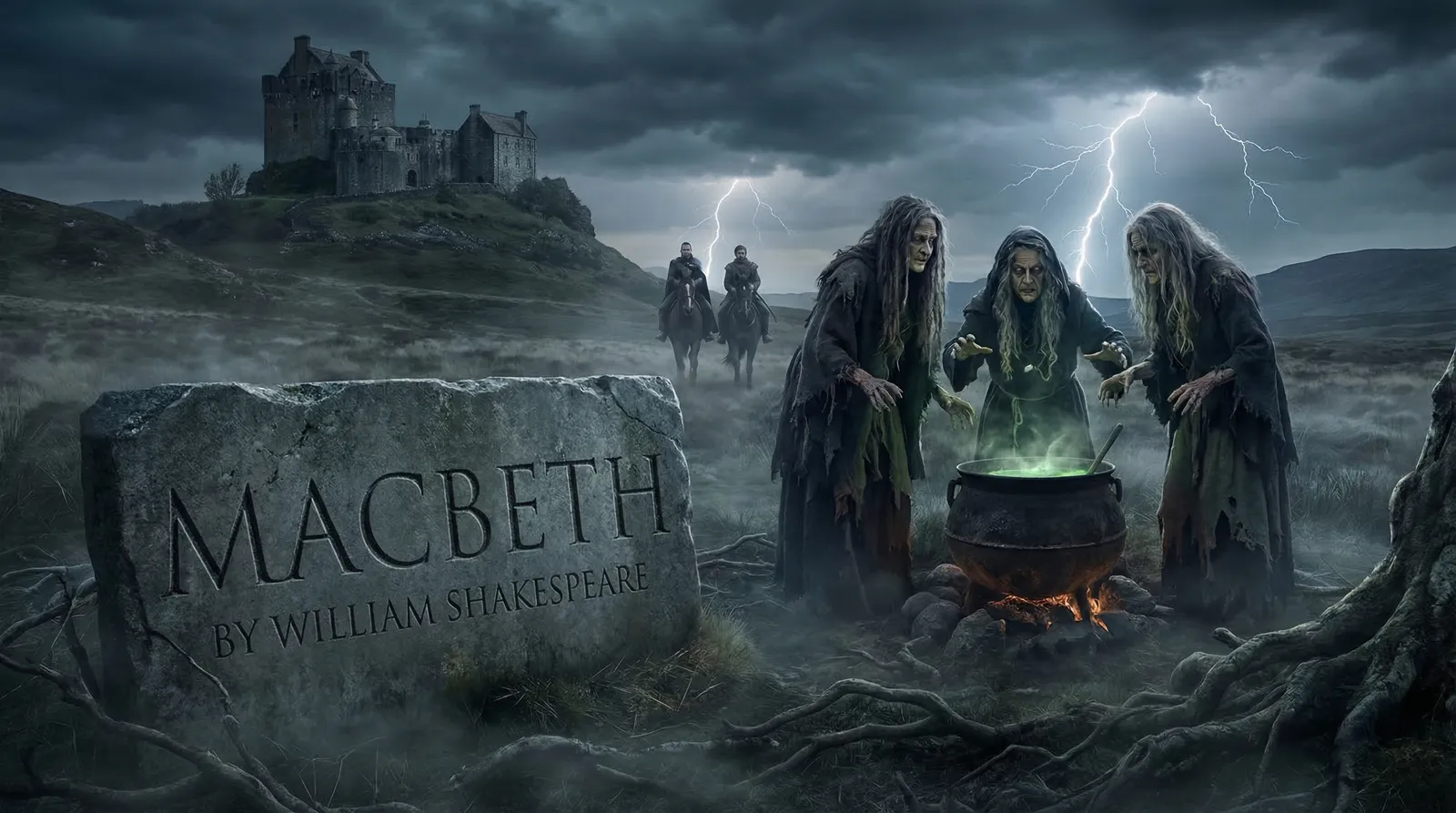
Shakespeare's Macbeth
William Shakespeare, born on April 23, 1564, in Stratford-upon-Avon, is widely regarded as one of the greatest playwrights in English literature. His tragic play "Macbeth" stands as a profound examination of ambition, power, and guilt. Written between 1606 and 1607, "Macbeth" explores the psychological and political consequences of unchecked ambition as the titular character, spurred by prophecy and his wife's encouragement, seeks to seize the throne of Scotland. The play was first performed in 1606 and remains a staple of theatrical repertoires worldwide, showcasing Shakespeare's mastery of language and deep understanding of human nature.

Comprehension and Contextualization
📝 Task: Briefly summarize the main events of the given excerpt. Point out its position within the play’s structure (exposition, rising action, climax, falling action, or catastrophe) and explain how this scene connects to the preceding events.
Scene II. A Camp near Forres.
Alarum within. Enter King Duncan, Malcolm, Donalbain, Lennox, with Attendants, meeting a bleeding Captain.
DUNCAN.
What bloody man is that? He can report,
As seemeth by his plight, of the revolt
The newest state.
MALCOLM.
This is the sergeant
Who, like a good and hardy soldier, fought
’Gainst my captivity.—Hail, brave friend!
Say to the King the knowledge of the broil
As thou didst leave it.
SOLDIER.
Doubtful it stood;
As two spent swimmers that do cling together
And choke their art. The merciless Macdonwald
(Worthy to be a rebel, for to that
The multiplying villainies of nature
Do swarm upon him) from the Western Isles
Of kerns and gallowglasses is supplied;
And Fortune, on his damned quarrel smiling,
Show’d like a rebel’s whore. But all’s too weak;
For brave Macbeth (well he deserves that name),
Disdaining Fortune, with his brandish’d steel,
Which smok’d with bloody execution,
Like Valour’s minion, carv’d out his passage,
Till he fac’d the slave;
Which ne’er shook hands, nor bade farewell to him,
Till he unseam’d him from the nave to the chops,
And fix’d his head upon our battlements.
DUNCAN.
O valiant cousin! worthy gentleman!
SOLDIER.
As whence the sun ’gins his reflection
Shipwracking storms and direful thunders break,
So from that spring, whence comfort seem’d to come
Discomfort swells. Mark, King of Scotland, mark:
No sooner justice had, with valour arm’d,
Compell’d these skipping kerns to trust their heels,
But the Norweyan lord, surveying vantage,
With furbish’d arms and new supplies of men,
Began a fresh assault.
DUNCAN.
Dismay’d not this
Our captains, Macbeth and Banquo?
SOLDIER.
Yes;
As sparrows eagles, or the hare the lion.
If I say sooth, I must report they were
As cannons overcharg’d with double cracks;
So they
Doubly redoubled strokes upon the foe:
Except they meant to bathe in reeking wounds,
Or memorize another Golgotha,
I cannot tell—
But I am faint, my gashes cry for help.
DUNCAN.
So well thy words become thee as thy wounds:
They smack of honour both.—Go, get him surgeons.
Exit Captain, attended.
Enter Ross and Angus.
Who comes here?
MALCOLM.
The worthy Thane of Ross.
LENNOX.
What a haste looks through his eyes! So should he look
That seems to speak things strange.
ROSS.
God save the King!
DUNCAN.
Whence cam’st thou, worthy thane?
ROSS.
From Fife, great King,
Where the Norweyan banners flout the sky
And fan our people cold.
Norway himself, with terrible numbers,
Assisted by that most disloyal traitor,
The Thane of Cawdor, began a dismal conflict;
Till that Bellona’s bridegroom, lapp’d in proof,
Confronted him with self-comparisons,
Point against point, rebellious arm ’gainst arm,
Curbing his lavish spirit: and, to conclude,
The victory fell on us.
DUNCAN.
Great happiness!
ROSS.
That now
Sweno, the Norways’ king, craves composition;
Nor would we deign him burial of his men
Till he disbursed at Saint Colme’s Inch
Ten thousand dollars to our general use.
DUNCAN.
No more that Thane of Cawdor shall deceive
Our bosom interest. Go pronounce his present death,
And with his former title greet Macbeth.
ROSS.
I’ll see it done.
DUNCAN.
What he hath lost, noble Macbeth hath won.
Exeunt.
✒️ Write down your answers here.
Sample Solution: Comprehension and Contextualization of ACT I, SCENE II
Summary of Main Events
In this scene, King Duncan, Malcolm, Donalbain, Lennox, and their attendants meet a bleeding captain returning from battle. The captain reports on the state of the revolt, describing the fierce battle against the rebel Macdonwald and the intervention of the valiant Macbeth, who defeated the traitor. Despite initial difficulties, Macbeth's bravery turned the tide in favor of Duncan's forces. However, the Norwegians, led by their king Sweno and assisted by the treacherous Thane of Cawdor, launched a fresh assault. Ross arrives with news of Macbeth and Banquo's victory over the Norwegians, and Duncan decides to execute the Thane of Cawdor for his betrayal and bestow his title upon Macbeth.
Position within the Play's Structure
This scene serves as part of the exposition and the beginning of the rising action. It provides crucial background information about the political situation in Scotland, establishing Macbeth as a heroic and capable warrior. The scene sets the stage for Macbeth's rise in status, foreshadowing his subsequent involvement with the witches and the unfolding drama of ambition and treachery.
Connection to Preceding Events
Scene II follows the opening scene with the witches, who plan to meet Macbeth after a battle. The report of the battle and Macbeth's valor aligns with the witches' prophecy of meeting him. This connection underscores the theme of fate and preordained events, as Macbeth's triumph and subsequent reward are pivotal moments that propel him into the witches' orbit, setting off a chain of events driven by ambition and supernatural influence.

Analysis of Character and Language
📝 Task: Analyze the provided excerpt with a focus on how Shakespeare conveys the central conflict. In your analysis, consider the following:
- The character constellation: How do the characters interact and what does their use of language (e.g., stichomythia, long soliloquies) reveal about their state of mind or social status?
- Stylistic devices: Identify key metaphors, symbols, or instances of irony. Explain how they contribute to the atmosphere of the scene.
- Form: Examine the use of Blank Verse or Prose. Why might Shakespeare have chosen this specific form for this specific character or moment?
✒️ Write down your analysis here.
Sample solution: Analysis of Character and Language in Macbeth Act I Scene II
Character Constellation and Interaction
In Act I Scene II of "Macbeth," King Duncan, Malcolm, Donalbain, Lennox, and Ross interact with a bleeding captain who reports on the state of the battle. This scene primarily focuses on the military conflict and the heroism of Macbeth. The characters' use of language reflects their social status and state of mind. Duncan, as king, speaks with authority and concern, demonstrating his leadership and reliance on reports from the battlefield. Malcolm and Lennox's interactions are respectful and inquisitive, indicating their roles as noblemen. The captain’s dialogue is vivid and detailed, conveying his firsthand experience of the chaos and his respect for Macbeth’s valor. The formal language used by the noble characters contrasts with the captain's more descriptive and urgent speech, highlighting the gravity of the situation.
Stylistic Devices
Shakespeare employs several key metaphors and symbols in this scene to enhance the atmosphere of conflict and valor. The captain describes the battle as "two spent swimmers that do cling together / And choke their art," a metaphor illustrating the desperation and struggle of the opposing forces. The imagery of Macbeth’s sword "smok’d with bloody execution" evokes a sense of fierce determination and skill, while "Valour’s minion" and "Bellona’s bridegroom" symbolize Macbeth’s embodiment of martial prowess and divine favor in battle. Irony is present in the description of Fortune as "a rebel’s whore," suggesting that Macbeth defies fate through his bravery. These devices contribute to an atmosphere of tension and impending change, foreshadowing Macbeth's rise in status and the play's exploration of fate and ambition.
Form: Blank Verse or Prose
Shakespeare predominantly uses blank verse in this scene, which is characteristic of noble characters and formal discourse. The rhythm and structure of blank verse lend a sense of gravity and nobility to the dialogue, fitting the high stakes and dramatic nature of the battlefield report. The captain’s speech, though part of the blank verse format, is marked by vivid imagery and emotional intensity, capturing the chaotic essence of war and the valor of Macbeth. This choice of form underscores the seriousness of the report and the honor associated with Macbeth’s actions, while maintaining the formal tone appropriate for the royal audience. The structured language enhances the dignity of the scene, aligning with the themes of heroism and conflict that are central to the play.

Interpretation and Deepening
📝 Task: Relate the events of this scene to one of the overarching themes of the play (e.g., the corruption of power, the restorative power of love, the confusion of identity/mistaken identity, or the conflict between fate and free will). Explain to what extent this scene serves as a turning point or a reinforcement of the play’s tragic or comic trajectory.
✒️ Write down your answers here.
Sample solution: Interpretation and Deepening of Act I, Scene II
Introduction
Act I, Scene II of Macbeth is a crucial moment that introduces several key themes of the play, including the corruption of power, the conflict between fate and free will, and the fragility of human relationships. In this scene, King Duncan receives reports of the battle against the rebel Macdonwald and the Norweyan forces, highlighting the valor and prowess of Macbeth. This scene serves as a reinforcement of the play's tragic trajectory, foreshadowing the eventual downfall of Macbeth due to his ambition and the corrupting nature of power.
The Corruption of Power
The theme of the corruption of power is evident in Duncan's decision to reward Macbeth with the title of Thane of Cawdor, stripping it from the traitorous former holder. Macbeth's valor and success in battle earn him recognition and power, setting the stage for his eventual moral decline as he seeks more power. The scene underscores how ambition and the allure of power can lead to corruption, as Macbeth's new title is the first step in his tragic journey towards tyranny and moral decay.
The Conflict Between Fate and Free Will
This scene also touches on the conflict between fate and free will. Macbeth is hailed as a hero and given a new title, which is a result of his actions on the battlefield. However, the audience knows that this recognition aligns with the witches' prophecy, suggesting that Macbeth's rise is fated. The tension between Macbeth's achievements and the prophecy introduces the question of whether his actions are driven by destiny or his own choices, a central conflict that will unfold throughout the play.
The Fragility of Human Relationships
The scene highlights the fragility of human relationships, particularly through Duncan's misplaced trust. By rewarding Macbeth, Duncan unknowingly sets in motion a chain of events that will lead to betrayal and his own death. This moment foreshadows the breakdown of loyalty and trust, emphasizing how fragile and susceptible to corruption human relationships can be, especially when ambition and power are involved.
Conclusion: Reinforcement of Tragic Trajectory
Act I, Scene II serves as a reinforcement of the tragic trajectory of Macbeth. By establishing Macbeth's valor and the rewards he receives, the scene sets the stage for his eventual downfall due to unchecked ambition and the corrupting influence of power. The themes introduced in this scene are central to the play's exploration of moral decay and the consequences of ambition, driving the narrative towards chaos and tragedy.
.png%3Falt%3Dmedia%26token%3D9a95163c-3317-4a40-bf6b-43a44a7520ca)
Evaluation and Transfer
📝 Task partnerwork: Choose one of the following options:
- A) Performance critique: Imagine you are a director. How would you stage this scene to make its central conflict understandable for a modern audience? Focus on lighting, positioning (proxemics) and tone of voice. Use a mindmap for the task.
- B) Critical discussion: "Shakespeare’s characters are archetypes of the human soul." Discuss this statement with reference to the excerpt analyzed in class. To what extent do the motives of the characters remain relevant in the 21st century?
“All the world’s a stage, and all the men and women merely players...”
Lade Zeichenfeld...
Sample solution!!!
B) Critical discussion
Sample solution: Critical Discussion of Shakespeare’s Archetypes
Introduction
The assertion that "Shakespeare’s characters are archetypes of the human soul" implies that his characters encapsulate universal patterns of human behavior and emotion. In examining the excerpt from Act I, Scene II of Macbeth, we delve into how these archetypes are manifested and their relevance to contemporary society in the 21st century.
Analysis of King Duncan and Macbeth as Archetypes
King Duncan and Macbeth serve as archetypes of leadership, ambition, and valor. King Duncan embodies the archetype of the benevolent ruler, whose trust and leadership are essential qualities that resonate across ages. His admiration for Macbeth reflects the timeless value placed on bravery and loyalty. Macbeth, on the other hand, represents the ambitious warrior, discontent with his current status and driven by the desire for power. This ambition is a universal trait that continues to be relevant, as individuals today grapple with the pursuit of success and recognition.
Relevance of Motives in the 21st Century
The motives of Duncan and Macbeth—trust, loyalty, ambition, and power—are deeply ingrained in human society and remain highly relevant today. The struggle for power and the consequences of ambition are issues prevalent in modern political landscapes and personal relationships alike. Duncan’s misplaced trust and Macbeth’s ruthless ambition mirror contemporary challenges in leadership and the ethical dilemmas faced by those in power. As individuals navigate complex societal structures, the balance between ambition and morality is as pertinent as ever.
Conclusion
Shakespeare’s characters, particularly King Duncan and Macbeth in this scene, act as archetypes of the human soul by embodying fundamental human experiences and emotions. Their motives and the conflicts they introduce continue to resonate in the 21st century, reflecting ongoing human concerns about leadership, ambition, and ethics. Through these archetypes, Shakespeare’s works offer profound insights into the enduring complexities of human nature, ensuring their relevance and resonance across generations.