to teach logo
Sign up

Interview with a famous scientist.

TT
by to-teach Team
4 pagesChemistry, Science, German, Biology, Physics, History
Template

Loading preview…

Your worksheet

Create exciting teaching materials about different scientists. Just enter the scientist's name and you're ready to go!

Need an idea?

Popular topics from other teachers

How our AI templates work

  • Content gets adapted

    Examples, texts and tasks match your focus.

  • Method & structure stay

    The didactically reviewed structure of the template won't change.

Description

Create an interview in which the students gain deeper insights into the scientist's work

Similar worksheets

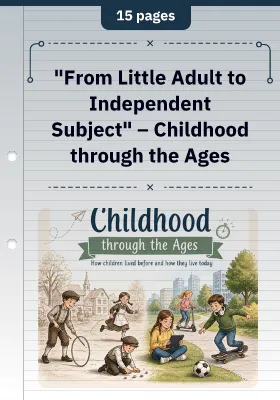
"From Little Adult to Independent Subject" – Childhood through the Ages

"From Little Adult to Independent Subject" – Childhood through the Ages

This worksheet aims to provide trainee teachers with a historically informed and socially critical understanding of the life stage known as ‘childhood’. Learners are to be made aware that childhood is not a rigid, biological state, but is subject to constant social change. They will learn to analyse historical patterns of upbringing and living environments, to contextualise the contemporary view of the child (including the UN Convention on the Rights of the Child), and to draw conclusions for their own professional approach by comparing the past and the present.

Content and methods:

This worksheet combines historical text analysis, the development of empathy, analysis of contemporary issues and research into international law. Following a personal reflection and an analysis of a historical period, the pupils write a fictional diary entry from a child’s perspective and contrast this with the reaction of a child today. They then map out the cornerstones of modern childhood in a practical matrix and compare historical and contemporary living conditions. The activity concludes with research into the UN Convention on the Rights of the Child, including its historical context, and a reflection on their own pedagogical approach.


Competencies:

Learners can...

  • Explain the concept of childhood as a socially shaped and historically changeable construct.
  • Analyse children’s historical living environments in terms of educational objectives, work requirements and legal status, guided by specific criteria.
  • Develop historical empathy through methods of shifting perspectives and reflect on different living conditions from multiple perspectives.
  • Identify the dimensions of modern childhood (including subject status, institutionalisation and mediatisation) and illustrate them using concrete examples from practice.
  • Independently research articles of the UN Convention on the Rights of the Child, place them in their historical context and relate them to today’s image of the child.
  • Use historical insights to critically examine current patterns of upbringing and apply them to one’s own professional approach.


Target group and level:

Adult students or trainees in the field of social pedagogy, particularly aspiring educators.


Note: Internet access is required for the research task

PedagogySocial PedagogyHistoryHealth and Social Care
Group Puzzle for Chemistry Class

Group Puzzle for Chemistry Class

Objective: This worksheet uses the cooperative learning method known as the “group puzzle” to teach complex concepts in chemistry and atomic physics. The goal is for students to gain a deep understanding of the selected topic through self-directed learning and peer teaching.


Content and Methods: The content is taught using a structured five-phase model that combines cooperative and independent learning: In home groups, each member takes on a specific subtopic, which is then explored in a subsequent “expert phase” in groups of students with the same subtopic, using informational texts and in-depth tasks. Afterward, the students return to their core groups, share their knowledge with one another, and consolidate their findings together before moving on to a cooperative work phase in which they solve complex tasks that can only be mastered by combining all the individual aspects. The process concludes with a joint evaluation in a plenary session and a reflection on the learning process.


Competencies:

  • Subject-Specific Competence: Acquiring in-depth knowledge of a topic in chemistry
  • Social Competence: Fostering teamwork and communication skills through the “expert” model
  • Methodological Competence: Applying cooperative learning methods to independently process information and convey knowledge
  • Transferability: Applying expert knowledge to hypothetical scenarios, such as the discovery of new elements


Target Audience and Level: High School


Chemistry
The Secrets of Milk

The Secrets of Milk

Objective: This workbook explores a historical and materials-science phenomenon: the production of casein, an early milk-based bioplastic. Students work as a team of researchers to investigate how the organic components of liquid cow’s milk can be transformed into a solid plastic through the action of acid.


Content and Methods: The content is conveyed through a combination of historical contextualization, experimental laboratory work, and material analysis: Starting with the question of how a solid material can be produced from milk, students explore the composition of milk and the effect of acids on proteins. They then experimentally extract casein, document the course of the reaction, and examine the properties of the resulting bioplastic. Finally, the results are used in a scientific application to evaluate the historical significance and material properties of casein as an alternative to plastic.


Competencies:

  • Technical expertise: Understanding of protein denaturation (acid precipitation of milk protein/casein) and the classification of galalith as a historical bioplastic
  • Knowledge acquisition: Planning, conducting, and systematically documenting a preparative organic chemistry experiment (filtration, solid isolation)
  • Materials and testing skills: Criteria-based analysis of the physical properties of a self-produced solid
  • Argumentation and language skills: Writing a technically sound report using precise scientific explanations


Target audience and level: Middle school

BiologyChemistry
The Green Battery

The Green Battery

Objective: This worksheet explores the electrochemical fundamentals of galvanic cells and how a lemon battery works in the context of modern, sustainable technology development. Students take on the role of a startup research team to experimentally and ecologically evaluate the suitability of a lemon as an environmentally friendly electrolyte, as well as the efficiency of various electrode pairings.


Content and Methods: The content is taught by combining theoretical fundamentals, experimental data collection, error analysis, and sustainability assessment: First, students explore the structure and functioning of electrochemical cells as well as the underlying redox reactions. They then test their hypotheses in an experiment, document measurement data, and analyze typical sources of error in the laboratory. Finally, they evaluate the performance and sustainability of various materials before summarizing their results in a technical report and a persuasive presentation.


Competencies:

  • Technical Competence: Understanding of redox reactions, electrode potentials, and the role of electrolytes in generating electrical power
  • Data Analysis: Conducting quantitative electrochemical measurements, systematically comparing variables, and identifying sources of methodological error
  • Evaluation Competence: Balancing maximum technical performance with environmental factors (extraction, recycling, toxicity) in the context of sustainable chemistry
  • Communication skills: Targeted, audience-oriented presentation of laboratory data for a business analysis or an investor pitch


Target audience and level: Middle School

BiologyChemistry
Chemistry in Search of Evidence

Chemistry in Search of Evidence

Objective: This worksheet uses a fictional criminal case to introduce students to the basics of nuclear chemistry and atomic structure in a playful way. Students examine β⁻ decay using the example of an isotope and learn to quantitatively determine atomic composition and radioactive decay processes based on atomic and mass numbers.


Content and Methods: The material is taught by combining contextual learning, tabular particle analyses, and mathematical methods for describing radioactive processes. The starting point is a fictional case file in which a laboratory investigation is used to develop fundamental questions about nuclear transformations and radiation. Building on this, the isotopes are analyzed in terms of their proton, neutron, and electron counts, and nuclear reaction equations and the principle of β⁻ decay are explored. This is supplemented by a quantitative evaluation of radioactive decay using half-life calculations to determine residual amounts and sample age, before students assess their understanding in a short, summary exit ticket.


Competencies:

  • Subject-specific competence: Distinguishing between basic physical and chemical concepts (isotope, atomic number, mass number) and classifying nuclear transformations
  • Scientific inquiry: Mathematical modeling of decay processes using half-life functions and deriving nuclear reaction equations
  • Communication and Explanation Skills: Simplifying complex atomic processes to suit the audience


Target Audience and Level: Middle School

ChemistryPhysics