Method Training: Gallery Walk

TT
by to-teach Team
3 pagesGrade 6 and abovenon-subject specific content, Geography, Politics, Religion, English
Template

Loading preview…

Your worksheet

Enter the name of a topic that is general enough to create four profiles with examples.

Need an idea?

Popular topics from other teachers

How our AI templates work

  • Content gets adapted

    Examples, texts and tasks match your focus.

  • Method & structure stay

    The didactically reviewed structure of the template won't change.

Description

Objective: This worksheet aims to familiarize students with the "Gallery Walk" method as a presentation and learning tool, and to develop their skills in information comprehension, collaborative presentation, active listening, and constructive feedback.


Content and methods: The worksheet introduces the "Gallery Walk" method by instructing students to watch a video explanation, followed by multiple-choice questions to assess their understanding of the method's steps and rationale. Students are then prompted to consider important aspects for a successful presentation during a gallery walk. A key activity involves collaboratively developing a questionnaire for evaluating classmates' projects and providing feedback. A sample questionnaire is provided in the "Additional information for teachers" section, outlining criteria such as informativeness, delivery, presenter's knowledge, and interest sparked. The worksheet then guides students through a practical application of the gallery walk, where they form groups, each person studies information on one aspect of a topic provided on cards, and prepares to present it. The "Participating in a gallery walk" section details the procedure for rotating between posters and presenting. The worksheet concludes with a reflection phase where groups provide feedback on presentations and discuss their overall experience with the gallery walk method.


Competencies:

  • Understanding of pedagogical methods (Gallery Walk)
  • Information comprehension and extraction
  • Presentation skills (oral communication, topic explanation)
  • Active listening and note-taking
  • Collaborative work and group dynamics
  • Constructive feedback and self-reflection


Target group: Secondary school students

Similar worksheets

📖 Reading Time: Grade 2 with Coloring Page

📖 Reading Time: Grade 2 with Coloring Page

The primary learning objective is advancing early English reading instruction, enhancing word- and sentence-level decoding fluency, expanding thematic vocabulary, and supporting multisensory cognitive consolidation through integrated visual-motor tasks.

Contents and Methods: The worksheet combines short, structured declarative sentences with an integrated word search puzzle and a concluding thematic coloring activity. Methodologically, learners first read clear descriptive sentences featuring foundational vocabulary, action verbs, and basic syntactic patterns. They then visually scan for and identify key target words within a letter grid matrix, reinforcing word recognition and orthographic memory. Finally, a detailed coloring page engages fine motor skills and serves as a motivating, multisensory capstone to consolidate lexical associations.

Competencies:

  • Reading & Decoding Skills (English): reliable decoding, fluent reading of short connected sentences, and structural understanding of simple English statements
  • Vocabulary & Language Competence: visual recognition, retention, and semantic grounding of high-frequency words, and descriptive action verbs
  • Visual Perception & Concentration: systematic scanning, visual discrimination, and focused attention through the word search puzzle
  • Fine Motor & Multisensory Learning: hand-eye coordination, creative focus, and multisensory reinforcement through thematic coloring

Target Group: Grade 2 and above

English
📖 Reading Time: Grade 1 with Coloring Page

📖 Reading Time: Grade 1 with Coloring Page

The primary learning objective is foundational early reading instruction in English, strengthening decoding skills at word and simple sentence levels, expanding basic thematic vocabulary, and supporting learner motivation and fine motor development through an integrated creative coloring activity for beginner readers.

Contents and Methods: The worksheet combines short, clearly structured declarative sentences in English centered around an engaging theme with a subsequent thematic coloring exercise. Methodologically, early learners read accessible, single-clause sentences featuring high-frequency sight words, and foundational action verbs. Following the reading phase, learners visually and creatively anchor their learning experience by coloring a detailed illustration corresponding to the topic, which reinforces concentration, haptic-visual coordination, and positive emotional engagement with the foreign language.

Competencies:

  • Reading & Decoding Skills (English): reliable decoding, word recognition of high-frequency vocabulary, and basic comprehension of simple English sentence structures
  • Vocabulary & Language Competence: acquisition and recognition of foundational thematic vocabulary (nouns, verbs, descriptive adjectives) in meaningful sentence contexts
  • Fine Motor Skills & Visual Perception: development of graphomotor control, hand-eye coordination, and sustained visual focus through mindful coloring
  • Motivation & Affective Learning: playful, low-anxiety access to foreign language learning through the combination of text and artistic expression

Target Group: Grade 1 and above

English
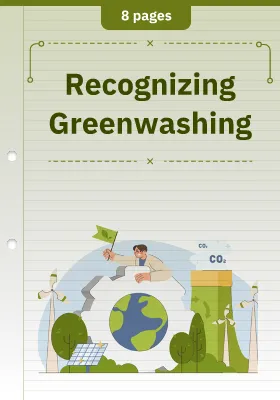
Recognizing Greenwashing

Recognizing Greenwashing

The goal of this worksheet is to enable students to independently identify and critically examine manipulative marketing strategies in retail. Using a specific case study, they will develop the theoretical foundation needed to distinguish between genuine sustainability promises and deliberate consumer deception, so they can make informed, independent consumer decisions in their daily lives.

Content and Methods: The content focuses on the definition and strategic characteristics of greenwashing, its psychological impact, and an analysis of legal consequences. Methodologically, the worksheet combines an image-based case analysis with in-depth journalistic text analysis. A video-based summary of theoretical categories of deception and a practical, criteria-based checklist serve to reinforce knowledge and facilitate active application to students’ own consumer behavior.

Competencies:

Analytical Competence: Students can systematically deconstruct visual design elements, price placements, and advertising messages in digital user interfaces.

Substantive Competence: They understand the definition of the technical term “greenwashing” and can distinguish between vague marketing phrases and verifiable sustainability labels.

Critical thinking skills: Students are able to critically evaluate the discrepancy between corporate sustainability reports and actual environmental impacts.

Reflective thinking skills: They can critically examine their own susceptibility to manipulative sales strategies and identify alternative courses of action.

Target audience and grade level: Intermediate (8th-10th grade)


EconomicsGeography
Understanding Influencer Marketing

Understanding Influencer Marketing

This worksheet aims to raise students’ awareness of the mechanisms, economic dimensions, and psychological strategies of modern digital marketing in everyday life.

Content and Methods: The material focuses on the economic significance of social media marketing based on statistical data, as well as the analysis of specific digital posts. Methodologically, the worksheet relies on a combination of practical case studies—in which an exemplary social media post is deconstructed both textually and statistically—and theoretical insights into behavioral economic effects. In addition, the material encourages multi-perspective discussion through reflective writing assignments and the comparison of contrasting stakeholder perspectives. Finally, the discussion of complex issues is used to synthesize what has been learned into the formation of independent judgments.

Competencies:

Analytical and Deconstructive Competence: The ability to systematically examine media content and linguistic and statistical devices for their manipulative or promotional effects

Reflective and Critical Thinking Competence: The ability to critically examine one’s own consumer behavior and evaluate economic phenomena from different perspectives

Media and Economic Competence: Understanding of digital market mechanisms, psychological influence strategies such as the authority bias or the bandwagon effect, and their impact on the economy

Target Audience and Level: 9th/10th grade

EconomicsPolitics