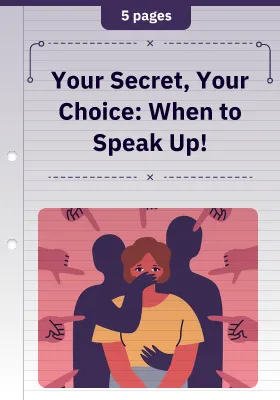
Recognizing Assault and Harassment

Recognizing Assault and Harassment

Objective:

Students will develop an awareness of assault and harassment, understand the differences between these concepts, and learn how to respond appropriately, both as individuals affected and as witnesses. The goal is to enhance their ability to defend themselves, set boundaries, and support others.

Content and Methods:

The worksheet defines "harassment" and "assault" and encourages students to find examples. A text on a selected topic serves as a case study to explain sexual harassment and discuss its impacts. Questions and a multiple-choice task deepen understanding. A word puzzle highlights the short- and long-term consequences of assaults. In partner work, students explore how to intervene as witnesses and why it's important not to look away. A final reflection focuses on the role of consent. Methods include text analysis, brainstorming, partner work, multiple-choice tasks, word puzzles, and reflection.

Competencies:

  • Distinguishing between harassment and assault
  • Recognizing and identifying problematic behavior
  • Analyzing the impacts of assault and harassment
  • Developing strategies for action as victims and witnesses
  • Understanding the importance of consent and the right to say "no"
  • Collaboration and reflection in groups

Target Group and Level:

Grade 7 and up
CU
DY
EB
FE

50 other teachers use this template

Target group and level

Grade 7 and up

Subjects

non-subject specific contentEthicsEnglishPhilosophy

Recognizing Assault and Harassment

Icon

When is it harassment and when is it assault?

Assault and harassment occur when someone intentionally disregards another person's boundaries - physically, verbally, or digitally. This can take many forms: unwanted touching, intrusive messages, offensive remarks, or coercive behavior. It's important to understand that assault and harassment are not about flirting or misunderstandings - they violate a person's rights and well-being. Those who experience such actions often feel powerless, insecure, or ashamed. Therefore, it's crucial to know and respect your own boundaries and those of others. Remember: It's always okay to say no - no matter the situation.

📋 Explain: What do you understand by harassment? What do you understand by an assault?

Search for four examples for each term.

👥 Task: Discuss your results with a partner.

📋 Task: Carefully read the following text and then answer the questions.

Understanding Cat-Calling: A Form of Harassment

Cat-calling is a term used to describe when someone makes unsolicited, often loud and inappropriate comments or whistles at another person, typically on the street. While it might seem harmless to some, cat-calling is actually a form of harassment and can make people, particularly women and girls, feel uncomfortable and unsafe.

When you hear someone cat-calling, it's important to understand why this behavior is considered an overstep or a form of harassment. Cat-calling often targets individuals based on their appearance, reducing them to objects rather than recognizing them as human beings with feelings and personal boundaries. This kind of behavior can be intimidating, especially when it happens in public spaces where the person being targeted might feel vulnerable.

The websites provided highlight different aspects of sexual harassment and abuse, which include unwanted comments or actions that make someone feel threatened or violated. Cat-calling fits into this category because it involves making someone feel like they don't have control over their own environment. It's a way of asserting power over someone else, even if the person doing the cat-calling doesn't realize it.

Cat-calling can also be seen as a form of gender-based harassment, where individuals are targeted because of their gender. This is why using gender-sensitive language, like "Schüler:innen", is important. It acknowledges that everyone, regardless of gender, can be affected by such behavior.

It's crucial to understand that cat-calling isn't just about words; it's about the impact those words have on the person being targeted. It can cause feelings of fear, anxiety, and shame. Recognizing cat-calling as harassment helps people understand the seriousness of the behavior and encourages them to speak out against it.

If you ever find yourself in a situation where you're being cat-called, remember that you have the right to feel safe and respected. It's okay to tell the person to stop, ignore them, or seek help if you feel threatened. Educating yourself and others about why cat-calling is harmful can help create a safer environment for everyone.

In conclusion, understanding cat-calling as a form of harassment is essential. It enables us to recognize and challenge inappropriate behavior, fostering a culture where respect and equality are prioritized. By speaking out against cat-calling, we contribute to a world where everyone can walk down the street without fear of being harassed.

Answer the questions correctly.

NOTE FOR EDUCATORS:

Subsequent discussion of the results and clarification of questions. Reflection on the material read.

🔎 Task: Assault and harassment can have serious impacts on those affected, both in the short and long term. Find the related terms in the puzzle.

👥 Task for Partner Work - Observing and Acting: Sometimes we witness assaults or harassment. It is important to know how to respond without putting yourself in danger. Together, answer the following questions.

1. What are some ways you could intervene as a bystander in a situation of harassment or assault (e.g., directly, indirectly, seeking help)?

2. Why is it important not to look away?

👥 Group Reflection: Discuss within your learning group why it is important for perpetrators to understand that "no" means "no" and that lack of consent constitutes an assault.

NOTE FOR EDUCATORS:

Here you will find an infographic that you can later display in the classroom or use as information for the students.

Stay Aware1Be vigilant and trust your instincts. Act promptly if youfeel uneasy or threatened. Involve Police2Contact police or relevant authorities immediately.Give a clear account of the incident. Seek Support3Reach out to friends or family. Emotional support isvital after such experiences. Counseling4Consider professional counseling. Therapy can helpyou process the event. Prevention5Learn self-defense and preventive measures. Educateyourself on safe practices.