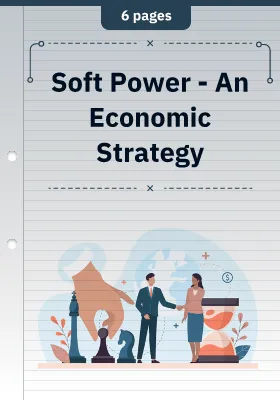
Soft Power - Eine wirtschaftliche Strategie

TT
by to-teach Team
6 pagesAb Klasse 10Politics, Economics
Template

Loading preview…

Your worksheet

Give an example of “soft power.” Name the country and, if applicable, a specific keyword related to “soft power.”

Need an idea?

Popular topics from other teachers

How our AI templates work

  • Content gets adapted

    Examples, texts and tasks match your focus.

  • Method & structure stay

    The didactically reviewed structure of the template won't change.

Description

Zielsetzung:

Die Lernenden analysieren das Konzept der Soft Power als modernes Instrument der Außenwirtschaftspolitik und verstehen, wie kulturelle Attraktivität systematisch zur Steigerung des nationalen Exports und des globalen Einflusses eingesetzt wird.

Inhalte und Methoden:

Anhand eines Sachtextes und eines fiktiven Zeitzeugenberichts werden die Unterschiede zwischen Hard und Soft Power sowie Mechanismen wie Nation Branding, Public Diplomacy und der Halo-Effekt erarbeitet. Die methodische Umsetzung erfolgt durch Textanalyse, die Rekonstruktion von Wirkungsketten, eine Recherche im „Global Soft Power Index“ sowie eine abschließende kritische Beurteilung staatlicher Kultursteuerung.

Kompetenzen:

  • Fachkompetenz: Unterscheidung und Erläuterung internationaler Machtkategorien (Hard vs. Soft Power)
  • Analysekompetenz: Untersuchung des wirtschaftlichen Wirkmechanismus kultureller Exportgüter (z. B. K-Pop) auf das Bruttoinlandsprodukt
  • Urteilskompetenz: Kritische Reflexion über die Chancen und Gefahren staatlicher Einflussnahme auf Kultur und nationale Identität
  • Medien- und Recherchekompetenz: Umgang mit globalen Vergleichsstudien zur Messung immaterieller Vermögenswerte von Nationen

Zielgruppe und Niveau:

Ab Klasse 10
Similar worksheets

Understanding Influencer Marketing

Understanding Influencer Marketing

This worksheet aims to raise students’ awareness of the mechanisms, economic dimensions, and psychological strategies of modern digital marketing in everyday life.

Content and Methods: The material focuses on the economic significance of social media marketing based on statistical data, as well as the analysis of specific digital posts. Methodologically, the worksheet relies on a combination of practical case studies—in which an exemplary social media post is deconstructed both textually and statistically—and theoretical insights into behavioral economic effects. In addition, the material encourages multi-perspective discussion through reflective writing assignments and the comparison of contrasting stakeholder perspectives. Finally, the discussion of complex issues is used to synthesize what has been learned into the formation of independent judgments.

Competencies:

Analytical and Deconstructive Competence: The ability to systematically examine media content and linguistic and statistical devices for their manipulative or promotional effects

Reflective and Critical Thinking Competence: The ability to critically examine one’s own consumer behavior and evaluate economic phenomena from different perspectives

Media and Economic Competence: Understanding of digital market mechanisms, psychological influence strategies such as the authority bias or the bandwagon effect, and their impact on the economy

Target Audience and Level: 9th/10th grade

EconomicsPolitics