Tongue Twisters (Easy/Intermediate)

TT
by to-teach Team
1 pageEnglischlernende auf A2-NiveauEnglish
Template

Loading preview…

Your worksheet

Choose a topic for the tongue twisters. This will ensure that the four example tongue twisters and your own writing task are all based on this theme.

Need an idea?

Popular topics from other teachers

How our AI templates work

  • Content gets adapted

    Examples, texts and tasks match your focus.

  • Method & structure stay

    The didactically reviewed structure of the template won't change.

Description

Zielsetzung: Das übergeordnete Lernziel des Arbeitsblattes ist es, Schüler:innen das englische Konzept von Zungenbrechern (Tongue Twisters) näherzubringen und dadurch ihre Aussprache, Diktion und allgemeinen Sprachfertigkeiten zu verbessern. Zudem sollen die Schüler:innen für Klangmuster in der Sprache sensibilisiert werden.

Inhalte und Methoden: Das Arbeitsblatt liefert zunächst eine Definition sowie ein Beispiel für Zungenbrecher und benennt deren Vorteile für das Sprechen. Inhaltlich werden vier Zungenbrecher mit der gewählten Thematik als Übungsmaterial präsentiert. Methodisch kombiniert das Material das laute Vorlesen mit einer kreativen Schreibaufgabe, bei der die Schüler:innen einen eigenen Zungenbrecher unter Verwendung von Alliteration und Assonanz verfassen sollen. Zum interaktiven und mündlichen Training werden abschließend drei spielerische Gruppenaktivitäten (Wettrennen, Staffel, Marathon) vorgeschlagen, bei denen die Zungenbrecher schnell und fehlerfrei aufgesagt werden müssen.

Kompetenzen:

  • Verbesserung der englischen Aussprache und Diktion
  • Bewusstsein für sprachliche Klangmuster (wie Alliteration und Assonanz)
  • Kreatives Schreiben (Verfassen eigener Zungenbrecher) in der Fremdsprache
  • Förderung der flüssigen mündlichen Sprachproduktion unter Zeitdruck
  • Soziale Interaktion und Teamgeist durch kooperative Wettbewerbe

Zielgruppe und Niveau: Englischlernende auf A2 Nievau

Similar worksheets

📖 Reading Time: Grade 2 with Coloring Page

📖 Reading Time: Grade 2 with Coloring Page

The primary learning objective is advancing early English reading instruction, enhancing word- and sentence-level decoding fluency, expanding thematic vocabulary, and supporting multisensory cognitive consolidation through integrated visual-motor tasks.

Contents and Methods: The worksheet combines short, structured declarative sentences with an integrated word search puzzle and a concluding thematic coloring activity. Methodologically, learners first read clear descriptive sentences featuring foundational vocabulary, action verbs, and basic syntactic patterns. They then visually scan for and identify key target words within a letter grid matrix, reinforcing word recognition and orthographic memory. Finally, a detailed coloring page engages fine motor skills and serves as a motivating, multisensory capstone to consolidate lexical associations.

Competencies:

  • Reading & Decoding Skills (English): reliable decoding, fluent reading of short connected sentences, and structural understanding of simple English statements
  • Vocabulary & Language Competence: visual recognition, retention, and semantic grounding of high-frequency words, and descriptive action verbs
  • Visual Perception & Concentration: systematic scanning, visual discrimination, and focused attention through the word search puzzle
  • Fine Motor & Multisensory Learning: hand-eye coordination, creative focus, and multisensory reinforcement through thematic coloring

Target Group: Grade 2 and above

English
📖 Reading Time: Grade 1 with Coloring Page

📖 Reading Time: Grade 1 with Coloring Page

The primary learning objective is foundational early reading instruction in English, strengthening decoding skills at word and simple sentence levels, expanding basic thematic vocabulary, and supporting learner motivation and fine motor development through an integrated creative coloring activity for beginner readers.

Contents and Methods: The worksheet combines short, clearly structured declarative sentences in English centered around an engaging theme with a subsequent thematic coloring exercise. Methodologically, early learners read accessible, single-clause sentences featuring high-frequency sight words, and foundational action verbs. Following the reading phase, learners visually and creatively anchor their learning experience by coloring a detailed illustration corresponding to the topic, which reinforces concentration, haptic-visual coordination, and positive emotional engagement with the foreign language.

Competencies:

  • Reading & Decoding Skills (English): reliable decoding, word recognition of high-frequency vocabulary, and basic comprehension of simple English sentence structures
  • Vocabulary & Language Competence: acquisition and recognition of foundational thematic vocabulary (nouns, verbs, descriptive adjectives) in meaningful sentence contexts
  • Fine Motor Skills & Visual Perception: development of graphomotor control, hand-eye coordination, and sustained visual focus through mindful coloring
  • Motivation & Affective Learning: playful, low-anxiety access to foreign language learning through the combination of text and artistic expression

Target Group: Grade 1 and above

English
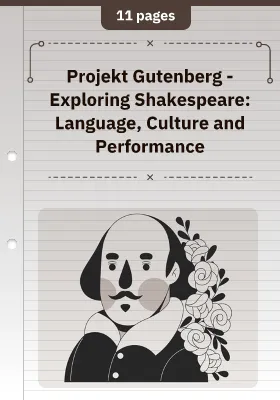
Projekt Gutenberg - Exploring Shakespeare: Language, Culture and Performance

Projekt Gutenberg - Exploring Shakespeare: Language, Culture and Performance

The aim is to systematically explore Shakespeare’s dramatic texts. Learners will be enabled to objectively deconstruct language, structure and cultural contexts, and to critically reflect on the tension between the historical text and modern performance.

Content and Methods: The worksheet guides students through an analytical process ranging from grasping the content to envisioning a practical stage performance.

Methods:

  • Structural classification: Locating scenes within the classical dramatic structure (e.g., exposition, peripeteia).
  • Analysis of language and form: Examining blank verse vs. prose, imagery, and rhetorical devices (e.g., stichomythia).
  • Thematic exploration: Linking scenes to universal motifs (power, fate, guilt).

Transfer: A choice between a performance critique (directorial concept/stage design) or a critical discussion on human archetypes. The primary texts for this exercise are sourced from Project Gutenberg.

Competencies:

  • Literary analysis skills: Confident handling of genre-specific characteristics and technical terms used in drama analysis.
  • Methodological skills: Application of categories from literary and theatre studies to decode the text.
  • Transfer and creative skills: Projecting historical material onto modern staging concepts and contemporary social issues.
  • Language awareness: Developing sensitivity to the impact of meter and figurative language.

Target Audience and Level: Advanced English course

English