Traditional Holidays in Transition (advanced)

Traditional Holidays in Transition (advanced)

In this worksheet, your students will explore how traditions surrounding traditional holidays have changed over time and which similar traditional holidays exist in other countries. They also explore negative impacts and consider the aspect of cultural identity.
KD
LG
MJ
NM

92 other teachers use this template

Target group and level

your students

Subjects

English

Traditional Holidays in Transition (advanced)

Different traditions

Sofia

Hi Sofia! How do you celebrate New Year's Eve in Spain?

17:10

Hi Liam! It's really fun! At midnight, we eat 12 grapes, one for each chime of the clock. How about you in Canada?

17:15

That sounds cool! In Canada, we usually have fireworks and some people go ice skating. Did your grandparents celebrate the same way?

17:20

Not exactly. My grandparents told me they used to have big family dinners and sometimes even stay up all night dancing. Did your family do anything different in the past?

17:25

Yeah, my parents told me that when they were kids, their grandparents would make a big bonfire and everyone would gather around it, telling stories until midnight. It sounds so different from now!

17:30

Wow, that sounds amazing! Do you guys have any special food for New Year's Eve?

17:35

We usually have a lot of snacks and sometimes a special dinner, like a turkey or ham. What about you?

17:40

We have a big dinner too, with seafood and other traditional Spanish dishes. And of course, the grapes at midnight!

17:45

I think it's awesome how different our celebrations are. It would be fun to try your traditions one day!

17:50

Definitely! Maybe one day we can celebrate together and mix our traditions. That would be so cool!

17:55

For sure! Have a great New Year's Eve, Sofia!

18:00

You too, Liam! Happy New Year!

18:05
Icon

How do you celebrate?

Read the chat conversation and talk about it in class: Do you celebrate this traditional holiday, and if so, how? Do you know of any other customs associated with this day?

Traditional holidays in different countries

The traditional holiday is celebrated differently in various countries. Can you correctly match the traditions?

Match the country with the tradition.

Traditional holidays in transition

Have a look at how traditions associated with the traditional holiday have changed over the course of several centuries.

John, 1700

John, 1700
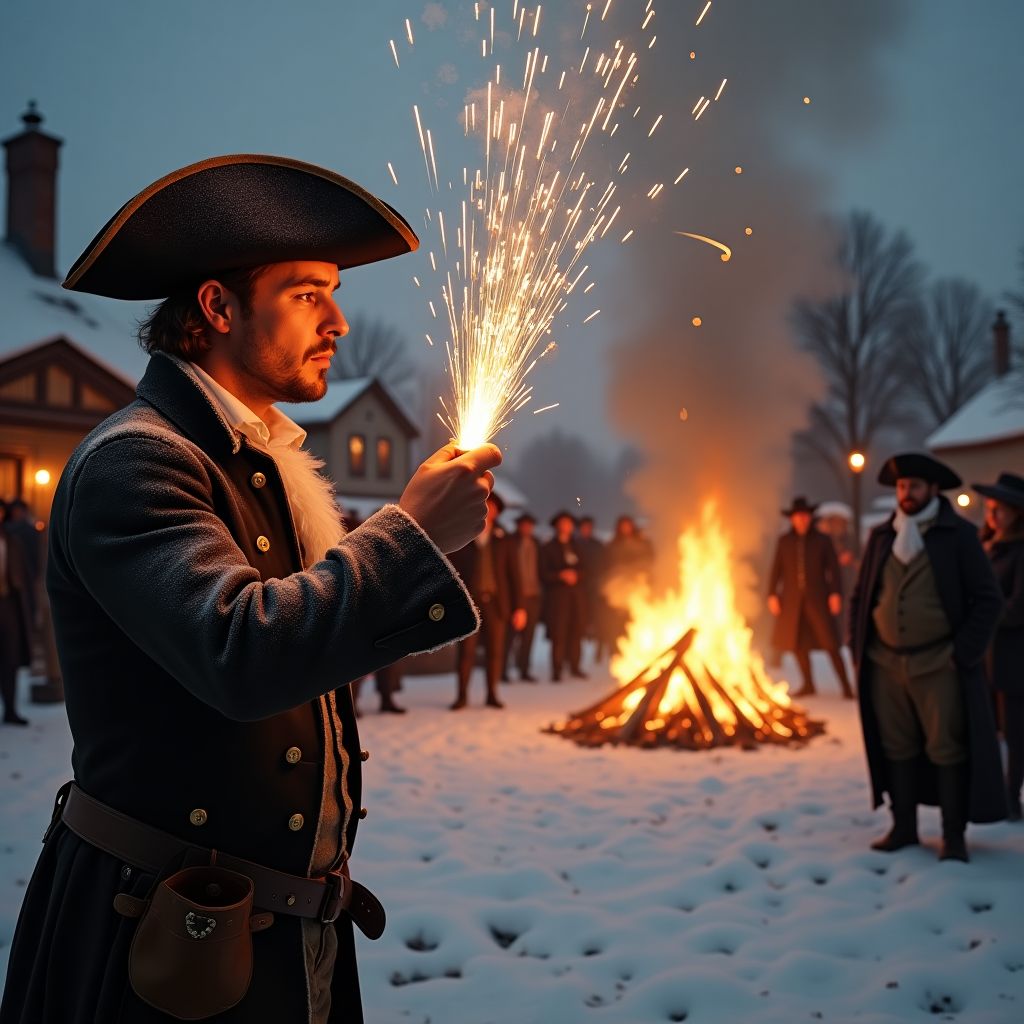
My name is John, and the year is 1700. Here in colonial America, we celebrate New Year's Eve by gathering in the village square. We light fireworks and a large bonfire to ward off evil spirits and bring good fortune for the coming year. The entire community comes together, and it's a joyous occasion filled with singing and dancing.
John describes a colonial New Year's Eve in 1700, emphasizing community gatherings, fireworks, and a large bonfire to ward off evil spirits and welcome the new year.

Sarah, 1850

Sarah, 1850
My name is Sarah, and the year is 1850. In the United States, we celebrate New Year's Eve with family gatherings at home. We decorate our parlor with garlands and candles, and we enjoy a feast that includes roast meats, pies, and other delights. It's a time for reflecting on the past year and making resolutions for the future.
Sarah describes a mid-19th century New Year's Eve in 1850, focusing on family gatherings at home, festive decorations, and a celebratory feast.

Emily, 2023

Emily, 2023
My name is Emily, and the year is 2023. In the United States, New Year's Eve is a major event, and many people gather in Times Square to watch the iconic ball drop at midnight. We celebrate with parties, music, and fireworks. It's a night filled with excitement and anticipation for the new year ahead.
Emily describes a contemporary New Year's Eve in 2023, highlighting the tradition of gathering in Times Square, watching the ball drop, and celebrating with parties and fireworks.

A different side of the tradition

Now read the newspaper article on the following page. What problem is being addressed here?

New Year's Eve: The Hidden Cost of Fireworks

Every New Year's Eve, the skies over the Netherlands are lit with spectacular displays of fireworks. While these colorful explosions are a sight to behold, they come at a significant cost. The tradition of allowing ordinary citizens to ignite fireworks between 6 PM on December 31 and 2 AM on January 1 has led to increasing concerns over safety and environmental impact.

Fireworks in the Netherlands. Photo by Peter van der Sluijs [CC BY-SA 3.0]

In recent years, the Netherlands has seen a troubling rise in injuries and property damage related to New Year's Eve fireworks. In 2016/17, a staggering 61% of victims were innocent bystanders, while the rest were the igniters themselves. The air pollution caused by the smoke from fireworks exacerbates respiratory problems and has even led to fatal traffic accidents due to smog.

The Dutch government has taken steps to mitigate these issues, such as limiting the sale of fireworks to the last three days of the year and imposing stricter safety regulations. However, illegal fireworks continue to pose a major problem, with an estimated one million kilos entering the country annually. Efforts to harmonize European safety standards have been ongoing, but the road to a safer New Year's Eve is still fraught with challenges.

As discussions about stricter regulations or even a complete ban on consumer fireworks continue, the Netherlands faces a delicate balance between tradition and safety. While fireworks are a cherished part of New Year's Eve celebrations, the hidden costs of injuries, environmental damage, and public safety cannot be ignored.

Icon

Criticism of traditional holidays

Although traditional holidays are celebrated often and with enthusiasm, there are also frequently negative aspects associated with them. Can you imagine what points might generally be criticized about traditional holidays?

Collect your ideas together in the class.

Discussion - Partner Work

Now prepare a discussion with role cards in partner work. One of you will take the pro position, and the other person will take the contra position. In addition to the arguments on the role cards, try to find other arguments for your position.

Jessica (pro)

Jessica (pro)
My name is Jessica, and I love celebrating New Year's Eve. It's a time for joy, togetherness, and new beginnings. The sense of community and shared experience during the celebrations, whether it's at a party or watching the ball drop in Times Square, is truly special. It's a night where people come together to celebrate the end of one year and the start of another with hope and positivity.
Jessica highlights the positive aspects of New Year's Eve, emphasizing joy, community, and the excitement of new beginnings.

Michael (contra)

Michael (contra)
My name is Michael, and I have some reservations about New Year's Eve celebrations. While it's a festive time for many, I worry about the environmental impact of fireworks and the significant amount of waste generated from parties and gatherings. Additionally, the focus on consumerism and excessive spending can overshadow the true meaning of the holiday. I believe we should find more sustainable and meaningful ways to celebrate the new year.
Michael criticizes New Year's Eve celebrations, focusing on environmental concerns, waste generation, and the impact of consumerism, advocating for more sustainable and meaningful ways to celebrate.

Further arguments

Discussion

Now have a discussion with your partner and try to convince them of your opinion.

Icon

Discussion in class

Discuss the results of your discussion rounds in class: Which position was more convincing?

Now also ask yourselves the question of what relevance such traditional holidays still have today and discuss this together as a class.

Further questions

Choose one of the following three questions, and answer them in a short text.