to teach logo
Sign up

Vokabeltrainer Französisch - B1

TT
by to-teach Team
6 pagesFranzösischlernende auf B1-NiveauFrench
Template

Loading preview…

Your worksheet

Enter the subject area for which you want to create the vocabulary trainer.

Need an idea?

Popular topics from other teachers

How our AI templates work

  • Content gets adapted

    Examples, texts and tasks match your focus.

  • Method & structure stay

    The didactically reviewed structure of the template won't change.

Description

Zielsetzung: Das übergeordnete Lernziel des Arbeitsblattes ist es, die französischen Vokabelkenntnisse der Schüler:innen auf dem Niveau B1 zu erweitern und zu festigen, insbesondere im Hinblick auf einen ausgewählten Wortschatz, sowie deren aktive Anwendung in verschiedenen Kontexten zu fördern.


Inhalte und Methoden: Das Arbeitsblatt konzentriert sich auf eine kleine, spezifische Vokabelliste von zehn Wörtern zu einem ausgewählten Themenbereich. Die methodischen Ansätze umfassen Vokabelzuordnung (Französisch-Deutsch), Ergänzungsübungen zur Anwendung der Vokabeln im Satzkontext, Satzbildung mit neuen Wörtern, mündliche Beschreibung (Tabu-Methode: Erklären der neuen Vokabeln, ohne bestimmte Schlüsselwörter zu verwenden), eine Sprechaufgabe mit technischer Unterstützung (Speak the Words, nur im Chrome-Browser unterstützt).


Kompetenzen:

  • Lexikalische Kompetenz: Abruf und Anwendung des spezifischen französischen Wortschatzes (B1)
  • Schriftliche Ausdrucksfähigkeit: Anwendung der Vokabeln in grammatikalisch korrekten Sätzen
  • Sprechkompetenz/Kommunikative Kompetenz: Umschreiben und Erklären von Begriffen unter Vermeidung von Schlüsselwörtern (Tabu-Methode)
  • Leseverständnis: Erfassen der Aufgabenstellungen und der Vokabeldefinitionen
  • Gedächtnisleistung: Erinnern und Zuordnen von Vokabeln


Zielgruppe und Niveau: Französischlernende auf dem Niveau B1

Similar worksheets

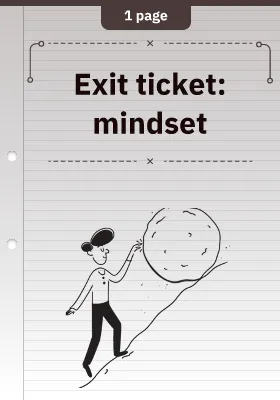
Exit Ticket: Mindset

Exit Ticket: Mindset

Objective

The primary objective of this "Exit Ticket" is to facilitate student self-reflection on their psychological approach to learning, specifically focusing on the application of a growth mindset within the last lesson's content. It aims to help students identify the difference between productive persistence and self-limiting behaviors when facing academic challenges.

Content and Methods

  • Content: The worksheet centers on real-time reflections regarding the last lesson's topic, including reactions to difficulty and the process of learning new concepts.
  • It addresses key mindset indicators: persistence through struggle, the choice between conceptual understanding and rote memorization, and the perception of mistakes.
  • It explores the social-emotional aspects of learning, such as the willingness to seek help and the ability to process constructive feedback.
  • Methods: The tool is designed as an "Exit Ticket," providing a structured format for formative assessment at the end of a lesson.
  • It utilizes comparative multiple-choice questions to help students categorize their own behaviors as either growth-oriented or fixed.
  • It employs open-ended reflective prompts to encourage students to analyze the impact of their mindset and plan for future improvement.

Competencies

  • Self-Awareness: Developing the ability to recognize one's own emotional and cognitive reactions to frustration and difficulty.
  • Metacognitive Reflection: Thinking about the "how" and "why" of learning, specifically choosing deep understanding over superficial memorization.
  • Resilience and Adaptability: Learning to view errors as data for improvement rather than personal failures.
  • Social Competence: Evaluating how an individual's mindset influences their communication with teachers and peers.

Target Group and Level

Grade 5 and above

non-subject specific contentArtPhysicsChemistryHistory