to teach logo
Sign up

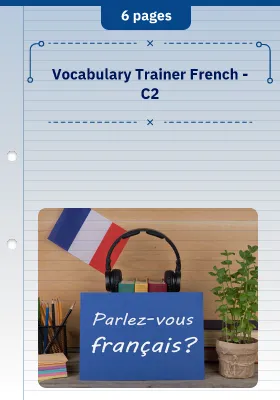
Vokabeltrainer Französisch - B1/B2 (eigene Vokabelliste - 20 Vokabeln)

TT
by to-teach Team
6 pagesFranzösischlernende auf B1/B2-NiveauFrench
Template

Loading preview…

Your worksheet

Enter exactly 20 French words with German translations.

Need an idea?

Popular topics from other teachers

How our AI templates work

  • Content gets adapted

    Examples, texts and tasks match your focus.

  • Method & structure stay

    The didactically reviewed structure of the template won't change.

Description

Zielsetzung: Das übergeordnete Lernziel des Arbeitsblattes ist es, die französischen Vokabelkenntnisse der Schüler:innen auf dem Niveau B1/B2 zu erweitern und zu festigen, insbesondere im Hinblick auf einen ausgewählten Wortschatz, sowie deren aktive Anwendung in verschiedenen Kontexten zu fördern.


Inhalte und Methoden: Das Arbeitsblatt konzentriert sich auf eine kleine, spezifische Vokabelliste von 20 Wörtern. Die methodischen Ansätze umfassen Vokabelzuordnung (Französisch-Deutsch), Lückentext-/Ergänzungsübungen zur Anwendung der Vokabeln im Satzkontext, Satzbildung mit neuen Wörtern, mündliche Beschreibung (Tabu-Methode: Erklären der neuen Vokabeln, ohne bestimmte Schlüsselwörter zu verwenden), eine Sprechaufgabe mit technischer Unterstützung (Speak the Words, nur im Chrome-Browser unterstützt).


Kompetenzen:

  • Lexikalische Kompetenz: Abruf und Anwendung des spezifischen französischen Wortschatzes (B1/B2)
  • Schriftliche Ausdrucksfähigkeit: Anwendung der Vokabeln in grammatikalisch korrekten Sätzen
  • Sprechkompetenz/Kommunikative Kompetenz: Umschreiben und Erklären von Begriffen unter Vermeidung von Schlüsselwörtern (Tabu-Methode)
  • Leseverständnis: Erfassen der Aufgabenstellungen und der Vokabeldefinitionen
  • Gedächtnisleistung: Erinnern und Zuordnen von Vokabeln


Zielgruppe und Niveau: Französischlernende auf dem Niveau B1/B2
Similar worksheets

Exit Ticket: Mindset

Exit Ticket: Mindset

Objective

The primary objective of this "Exit Ticket" is to facilitate student self-reflection on their psychological approach to learning, specifically focusing on the application of a growth mindset within the last lesson's content. It aims to help students identify the difference between productive persistence and self-limiting behaviors when facing academic challenges.

Content and Methods

  • Content: The worksheet centers on real-time reflections regarding the last lesson's topic, including reactions to difficulty and the process of learning new concepts.
  • It addresses key mindset indicators: persistence through struggle, the choice between conceptual understanding and rote memorization, and the perception of mistakes.
  • It explores the social-emotional aspects of learning, such as the willingness to seek help and the ability to process constructive feedback.
  • Methods: The tool is designed as an "Exit Ticket," providing a structured format for formative assessment at the end of a lesson.
  • It utilizes comparative multiple-choice questions to help students categorize their own behaviors as either growth-oriented or fixed.
  • It employs open-ended reflective prompts to encourage students to analyze the impact of their mindset and plan for future improvement.

Competencies

  • Self-Awareness: Developing the ability to recognize one's own emotional and cognitive reactions to frustration and difficulty.
  • Metacognitive Reflection: Thinking about the "how" and "why" of learning, specifically choosing deep understanding over superficial memorization.
  • Resilience and Adaptability: Learning to view errors as data for improvement rather than personal failures.
  • Social Competence: Evaluating how an individual's mindset influences their communication with teachers and peers.

Target Group and Level

Grade 5 and above

non-subject specific contentArtPhysicsChemistryHistory