to teach logo
Sign up

Work with Political Cartoons

TT
by to-teach Team
1 pageMiddle school studentsEnglish, History, Politics
Template

Loading preview…

Your worksheet

Insert a historical caricature in image format. This will serve as the main visual source for the questions on analysis and truth on the worksheet.

or

How our AI templates work

  • Content gets adapted

    Examples, texts and tasks match your focus.

  • Method & structure stay

    The didactically reviewed structure of the template won't change.

Description

Objective: This worksheet aims to teach students how to effectively analyze political cartoons by examining a historical illustration.

Content and methods: The worksheet centers on the given cartoon. It uses true/false questions to verify students' understanding of the cartoon's basic facts and visual components. Additionally, it provides a step-by-step guide for analyzing political cartoons, prompting students to examine visual details, establish historical context, and interpret the symbolic significance of the figures and their expressions.

Competencies:

  • Visual source analysis
  • Historical contextualization
  • Critical interpretation of symbolism
  • Reading comprehension

Target group: Middle school students

Similar worksheets

📖 Reading Time: Grade 2 with Coloring Page

📖 Reading Time: Grade 2 with Coloring Page

The primary learning objective is advancing early English reading instruction, enhancing word- and sentence-level decoding fluency, expanding thematic vocabulary, and supporting multisensory cognitive consolidation through integrated visual-motor tasks.

Contents and Methods: The worksheet combines short, structured declarative sentences with an integrated word search puzzle and a concluding thematic coloring activity. Methodologically, learners first read clear descriptive sentences featuring foundational vocabulary, action verbs, and basic syntactic patterns. They then visually scan for and identify key target words within a letter grid matrix, reinforcing word recognition and orthographic memory. Finally, a detailed coloring page engages fine motor skills and serves as a motivating, multisensory capstone to consolidate lexical associations.

Competencies:

  • Reading & Decoding Skills (English): reliable decoding, fluent reading of short connected sentences, and structural understanding of simple English statements
  • Vocabulary & Language Competence: visual recognition, retention, and semantic grounding of high-frequency words, and descriptive action verbs
  • Visual Perception & Concentration: systematic scanning, visual discrimination, and focused attention through the word search puzzle
  • Fine Motor & Multisensory Learning: hand-eye coordination, creative focus, and multisensory reinforcement through thematic coloring

Target Group: Grade 2 and above

English
📖 Reading Time: Grade 1 with Coloring Page

📖 Reading Time: Grade 1 with Coloring Page

The primary learning objective is foundational early reading instruction in English, strengthening decoding skills at word and simple sentence levels, expanding basic thematic vocabulary, and supporting learner motivation and fine motor development through an integrated creative coloring activity for beginner readers.

Contents and Methods: The worksheet combines short, clearly structured declarative sentences in English centered around an engaging theme with a subsequent thematic coloring exercise. Methodologically, early learners read accessible, single-clause sentences featuring high-frequency sight words, and foundational action verbs. Following the reading phase, learners visually and creatively anchor their learning experience by coloring a detailed illustration corresponding to the topic, which reinforces concentration, haptic-visual coordination, and positive emotional engagement with the foreign language.

Competencies:

  • Reading & Decoding Skills (English): reliable decoding, word recognition of high-frequency vocabulary, and basic comprehension of simple English sentence structures
  • Vocabulary & Language Competence: acquisition and recognition of foundational thematic vocabulary (nouns, verbs, descriptive adjectives) in meaningful sentence contexts
  • Fine Motor Skills & Visual Perception: development of graphomotor control, hand-eye coordination, and sustained visual focus through mindful coloring
  • Motivation & Affective Learning: playful, low-anxiety access to foreign language learning through the combination of text and artistic expression

Target Group: Grade 1 and above

English
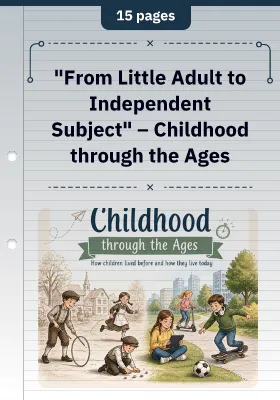
"From Little Adult to Independent Subject" – Childhood through the Ages

"From Little Adult to Independent Subject" – Childhood through the Ages

This worksheet aims to provide trainee teachers with a historically informed and socially critical understanding of the life stage known as ‘childhood’. Learners are to be made aware that childhood is not a rigid, biological state, but is subject to constant social change. They will learn to analyse historical patterns of upbringing and living environments, to contextualise the contemporary view of the child (including the UN Convention on the Rights of the Child), and to draw conclusions for their own professional approach by comparing the past and the present.

Content and methods:

This worksheet combines historical text analysis, the development of empathy, analysis of contemporary issues and research into international law. Following a personal reflection and an analysis of a historical period, the pupils write a fictional diary entry from a child’s perspective and contrast this with the reaction of a child today. They then map out the cornerstones of modern childhood in a practical matrix and compare historical and contemporary living conditions. The activity concludes with research into the UN Convention on the Rights of the Child, including its historical context, and a reflection on their own pedagogical approach.


Competencies:

Learners can...

  • Explain the concept of childhood as a socially shaped and historically changeable construct.
  • Analyse children’s historical living environments in terms of educational objectives, work requirements and legal status, guided by specific criteria.
  • Develop historical empathy through methods of shifting perspectives and reflect on different living conditions from multiple perspectives.
  • Identify the dimensions of modern childhood (including subject status, institutionalisation and mediatisation) and illustrate them using concrete examples from practice.
  • Independently research articles of the UN Convention on the Rights of the Child, place them in their historical context and relate them to today’s image of the child.
  • Use historical insights to critically examine current patterns of upbringing and apply them to one’s own professional approach.


Target group and level:

Adult students or trainees in the field of social pedagogy, particularly aspiring educators.


Note: Internet access is required for the research task

PedagogySocial PedagogyHistoryHealth and Social Care
Understanding Influencer Marketing

Understanding Influencer Marketing

This worksheet aims to raise students’ awareness of the mechanisms, economic dimensions, and psychological strategies of modern digital marketing in everyday life.

Content and Methods: The material focuses on the economic significance of social media marketing based on statistical data, as well as the analysis of specific digital posts. Methodologically, the worksheet relies on a combination of practical case studies—in which an exemplary social media post is deconstructed both textually and statistically—and theoretical insights into behavioral economic effects. In addition, the material encourages multi-perspective discussion through reflective writing assignments and the comparison of contrasting stakeholder perspectives. Finally, the discussion of complex issues is used to synthesize what has been learned into the formation of independent judgments.

Competencies:

Analytical and Deconstructive Competence: The ability to systematically examine media content and linguistic and statistical devices for their manipulative or promotional effects

Reflective and Critical Thinking Competence: The ability to critically examine one’s own consumer behavior and evaluate economic phenomena from different perspectives

Media and Economic Competence: Understanding of digital market mechanisms, psychological influence strategies such as the authority bias or the bandwagon effect, and their impact on the economy

Target Audience and Level: 9th/10th grade

EconomicsPolitics