
My body belongs to me
8

The world of Start Ups
5

AI skills
26

Substitute Lessons
16

Countdown to Summer
9

Focus on women
6
Filters
Worksheets

Adolescence: When Emotions Outpace Reason—Understanding Behavior and Providing Professional Guidance
This worksheet introduces future professionals to the biopsychological foundations of adolescence. Learners should recognize that challenging behavior often results from neurological changes and is not a deliberate act of aggression. The goal is to distinguish between the person and their actions in order to act in a way that de-escalates situations, provides support, and maintains positive relationships in their daily professional practice.
Content and Methods:
The material combines theoretical input from developmental psychology with practical case studies and self-reflection. After exploring the neurological foundations, learners “decode” typical behaviors. In a subsequent case analysis, they critically evaluate educational interventions and develop alternative professional approaches. A concluding reflection on their own emotional “triggers” reinforces their professional attitude.
Competencies:
Learners can...
- explain the neurological and psychological changes that occur during adolescence (particularly the interaction between the limbic system and the prefrontal cortex).
- psychologically interpret observable, challenging adolescent behavior (such as provocation, rule-breaking, or shame) and classify it as an age-typical developmental task.
- critically analyze the actions of professionals in acute crisis situations (e.g., in cases of extreme risk-taking behavior) with regard to de-escalation, the duty to protect, and relationship-building.
- Develop professional and practical alternative courses of action that simultaneously set clear boundaries and preserve the adolescents’ emotional safety.
- Reflect on one’s own emotional “triggers” when interacting with adolescents in order to maintain professional distance and composure in everyday work.
Target group and level:
Adult students or trainees in the field of social pedagogy, particularly aspiring educators.

The Challenge of Youth– Understanding and Providing Educational Support for Developmental Tasks According to Hurrelmann
This worksheet aims to provide aspiring educators with a solid sociological understanding of the “adolescence” life stage based on Klaus Hurrelmann’s model of developmental tasks. Learners will gain an awareness of the specific challenges, areas of conflict, and identity-formation processes that adolescents must navigate. They will learn to apply theoretical developmental tasks to concrete everyday situations faced by adolescents, analyze critical factors such as school-related pressure to perform, and develop strategies to alleviate these pressures in educational practice.
Content and Methods: This worksheet addresses the specific characteristics and challenges of adolescence, the four central developmental tasks identified by Klaus Hurrelmann (acquiring skills, forming bonds, consuming, and participating), as well as the tension between various societal influences and the development of identity in children and adolescents. Methodologically, the worksheet employs a combination of personal reflection and partner discussions to define concepts, an informative academic text with a tabular classification of everyday examples, and a small-group problem analysis to develop practical, stress-reducing approaches for educational practice.
Competencies:
Learners can...
- describe the characteristics of adolescence and distinguish it from childhood and adulthood, providing reasons for their distinctions.
- explain the four developmental tasks identified by Klaus Hurrelmann (acquiring skills, forming bonds, consuming, participating) and classify everyday situations according to these criteria.
- critically reflect on the causes and consequences of academic pressure on adolescents’ identity and personality development.
- design and justify action-oriented approaches and strategies to alleviate pressure in schools and educational settings.
Target group and level:
Adult students or trainees in the field of social pedagogy, particularly aspiring educators.

Understanding Development: The Phases of Childhood
This worksheet aims to provide aspiring educators with a solid understanding of the stages of child development (early, middle, and late childhood). Learners should be made aware of how to correctly classify developmental phenomena and milestones in the areas of motor skills, cognition, language, and emotional/social development. They will learn to critically compare their own everyday experiences with scientific findings, to analyze everyday observations from a professional perspective, and to design needs-based educational interventions based on a needs assessment.
Content and Methods:
The worksheet combines visual stimuli, prior knowledge, academic texts, social media analyses, and case studies. After assessing their prior knowledge of the three stages of childhood, students explore the developmental characteristics of each stage in terms of motor skills, cognition, language, and social behavior. Using fictional tweets from professional practice, they classify developmental phenomena according to academic categories. The unit concludes with a case study from a selected stage of childhood, for which students conduct a needs assessment and develop a well-reasoned practical plan.
Competencies:
Learners can...
- describe and distinguish between the developmental stages of early, middle, and late childhood in terms of their motor, cognitive, and social-emotional dimensions,
- identify key developmental phenomena (e.g., the emergence of self-awareness, magical thinking, acquisition of cultural skills) in observational data and explain them using specialized terminology,
- systematically compare their own practical observations with expert knowledge of developmental theory,
- conduct a pedagogical needs assessment for a specific case study and, based on this, develop and justify tailored pedagogical interventions.
Target group and level:
Adult students or trainees in the field of social pedagogy, particularly aspiring educators.

Needs Table: What keeps me healthy?
Students explore their own needs and personal sources of strength and reflect on what contributes to their well-being.
Content and methods: The worksheet uses a needs table in which students first identify their own sources of strength and then assess how well their needs are currently being met. They then identify the needs with the lowest scores, choose suitable self-care strategies, and develop concrete next steps. An audio example, an overview of different self-care strategies, and a buddy agreement support reflection and help students put their ideas into practice in everyday life.
Skills:
- identify personal needs and sources of strength
- reflect on their own well-being
- choose appropriate self-care strategies
- plan concrete steps for action
- make conscious use of support from others
Target group and level: Suitable for secondary school students, particularly for developing self-reflection, health awareness, and social-emotional skills.
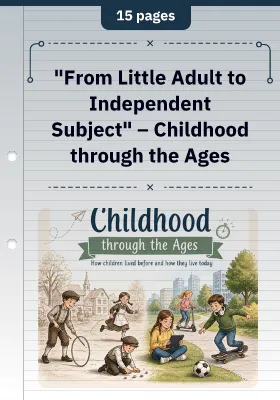
"From Little Adult to Independent Subject" – Childhood through the Ages
This worksheet aims to provide trainee teachers with a historically informed and socially critical understanding of the life stage known as ‘childhood’. Learners are to be made aware that childhood is not a rigid, biological state, but is subject to constant social change. They will learn to analyse historical patterns of upbringing and living environments, to contextualise the contemporary view of the child (including the UN Convention on the Rights of the Child), and to draw conclusions for their own professional approach by comparing the past and the present.
Content and methods:
This worksheet combines historical text analysis, the development of empathy, analysis of contemporary issues and research into international law. Following a personal reflection and an analysis of a historical period, the pupils write a fictional diary entry from a child’s perspective and contrast this with the reaction of a child today. They then map out the cornerstones of modern childhood in a practical matrix and compare historical and contemporary living conditions. The activity concludes with research into the UN Convention on the Rights of the Child, including its historical context, and a reflection on their own pedagogical approach.
Competencies:
Learners can...
- Explain the concept of childhood as a socially shaped and historically changeable construct.
- Analyse children’s historical living environments in terms of educational objectives, work requirements and legal status, guided by specific criteria.
- Develop historical empathy through methods of shifting perspectives and reflect on different living conditions from multiple perspectives.
- Identify the dimensions of modern childhood (including subject status, institutionalisation and mediatisation) and illustrate them using concrete examples from practice.
- Independently research articles of the UN Convention on the Rights of the Child, place them in their historical context and relate them to today’s image of the child.
- Use historical insights to critically examine current patterns of upbringing and apply them to one’s own professional approach.
Target group and level:
Adult students or trainees in the field of social pedagogy, particularly aspiring educators.
Note: Internet access is required for the research task
Theories - Applying and Exploring Them in Depth
The worksheet aims to provide students with a deep understanding of a pedagogical theory. Students apply central technical terms, transfer theoretical concepts to pedagogical scenarios, and reflect on the relevance of the theory for practical application.
Content and methods:
The focus is on the application, in-depth exploration, and critical reflection of an educational theory. Methodologically, the worksheet combines the translation of technical terms into everyday language, cooperative group work via an expert group method, the elaboration and presentation of subject-specific content, the development of practical case studies, the analysis of different positions and arguments, as well as a concluding reflection and self-assessment.
Competencies:
- Apply and explain central terms and concepts of a theory
- Comprehend, structure, and summarize specialized texts
- Transfer theoretical content to pedagogical situations and case examples
- Analyze and evaluate professional positions and arguments
- Formulate and justify personal judgments
- Reflect on and assess one's own learning progress
Target group and level:
Adult students or trainees in the field of social pedagogy, particularly aspiring educators.
Note on further work: The worksheet serves to deepen and apply a pedagogical theory. It can build upon an introductory worksheet and forms the foundation for further tasks in which theoretical concepts are applied to more complex practical examples and critically reflected upon. Introductory worksheet on the topic: Theories – Fundamentals
Note: Internet access is required for the group research phase.
Theories – Fundamentals
The worksheet aims to provide students with a fundamental understanding of a specific theory within the field. Students are expected to grasp the theory's core assumptions, contextualize technical terms, and recognize the significance of theoretical explanatory approaches for analyzing, interpreting, and reflecting on subject-specific contexts.
Content and Methods:
The focus is on the core idea of the respective theory, key technical terms, and important theorists, as well as their relevance to understanding subject-specific phenomena, processes, or practical situations. Methodologically, the worksheet combines image analysis, hypothesis generation, work with texts, structuring information via a study card, subject-specific review through a terminology puzzle, and a final self-assessment.
Competencies:
- Acquiring specialized knowledge regarding theoretical explanatory approaches and applying key terms
- Extracting, highlighting, and structuring information from a foundational text
- Explaining theoretical content in one's own words
- Verifying initial hypotheses and refining them using subject-specific terminology
- Reflecting on and assessing one's own learning progress
Target Group and Level:
Students or trainees in the field of social pedagogy, particularly aspiring educators. The level of difficulty ranges from basic to intermediate.
Functions of Social Attitudes
This worksheet aims to provide students with a comprehensive understanding of social attitudes by defining their structural components and analyzing their psychological functions based on Daniel Katz’s functional theory. Students learn to identify how attitudes help individuals navigate social environments, express identity, and maintain self-esteem.
Content and methods:
The worksheet employs a multi-step pedagogical approach, starting with a realistic class chat scenario to prompt initial reflection. It then uses structured multiple-choice tasks to clarify the cognitive, affective, and conative components of attitudes. Finally, the material introduces Katz’s four functions (adaptive, value-expressive, knowledge, and ego-defensive) through a social media-style infographic, requiring students to apply these concepts by categorizing the classmates' statements and reflecting on their own perspectives.
Competencies:
- Definition and differentiation of the structural components of attitudes (ABC-model)
- Analytical application of Katz’s functional theory to real-life scenarios
- Self-reflection and perspective-taking within social contexts
- Critical evaluation of the changeability of attitudes based on their underlying functions
Target group: grades 10 and higher + students of social education
Exit Ticket: Real World Connection
Objective: This worksheet aims to reinforce students' understanding of the given topic while prompting them to transfer and apply theoretical concepts to real-world scenarios.
Content and methods: The worksheet addresses the given topic through an exit ticket format. Students answer targeted recall and open-ended conceptual questions assessing factual comprehension and cause-and-effect reasoning. Finally, they engage in applied writing prompts requiring them to analyze practical real-world applications in navigation, agriculture, and daily life, before formulating an original application example.
Competencies:
- Scientific explanation and causal reasoning
- Knowledge transfer and real-world application
- Critical thinking and hypothesis formation
- Written communication and conceptual synthesis
Target group: Middle School
From Art to Science: A Comprehensive Tool for All Your Worksheet Needs
Create worksheets for any subject and topic of your choice, using texts from our AI or your own sources.