
Adapt vocabulary for an English lesson without losing the subject content
Use to teach’s vocabulary adaptation tool to prepare a reading for an A2 or B1 English class. Add your source, select the language and target setting, then identify the subject words learners still need. Review the result alongside the original before building the reading task.
This guide uses a short geography passage about rainwater on a school playground. The classroom question stays the same throughout: why does planted ground handle rain differently from asphalt? The adaptation changes how learners reach that explanation.
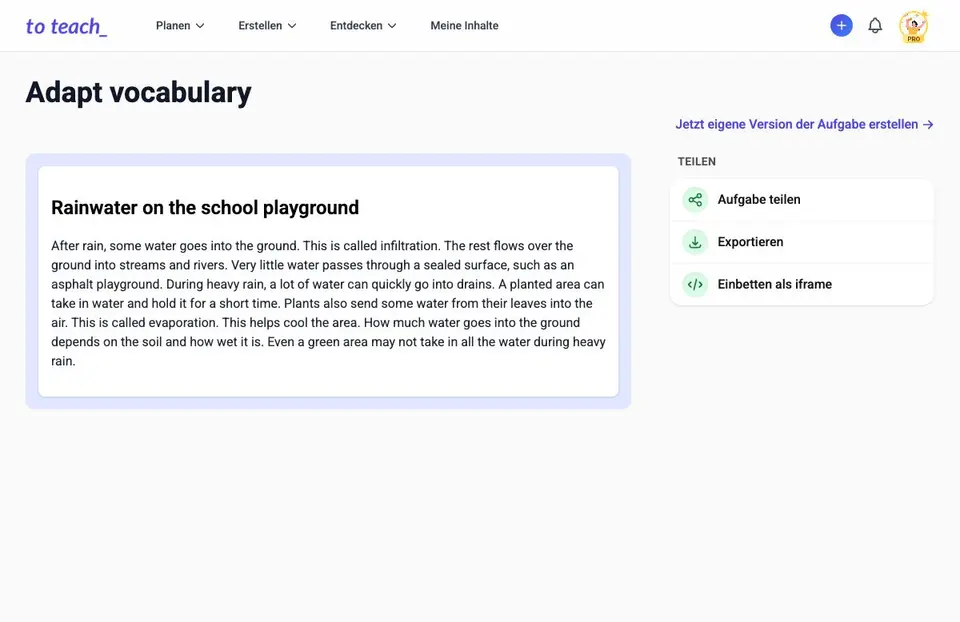
Read the finished vocabulary-adaptation example — full view
Choose the words you want learners to use
Before generating the reading, separate unfamiliar everyday wording from the vocabulary you intend to teach. In our source, “temporarily” can become “for a short time.” Infiltration, sealed surface and evaporation are different: they name the processes and conditions learners will discuss, so we keep them and explain them.
The original begins: “After a rain shower, some water infiltrates the soil while the rest flows over the surface into streams and rivers. Sealed surfaces, such as an asphalt school playground, allow very little water to enter the ground.”
It also explains that plants release water into the air, that this contributes to cooling, and that infiltration depends on the soil and how wet it already is. The final point matters for the class’s explanation: even planted ground can be overwhelmed by heavy rain.
The complete source passage
Use this original passage to create the adaptation or give it to learners who are ready for the denser reading.
After a rain shower, some water infiltrates the soil while the rest flows over the surface into streams and rivers. Sealed surfaces, such as an asphalt school playground, allow very little water to enter the ground. During heavy rain, a large amount can therefore reach the drainage system in a short time. A planted area can absorb water and store it temporarily. Plants release some of the water they take up through their leaves into the air. This evaporation contributes to cooling. The amount of water that infiltrates depends partly on the type of soil and how wet it already is. Even a green area can therefore be overwhelmed by heavy rain.
Set up the adaptation
Open the vocabulary adaptation tool. In the source panel, choose Text, give the passage a recognisable title and paste the source.
Select English as the output language. Choose A2 or B1 to guide the adaptation; this example uses A2.
Use the optional instruction field to name the teaching purpose and words to retain. We asked for the contrast between asphalt and planted ground, explanations of the three target terms, and preservation of the heavy-rain qualification.
Create the material and read the whole result against the source.
A useful instruction for this lesson is: “Adapt the vocabulary for an A2 English class aged 12–13. Keep the scientific meaning and the contrast between asphalt and planted ground. Keep and briefly explain infiltration, sealed surface and evaporation. Preserve the point that even planted areas can be overwhelmed by heavy rain.”
Make two edits that improve this reading
Our first result used familiar verbs such as “goes into,” “take in” and “hold.” It also removed the target terms. We used the AI revision control to restore infiltration after the first sentence and evaporation after the description of water moving from leaves into the air.
The second edit kept the science precise. The first result said water “cannot pass through” hard surfaces. We changed that to “Very little water passes through a sealed surface, such as an asphalt playground.” This preserves the meaning of the original instead of turning it into an absolute claim.
The finished opening now reads: “After rain, some water goes into the ground. This is called infiltration. The rest flows over the ground into streams and rivers. Very little water passes through a sealed surface, such as an asphalt playground.” The final sentence still explains that a green area may not take in all the water during heavy rain.
Use the text in the reading phase
Give pairs the same question: “Why does planted ground handle rain differently from asphalt?” Ask them to underline two pieces of evidence, then explain the difference in two sentences. A sentence frame such as “On asphalt, …, whereas on planted ground, …” supports the explanation without supplying the answer.
For a short individual check, ask: “Can a planted playground take in all the water during heavy rain? Use the text to explain.” This checks the qualification that learners can otherwise miss when discussing the advantages of green space.
You can place this reading inside a lesson plan and create the comparison activity for its reading phase. Use the original passage with learners ready for denser language and the adapted passage with learners who need more language support; both groups can contribute to the same discussion.
Choose vocabulary adaptation or broader simplification
Choose vocabulary adaptation when an A2 or B1 language target is central to the task. If you need a broader rewrite with shorter sentences and explanations of difficult ideas, use the classroom text-simplification guide. In either workflow, decide which concepts and relationships must survive before changing the wording.
Adapt a passage for your next English lesson
Keep an authentic web source useful for a language lesson
For a web article, start with one coherent passage rather than copying the whole page. Remove menus, adverts and unrelated recommendations before pasting it into the Text source field. Keep the original title, author or organisation and link alongside the adapted reading. Learners can then compare selected wording with its original context.
Make two short vocabulary lists before you generate: subject terms to keep, and wording you are happy to replace. In this example, infiltration and evaporation belong in the first list; temporarily can be expressed as for a short time. For a news article, names, dates, quantities and expressions of uncertainty also need to retain their meaning. A simpler verb should not change who did what or how certain the source is.
In class, give pairs a short original extract and its adapted version. Ask them to match two phrases, explain one word choice and identify a subject term that stayed. This gives the original source a clear purpose without requiring learners to read the entire webpage before they can answer the lesson question.
Bereit, diese Idee in eigenes Unterrichtsmaterial umzusetzen?
Schließe dich tausenden Lehrkräften an und bereite deinen Unterricht mit KI schneller, differenzierter und kreativer vor.
DSGVO-konform · In 30 Sek. startklar · Keine Kreditkarte nötig
Du interessierst dich für eine Schullizenz? Beratungsgespräch vereinbaren