
Simplify classroom texts with AI while keeping the learning goal
To simplify a classroom text in to teach, add the original passage, choose Simplify texts, then set the language and difficulty level. Use the instruction field to name the vocabulary, relationships and qualifications that must remain. The aim is a reading your pupils can work with while still answering the same subject question.
Here is a complete example about rain on a school playground. The original passage explains infiltration, sealed surfaces and evaporation. The adapted version uses shorter sentences and explains those terms in context. Both versions lead to the same task: explain why a planted playground handles rainwater differently from asphalt.
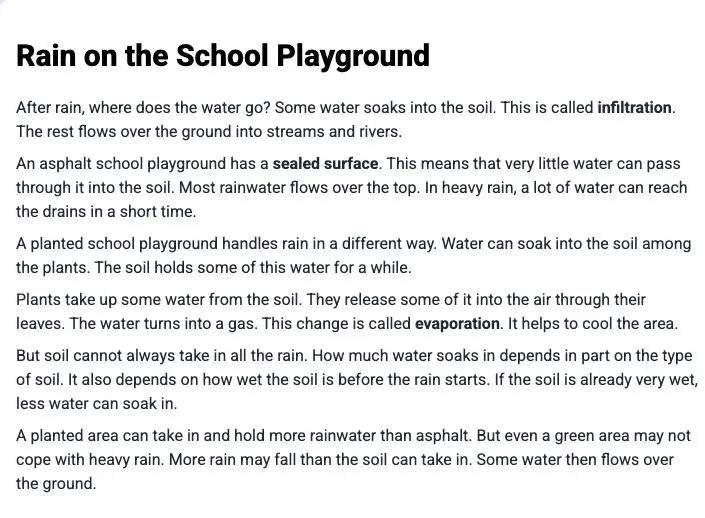
Read the finished simplified playground text — full view
The complete classroom source passage
After a rain shower, some water infiltrates the soil while the rest flows over the surface into streams and rivers. Sealed surfaces, such as an asphalt school playground, allow very little water to enter the ground. During heavy rain, a large amount can therefore reach the drainage system in a short time. A planted area can absorb water and store it temporarily. Plants release some of the water they take up through their leaves into the air. This evaporation contributes to cooling. The amount of water that infiltrates depends partly on the type of soil and how wet it already is. Even a green area can therefore be overwhelmed by heavy rain.
Start with the question the reading must help pupils answer
Choose the part of your source that supports the lesson goal. Before changing the language, list the ideas pupils need to take from it. In this example, water can enter soil or flow over the surface; asphalt lets very little through; planted ground can hold water; and even a green area can be overwhelmed by heavy rain.
That final qualification matters. Removing it would make the passage easier to read at the cost of a misleading explanation. Decide which words need support and which ideas cannot be removed.
Our original opening reads: “After a rain shower, some water infiltrates the soil while the rest flows over the surface into streams and rivers. Sealed surfaces, such as an asphalt school playground, allow very little water to enter the ground.”
Create the adapted version in to teach
Open the Material Tools and add the passage as a Text source. Select Simplify texts from the formats. The tool provides three difficulty choices and a separate output-language selector. For this example, we chose the simple setting and English.
Adapt your reading in to teach
Use the instruction field to describe the reading task, rather than relying on the difficulty choice alone. For a mixed-reading-ability class aged 11–12, ask for short sentences and clear references. Specify that infiltration, sealed surface and evaporation should stay, with explanations beside them.
Simplify the text for a mixed-reading-ability class aged 11–12. Use short sentences and clear references. Keep and explain infiltration, sealed surface and evaporation. Preserve the limitation that green areas can also be overwhelmed by heavy rain. Add no unrelated facts. The shared goal is to explain why a planted school playground handles rainwater differently from an asphalt one.
Compare the actual wording, not just the length
The generated opening says: “After rain, where does the water go? Some water soaks into the soil. This is called infiltration. The rest flows over the ground into streams and rivers.” The technical term remains, but a familiar explanation comes first. The original sentence connecting two routes becomes a sequence of shorter statements.
The output also explains a sealed surface as one that lets very little water pass into the soil. Later paragraphs describe water storage and evaporation separately. At the end, it retains the limit: more rain may fall than the soil can take in.
These changes are useful editing decisions to look for in your own result: clear subjects, one main relationship at a time, an explanation beside a necessary term and qualifications kept where they change the meaning. Shorter is not the only target. This example adds explanations, so counting words alone would miss the support it provides.
Read the source and result side by side. Check names, quantities and causal links. Pay attention to words such as some, can, little and may. “A planted area can hold water” and “a planted area stops flooding” are different claims. Keep the first meaning when adapting the sentence.
Use different reading support for a shared classroom task
Give pupils the original or adapted passage according to the support they need. Ask everyone to mark where rainwater goes, then explain the difference between the asphalt and planted areas. Pupils who need a writing prompt can start with “On asphalt …”, “In planted soil …” and “During very heavy rain …”. Others write without the sentence starters.
For the next question, ask why “green areas prevent flooding” is too broad. Pupils should refer to soil type, how wet the soil already is and the amount of rain. This moves beyond recalling a definition and uses the qualification both texts preserve.
Place the reading in the explanation-building phase of your lesson plan. Use the shared question for the class discussion, then a short independent answer to see which relationships pupils can explain. The adapted text supports that sequence rather than becoming an isolated easier worksheet.
Choose the next format for the obstacle you see
If pupils understand the sentences but need help recalling a few terms, a small flashcard set may be more useful than rewriting the whole passage again. If the source is already a PDF, keep the document as the input and compare the generated reading against the relevant passage.
Build a focused flashcard set from a reading
Use a PDF as the source for text simplification
Read the environmental background to the rainwater example
Turn a web reading into a focused classroom source
When your starting point is a web article, select the passage that answers your lesson question before adapting it. Copy that passage into the Text source field. Leave out navigation menus, newsletter prompts, repeated captions and unrelated recommendations. Keep the title, author or organisation, publication date where provided, and original link with your teaching notes so you can check the context again.
For the playground task, choose the explanation of infiltration and sealed surfaces rather than the entire water-management website. Keep the sentence describing the limits of planted ground: it supports the final discussion question. If the article relies on a chart or photograph, include that in your classroom source or choose a passage that makes sense without it. A simpler paragraph should not depend on a missing figure.
After generating the reading, compare it with the selected passage, not just with the topic you remember. Retain attribution to the original source when sharing the adapted reading, and follow its reuse terms. The environmental-background link above provides further reading on rainwater management; the complete classroom input is reproduced earlier in this guide.
When the obstacle is the task instruction
You can also simplify task instructions. Keep the required actions, their order and any conditions unchanged. For example, “Compare the two surfaces and explain one limitation” still requires both a comparison and an explanation; replacing it with “Name the surfaces” would change the task. Ask pupils to describe what they need to do before they begin.
Bereit, diese Idee in eigenes Unterrichtsmaterial umzusetzen?
Schließe dich tausenden Lehrkräften an und bereite deinen Unterricht mit KI schneller, differenzierter und kreativer vor.
DSGVO-konform · In 30 Sek. startklar · Keine Kreditkarte nötig
Du interessierst dich für eine Schullizenz? Beratungsgespräch vereinbaren