
Turn a PDF into a clear classroom reading with AI
To turn a PDF into simpler classroom language in to teach, add the document as your source, choose Simplify texts, then set the output language and difficulty. Tell the tool which terms and relationships the class must still learn. Review the new reading against the PDF before using it in the lesson.
This walkthrough uses a one-page school-pond PDF. The aim is to help learners aged 11–12 explain a food chain, including what its arrows mean. You can inspect the finished reading and use the same checking process with your own source.
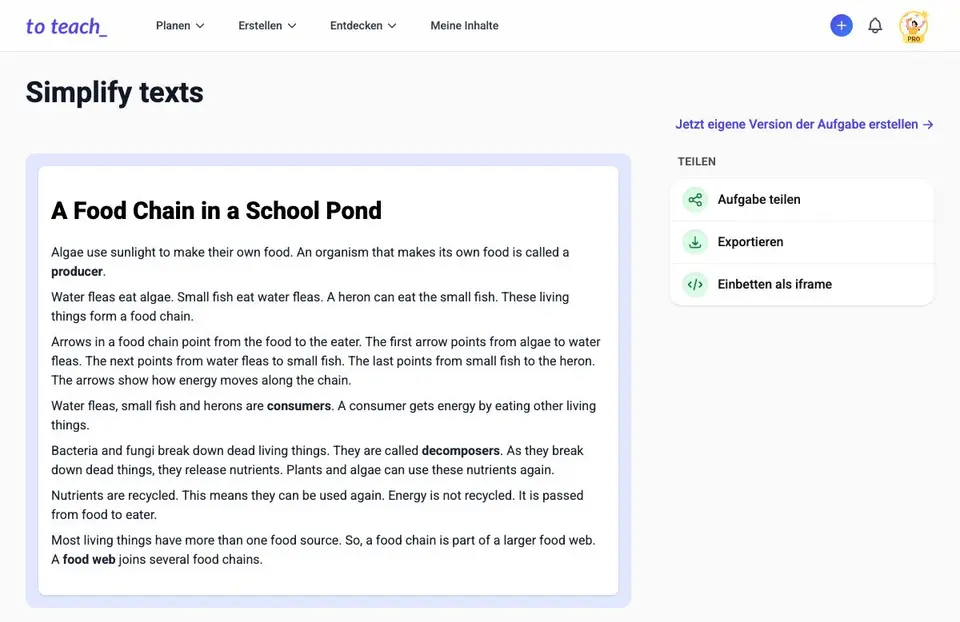
Read the finished PDF-to-reading example — full view
Choose the part of the PDF that serves your lesson
A document may contain a reading passage, diagrams, questions and teacher notes. Decide which part learners need before generating a new text. If the lesson asks them to explain a food chain, focus on the passage that describes feeding relationships rather than treating every page as equally relevant.
Our source begins: “Algae use sunlight to make their own food. Water fleas eat algae. Small fish eat water fleas, and a heron can eat the fish.” It then explains arrow direction, producers, consumers, decomposers and food webs. Those ideas form the checklist for the adapted reading.
If you need only one passage from the PDF, copy that passage into a Text source and keep the PDF available for comparison. For your own PDF, inspect headings, tables and any diagram labels that carry meaning. A readable paragraph about a diagram does not automatically replace the diagram. Keep the original visual beside the new text when learners need it to answer the question.
Add the PDF and specify the reading task
Open the source panel in Material Tools and choose Document to add a PDF. A document already in your saved materials can be selected again. We used school-pond-source.pdf for this example. Select Simplify texts, choose English and use the Easy setting as the starting point.
In the optional instruction field, give the age, the reading purpose and what must remain. Our instruction requested short sentences, explanations of producer, consumer and decomposer, and the original food-chain sequence: algae → water fleas → small fish → heron. We also asked to keep the difference between recycled nutrients and transferred energy.
Name any headings, numbered steps or lists that the rewritten reading should keep, then check their order in the result. This is more useful than “make it easy.” It gives you specific features to look for in the result. It also tells the tool that an important subject term should be explained rather than replaced with a vague everyday word.
Compare the result with the source
The resulting reading separates the ideas into short paragraphs. Its first paragraph explains that algae make their own food using sunlight and names them as producers. Another explains consumers. The decomposer paragraph names bacteria and fungi, describes what they break down and follows the nutrients back to plants and algae.
We checked three details before keeping it. First, the arrows still point from food to eater. Second, the reading distinguishes the three organism roles. Third, it says that nutrients can be used again while energy passes along the chain. The final paragraph connects individual chains to a food web.
The adapted version is longer than the original because it explains terminology and spells out the arrows. That suits this reading task. If your class needs a shorter passage, ask for a more compact version while naming the ideas to retain, then check those ideas again.
Give both reading groups the same question
Use the original PDF with one group and the adapted reading with another. Ask both groups to draw the four-organism food chain and explain one arrow. A useful sentence frame is “The arrow points from … to … because …”. The shared question lets the groups discuss the same relationship even when their reading support differs.
Then ask each learner: “What is recycled in this pond system, and what is transferred along the food chain?” This checks the distinction that can disappear if the class concentrates only on naming organisms. Use an answer from the reading as evidence, rather than accepting a list of the three organism roles.
Place the reading in the relevant phase of your lesson plan. If you need a separate task sheet, use the worksheet tool for the diagram and explanation prompts. The reading and the task should support the same outcome.
Keep the PDF and the adapted reading together
The output is a new reading, not an edited copy of every element in the original PDF. Keep the source available while you review names, numbers, labels and relationships. Check the actual layout you intend to give the class, especially if a table or image is needed alongside the text.
If your source is already plain text, follow the text-simplification guide. If you are preparing a language task at CEFR level A2 or B1, the vocabulary adaptation guide shows a different set of editing decisions. For a PDF reading task, start with the document and preserve the evidence learners need.
Bereit, diese Idee in eigenes Unterrichtsmaterial umzusetzen?
Schließe dich tausenden Lehrkräften an und bereite deinen Unterricht mit KI schneller, differenzierter und kreativer vor.
DSGVO-konform · In 30 Sek. startklar · Keine Kreditkarte nötig
Du interessierst dich für eine Schullizenz? Beratungsgespräch vereinbaren