Adapt the vocabulary of a PDF for an English lesson
A useful science reading can be too demanding in English even when pupils understand the topic. In to teach, select your PDF as the source for Adapt vocabulary, choose A2 or B1 and specify the subject terms pupils need to keep. The result is a new reading text you can use alongside the original document.
Our example uses a one-page PDF about a school pond. The teaching task is to explain who eats whom and what happens to nutrients when organisms die. Producer, consumer and decomposer therefore belong in the adapted reading, with explanations beside them.
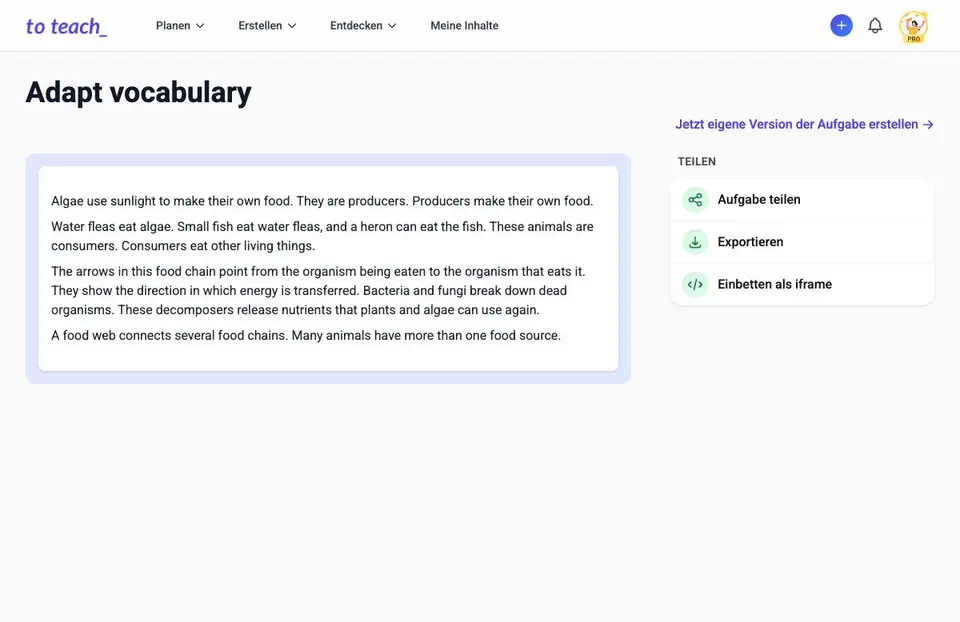
Read the adapted English version — full view
Select the document and the language target
Open Adapt vocabulary, then use the source panel to choose Document. Add your PDF, or select a document you have already saved. We used school-pond-source.pdf, the same original document used in the crossword and quiz examples.
The current tool offers A2 and B1 settings and a separate output-language selector. We selected A2 and English. Those settings guide the rewrite; the teaching decisions come from the words and relationships you ask it to preserve.
For this reading, we asked for short connected paragraphs for pupils aged 11–12. We named producer, consumer and decomposer, the sequence algae → water fleas → small fish → heron, and the distinction between energy moving through the chain and nutrients being used again.
Keep the vocabulary that carries the science
The first result made the sentences shorter and explained producers and consumers. It described bacteria and fungi breaking down dead plants and animals, but left out the word decomposer. That would make a later task asking pupils to identify decomposers unnecessarily difficult.
We used the AI revision control to restore the term and its explanation. We also changed “Most living things eat more than one kind of food” to “Many animals have more than one food source.” The second wording avoids treating plants as animals that eat other organisms.
The finished passage includes a food-web definition and explicit explanations of producer and consumer. The finished passage now says: “Bacteria and fungi break down dead organisms. These decomposers release nutrients that plants and algae can use again.” It also explains that arrows point from the organism being eaten to the organism that eats it.
Compare those relationships against the PDF, not just the sentence length. An adaptation that removes a target term needs a different edit from one that reverses a food-chain arrow. Here, we kept the scientific vocabulary and made its meaning visible in the surrounding sentences.
Use both readings for one classroom task
Give pupils the original PDF or the adapted passage according to the language support they need. Ask everyone to draw the same four-organism food chain and label the producer and consumers. Then ask where bacteria and fungi fit into the explanation: they break down dead organisms and release nutrients.
For a short individual check, ask pupils to explain one arrow in words and complete this sentence: “Nutrients can be used again because …”. These questions require the relationships in the reading, rather than a list of definitions copied without context.
Place the reading before the explanation or diagram phase in your lesson plan. The original and adapted readings support a shared discussion and the same final task.
Choose the workflow that matches your source
This workflow rewrites the document’s text; it does not reproduce the PDF’s original page design. Our finished example is a connected reading, with the source document kept separately for comparison.
If your source is already plain text, use the text vocabulary-adaptation guide. For broader simplification rather than an A2 or B1 language target, see how to turn a PDF into a clear classroom reading.
Bereit, diese Idee in eigenes Unterrichtsmaterial umzusetzen?
Schließe dich tausenden Lehrkräften an und bereite deinen Unterricht mit KI schneller, differenzierter und kreativer vor.
DSGVO-konform · In 30 Sek. startklar · Keine Kreditkarte nötig
Du interessierst dich für eine Schullizenz? Beratungsgespräch vereinbaren