Create a multiple-choice quiz that checks pupils’ understanding
A useful classroom quiz tells you which idea to revisit. With to teach, you can create a multiple-choice quiz from the text your pupils are reading, then refine the questions and answer options before sharing it. Here we build four questions about a pond food chain and improve two details in the generated draft.
Open the four-question quiz. It checks arrow direction, producers, nutrient uptake and the difference between a food chain and a food web.
Open the four-question quiz — full view
The source: a school pond food chain
Algae use sunlight to make their own food. Water fleas eat algae. Small fish eat water fleas, and a heron can eat the fish. The arrows in this food chain point from the organism being eaten to the organism that eats it. They show the direction in which energy is transferred. Algae are producers. Water fleas, fish and herons are consumers. Bacteria and fungi break down dead organisms. These decomposers release nutrients that plants and algae can use again. A food web connects several food chains because most organisms have more than one food source.
Give each question a job
Before generating, write down what you want to learn from the answers. In this example: can pupils explain an arrow, recognize a producer, identify who directly takes up released nutrients, and distinguish one feeding sequence from a web? Those are four separate decisions. Four versions of “What do fish eat?” would tell you much less.
Create the first version
Create a multiple-choice quiz in to teach and add the passage as a Text source.
Create a multiple-choice quiz in to teach
Select Multiple Choice, choose English and set the number of questions to four.
Describe the class and the four ideas to check. Ask for exactly one correct answer and three plausible distractors per question.
Create the quiz, then read every question and all four options before using it.
Our brief specified pupils aged 10–12, the four concepts above, short answer options and no trick wording. We also asked for common misconceptions, such as reversing the food-chain arrow, to inform the incorrect answers.
Look at the first question
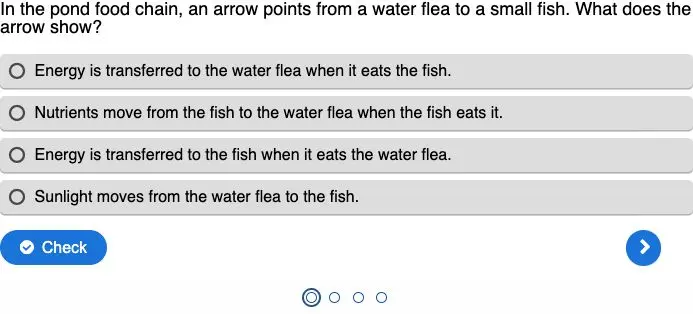
“In the pond food chain, an arrow points from a water flea to a small fish. What does the arrow show?” The correct answer is “Energy is transferred to the fish when it eats the water flea.” An option that reverses the transfer gives you something specific to discuss if pupils select it.
After pupils answer, ask one of them to explain why the arrow points towards the fish. You can use the same question at the end of the lesson, after tracing another feeding relationship together.
Edit ambiguity out of the nutrient question
The generated question asked what could happen to nutrients after decomposition. One incorrect option said they could be used again by herons. That is a poor distinction: nutrients can eventually reach a heron through its food. We changed the question to “According to the passage, which organisms can directly use the nutrients released by decomposers?”
The revised correct answer is “Plants and algae.” The other options pair pond animals. Adding “directly” and tying the question to the passage makes the intended distinction explicit. Use “Revise with AI” to clarify an ambiguous question, then check that the revised options still contain exactly one correct answer.
Do not make the correct answer the obvious one
In the food-web question, the first correct answer was a long explanation while several distractors were much shorter. We shortened it to “Several connected feeding sequences.” The other options became “One straight feeding sequence”, “Only the largest pond animals” and “Only the organisms that make food”. Pupils now have to compare meanings instead of spotting the most detailed sentence.
For your own quiz, check that options use a similar grammatical form, that only one is correct under the wording of the question, and that the source supports the answer. Read the question without the options once: it should still make sense.
Use the answers to choose the next activity
If pupils reverse the arrow, redraw one feeding relationship and explain it aloud. If they confuse producers and consumers, sort the organisms by how they obtain food. If the vocabulary itself is the barrier, use the companion crossword before returning to the explanation. The purpose is to decide what to teach next, not just collect four marks.
Share and reuse the material
The interactive quiz includes answer checking and a solution view. The editor also offers a download menu and a spreadsheet download for importing the quiz into Kahoot. Choose the format your lesson needs and inspect that export before distributing it. Keep solution files separate from pupil copies.
The example was created in a signed-in to teach account. You can keep its source in the same material session, create a follow-up activity and add materials to a worksheet. For another biology context, browse the biology content collection. If your source is a document, use the PDF-to-quiz guide.
Bereit, diese Idee in eigenes Unterrichtsmaterial umzusetzen?
Schließe dich tausenden Lehrkräften an und bereite deinen Unterricht mit KI schneller, differenzierter und kreativer vor.
DSGVO-konform · In 30 Sek. startklar · Keine Kreditkarte nötig
Du interessierst dich für eine Schullizenz? Beratungsgespräch vereinbaren