
Create a classroom comparison table from a text
A comparison table helps pupils put evidence from a reading side by side. In to teach, add the passage as a Text source, choose Table and name the columns you need in the instruction field. Start with the question pupils must answer: that question determines which information belongs in the table.
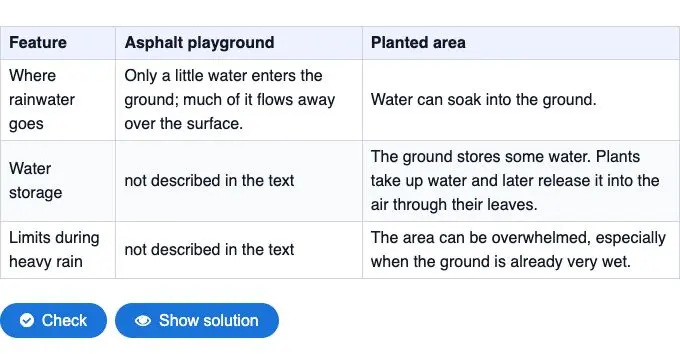
This example compares rainwater on an asphalt playground with rainwater on a planted area. The finished table has three rows: where the water goes, how it is stored and what happens during heavy rain. Use it to move from finding information in a text to explaining a difference.
Open the finished English table — full view
Choose a comparison the source can support
A useful table compares the same features across its columns. “Asphalt playground” and “Planted area” work as column headings because the passage describes both surfaces. “Good” and “Bad” would turn a description into a judgement before pupils have examined the evidence.
Our short German source says that, on an asphalt playground, little water enters the ground and much flows over the surface. On planted ground, water can soak into soil; soil stores some of it, plants take it up and later release water through their leaves. The final sentence adds a limit: even planted ground can be overwhelmed during heavy rain, especially when the soil is already wet. The English output keeps that qualification.
The source passage and an English classroom version
This example uses German input and English output. Here is the passage for this comparison, followed by an English translation for the reading activity.
Nach einem Regenschauer fließt Wasser auf verschiedenen Wegen ab. Auf einem asphaltierten Schulhof kann nur wenig Wasser in den Boden eindringen. Ein großer Teil fließt über die Oberfläche ab. Auf einer bepflanzten Fläche kann Wasser in den Boden versickern. Der Boden speichert einen Teil davon; Pflanzen nehmen Wasser auf und geben es später über ihre Blätter an die Luft ab. Auch eine bepflanzte Fläche kann bei starkem Regen überlastet sein, besonders wenn der Boden bereits sehr nass ist.
English translation:
After a rain shower, water flows away along different routes. On an asphalt playground, only a little water can enter the ground. Much of it flows over the surface. In a planted area, water can soak into the soil. The soil stores some of it; plants take up water and later release it into the air through their leaves. A planted area can also be overwhelmed during heavy rain, especially when the soil is already very wet.
Set the columns and the evidence rule
Open Material Tools, add your passage through Text, then choose Table from the format selector. Select the output language. In the instruction field, specify both the column headings and the features to compare. For this comparison, specify Feature | Asphalt playground | Planted area, with rows for water movement, storage and limits during heavy rain.
Ask the tool to use only the source, add no quantities and write “not described in the text” where information was missing. That matters here: the passage describes storage in planted soil, but gives no comparable storage detail for asphalt. An empty evidence gap should not silently become “zero storage”.
Create a table from your teaching text
Read across a row before accepting it
The generated table places surface runoff opposite water soaking into the ground. In its storage row, the asphalt cell says “not described in the text”; the planted-area cell explains storage and plant uptake. The heavy-rain row retains the already-wet-ground condition. These are the three checks to make against your own reading: comparable features, no invented facts and no lost qualifications.
The storage cell also mentions water returning to the air through leaves. For a class still learning the processes, use that detail to distinguish storage from release rather than treating everything in that cell as storage. You could request separate rows for those processes when that distinction is your lesson goal.
Let pupils explain the pattern
During the reading phase, ask pupils to highlight one source sentence for each row. In pairs, they then explain which cells contain evidence and which record a gap. “Not described” means the passage does not tell us; it does not mean the process cannot occur.
For the class discussion, ask: Why can a planted playground take in rainwater, yet still be overwhelmed? A complete answer uses both the water-movement row and the wet-soil condition. Finish with one independent sentence linking the comparison to the source. This gives the table a purpose beyond copying information.
Keep the passage beside the table. If language is the obstacle, prepare a simpler reading while keeping the same comparison question. In a lesson unit, place the source reading and comparison in the appropriate lesson phase, then create any further materials for the explanation or review phase.
Bereit, diese Idee in eigenes Unterrichtsmaterial umzusetzen?
Schließe dich tausenden Lehrkräften an und bereite deinen Unterricht mit KI schneller, differenzierter und kreativer vor.
DSGVO-konform · In 30 Sek. startklar · Keine Kreditkarte nötig
Du interessierst dich für eine Schullizenz? Beratungsgespräch vereinbaren