
Create flashcards from a text: build a set your class can actually use
Start with what students should be able to explain, then turn the relevant terms from your text into a short flashcard set. In to teach, you can supply the source, choose the explanation style and specify the number of cards. A useful set gives each card one clear job: a term to recall, a distinction to explain or a question to answer.
For a lesson about food chains, that means choosing the concepts students need for the next task. A card for “food web” helps them explain why several chains connect. A card that asks them to reproduce an entire paragraph is much harder to use in a quick pair activity.
Open the four pond flashcards in full view
Choose the knowledge the cards should support
Read your source once before generating. Mark the terms students will need later, including any subject vocabulary you want to keep. In a school-pond reading, a focused set might cover algae, water fleas, food chain and food web. The aim is to prepare students to explain relationships between organisms, not just collect four definitions.
Keep closely related concepts together so pupils can compare them. After revising “food chain” and “food web”, ask what a web shows that a single chain does not. That question turns the cards into preparation for an explanation.
Use the original passage
Water plants and algae grow in the school pond. They use sunlight to make their own food. Water fleas eat algae. Small fish eat water fleas. A heron can eat the small fish. The arrows in a food chain point from the organism being eaten to the eater: algae → water fleas → small fish → heron. This shows the direction in which energy is transferred. A food web connects several food chains because many animals have more than one food source.
Add the source and set up the flashcards
Open Material Tools, add your text as the source and choose Flashcards. Set the output language to the language students will use in the lesson. Choose the number of cards, then use the instruction field to name the concepts you want the set to cover.
The difficulty options change the kind of explanation. The tool describes the easiest option as simple explanations, the middle option as explanations for students and the hardest option as definitions of the term. Choose the wording your class needs; a more formal definition is not automatically a more demanding classroom task.
For the pond example, try an instruction such as:
Create four English flashcards for algae, water fleas, food chain and food web, using the source text. Keep each explanation short. Preserve the distinction between a single food chain and a food web. Do not add facts that are absent from the source.
What the finished set contains
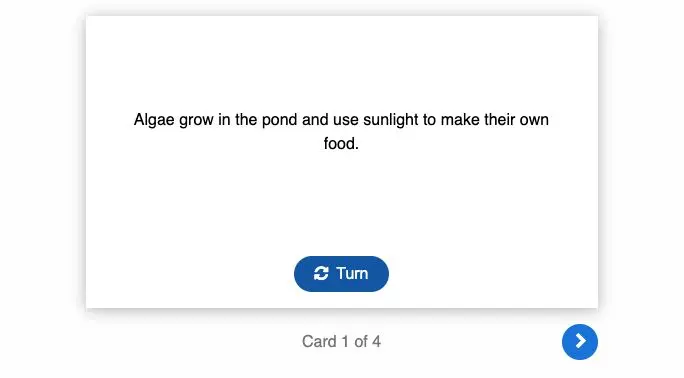
The example has four cards: algae, water fleas, food chain and food web. The food-chain card explains who eats whom in one line and gives the arrow direction. The food-web card explains why several chains connect. Keep both: they prepare students to compare two different ways of representing feeding relationships.
Edit for a useful answer
Check the cards against your source. Look especially for definitions that use another unfamiliar term: a pupil who cannot explain “organism” may need a concrete example before that word helps them define a food chain.
Keep the question or term precise and the explanation short enough to compare with a spoken answer. If two cards repeat the same idea, specify the missing distinction in your generation instructions and check the new set. If a card contains several facts, decide which one students should recall first.
For this topic, also check the direction of the arrows in any accompanying food-chain explanation. Students should be able to explain what an arrow means, not only name the animals on either side of it. Keep that as a follow-up task rather than hiding a whole explanation in a long card.
Use the cards between reading and application
Give students the source passage first. Then let pairs take turns saying an explanation before revealing the card. The partner checks whether the essential idea is present and asks for an example when the answer is vague. Have each pair write down the terms they cannot yet explain, then return to those cards for a second round.
After the cards, return to the lesson’s application task: draw a pond food chain, explain the arrows and show how it could connect to another chain. This keeps vocabulary practice attached to the content students are learning.
In a later lesson, reuse selected cards before the next reading or practical task. Choose the terms students still need rather than adding a new set simply because another source is available.
When your source is a PDF
A PDF often contains more than the passage you want: page headings, captions, glossaries and several topics. Select a coherent section and decide which concepts deserve cards before generating the set. Check every definition against that section, especially where diagrams or tables carry part of the meaning.
Choose the source: pasted text, a webpage or a printed page
For a selected passage, choose Text in the source picker and paste only the reading your class will use. Keep a caption if the explanation depends on it. For an online article, the source picker also offers Website with a URL field. These are two different starting points: a passage you have selected yourself, or text imported from a page.
Before generating from an imported source, check that the article text is actually available. If the page does not import, use the Text option for the passage you want. Leave out menus, related-story headlines and newsletter prompts. Keep the source title and original URL with your lesson notes so you can return to its context.
The picker separates Image from Text from image. Use Text from image for a photograph or scan of printed words; use Image when the picture itself is the source. With extracted text, compare subject terms, numbers and symbols with the original. A missing arrow in the pond passage changes the relationship the flashcards are supposed to explain.
Keep the full source available during the card activity. A definition card can support recall, but a diagram or a passage may contain the evidence needed to explain the relationship. After turning the food-web card, have pupils find the sentence explaining why food chains connect. Then provide a branching food-web diagram and ask them to identify an organism with more than one food source.
Bereit, diese Idee in eigenes Unterrichtsmaterial umzusetzen?
Schließe dich tausenden Lehrkräften an und bereite deinen Unterricht mit KI schneller, differenzierter und kreativer vor.
DSGVO-konform · In 30 Sek. startklar · Keine Kreditkarte nötig
Du interessierst dich für eine Schullizenz? Beratungsgespräch vereinbaren