
Create flashcards from a webpage: choose the reading, then build the set
Create flashcards from a webpage by selecting the passage your class is reading, adding it as a source in to teach and choosing Flashcards. A short, named section gives you a more focused revision set than an entire page with menus, related stories and several topics. This example turns three entries from NOAA’s water-cycle page into three cards.
Choose the reading before the card count
NOAA’s water-cycle page covers storage, changing states, movement and human activity. For a lesson on water moving between liquid and vapor, use the entries Evaporation, Transpiration and Condensation under “From liquid to vapor and back again.” Leave the later sections out of this set.
Open NOAA’s original water-cycle page
This selection gives each card a clear job: explain a process and retain a concrete detail from the assigned reading. It does not ask pupils to recall information from an unrelated part of the webpage. Keep the original link with the activity so pupils can return to the evidence.
The finished three-card set
Try the three webpage-based flashcards
Evaporation
Liquid water turns into water vapor when it takes in energy, such as energy from the sun, the air, or our body heat.
Transpiration
Water that plants take in through their roots can leave as water vapor from their leaves. This is called transpiration.
Condensation
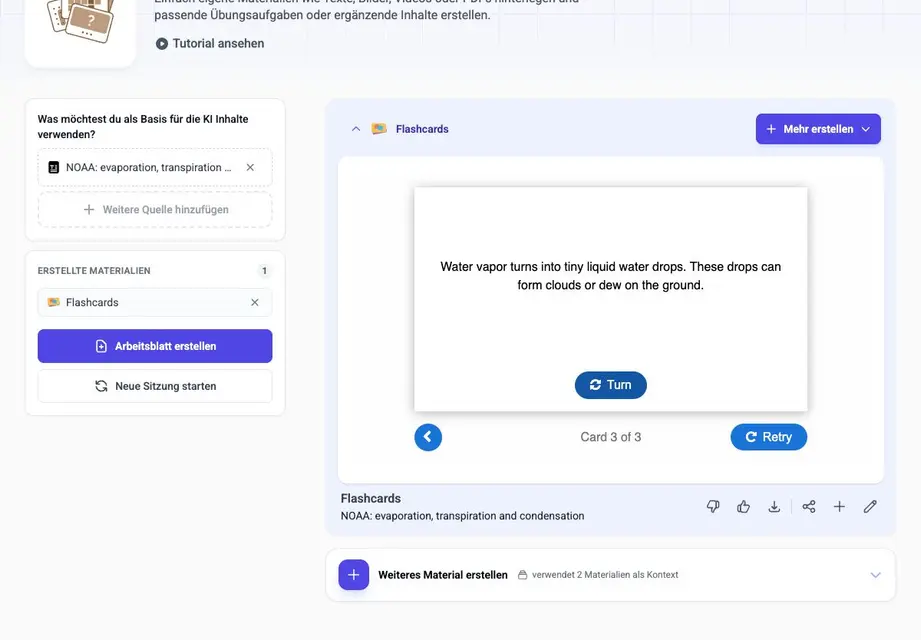
Water vapor turns into tiny liquid water drops. These drops can form clouds or dew on the ground.
The cards shorten the reading while keeping different kinds of detail: energy sources, the route through a plant, and visible examples of liquid droplets. They do not reproduce every sentence. For condensation, the original also explains when it happens; return to that sentence if your lesson includes the conditions for condensation.
Add the webpage passage to to teach
Use the source control to add material. You can choose Website and enter a URL. If the page does not import, select the relevant passage in your browser and add it through Text instead. The example here was created through Text from the three selected NOAA entries.
Give the source a title you will recognise, paste the passage with its three headings, and save it. Check that the start and end of each entry are complete. Leave out navigation, advertisements and unrelated recommended articles. Keep the publisher and original URL in your lesson notes; pasted text alone does not preserve all the context of the webpage.
Choose English and Easy. In the task instructions, request exactly three cards: Evaporation, Transpiration and Condensation. Ask for a concise explanation of each, using only the supplied passage, with the energy sources, roots and leaves, and clouds or dew retained. Generate the set and read both sides of every card.
Check what shortening removed
Compare each answer with its matching source entry. The evaporation card preserves energy from the sun, air and body heat. The transpiration card keeps both roots and leaves, so it describes a connected process rather than just naming plants. The condensation card keeps the change from vapor to liquid and the examples clouds and dew.
Decide whether an omitted detail belongs in the recall task or in a follow-up question. Here, ask pupils to find the condition for condensation in the original passage after they have explained the card. That gives them a reason to return to the reading without turning every card into a paragraph to memorise.
Use the set after reading
First let pupils read and annotate the selected entries. Then show one card front and ask them to explain the process before turning it over. After checking, have them identify which sentence in the source supports the answer. Accept accurate explanations in their own words.
Finish by pairing Evaporation with Condensation: pupils explain how their starting and ending states differ. Add Transpiration and ask how it connects to evaporation. The three terms become a comparison, rather than three isolated definitions.
If you later add another section of the webpage, make a separate set or deliberately revise the task. Recheck the source before reusing it with a new class: online pages can change, and a previously selected paragraph may no longer sit under the same heading.
Ready to turn this idea into your own lesson material?
Join thousands of teachers who use AI to prep faster, differentiate more easily, and teach more creatively.
GDPR compliant · Ready in 30 sec · No credit card required
Interested in a school license? Book a consultation