
Create flashcards from a PDF: turn a class reading into focused revision
A PDF reading already contains the material your class needs to revisit. In to teach, add the document as your source, choose Flashcards, then set the language, explanation level and number of cards. Specify the concepts you want learners to recall instead of asking for a card for every sentence.
This example uses a short reading about a school pond. The four cards cover producer, consumer, decomposer and food web. They give pupils a way to rehearse the vocabulary before explaining how organisms are connected.
Open the four PDF flashcards in full view
Choose a reading with a clear revision purpose
Start with the passage your class has studied. For a long document, decide which section matters for the next activity and identify the terms it introduces. A focused set is easier to use in a lesson than a collection that mixes definitions, background facts and unrelated chapters.
Our pond reading distinguishes organisms that make their own food, organisms that eat other living things and organisms that break down dead material. Those differences are the point of the card set. Individual animal names are examples within the explanations, rather than four separate facts to memorise.
Add the PDF and set up the cards
Open the Material Tools and select Document as the source type. Upload the PDF, then choose Flashcards. If you have already saved the source, select it from your saved materials; the example uses school-pond-source.pdf.
Create flashcards from your PDF in to teach
Choose English and four cards. For this set we selected the simple explanation level. The level control changes the style of the explanation: simple explanations, explanations for pupils or definitions. Choose the level that suits the reading and your class, then describe the concepts you want included.
Create four flashcards based only on the PDF: producer, consumer, decomposer and food web. Use short explanations for a class revising the pond food chain. Include an example organism from the document where helpful. Keep the difference between energy transfer and nutrient recycling clear.
Compare the generated cards with the document
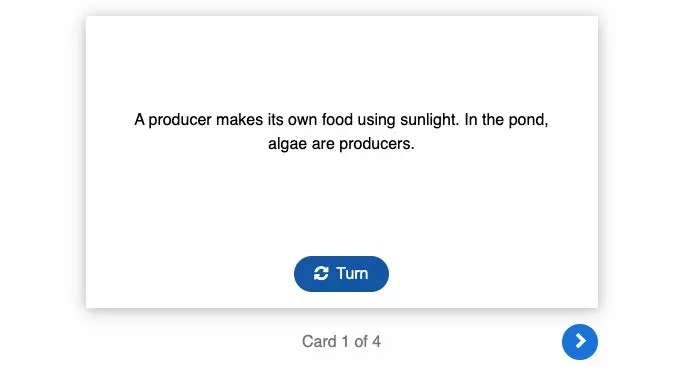
The producer card explains that producers make their own food using sunlight and identifies algae as the pond example. The consumer card describes feeding on other living things, using water fleas eating algae and fish eating water fleas.
The decomposer card needs particular attention. Its explanation names bacteria and fungi, describes the breakdown of dead organisms and says that released nutrients can be used again. It then distinguishes recycled nutrients from energy transferred along the food chain. That distinction is more useful than a vague statement that everything in the pond is recycled.
The final card defines a food web as connected food chains and links this to organisms having more than one food source. Compare that explanation with the original passage before using the cards with the class.
Read every front and back. Check that each card explains an essential term in language your class can use. If a card covers unrelated ideas, revise the generation instructions so each card has one focus, then check the new set. Where a PDF relies on a diagram or table, check the original visual too; a short definition should not stand in for the relationship pupils need to explain.
Use the cards between reading and application
After reading the PDF, pupils work in pairs. One explains the term before turning the card. The partner checks for the central idea and asks for a pond example. Swap roles for the next card, then revisit the terms that needed a prompt.
Follow the card round with a task that uses the distinctions: draw a pond food chain, label the producer and consumers, and explain where decomposers fit. Ask why a food web can show more feeding relationships than one chain. The cards support this explanation; they do not replace it.
For a class that needs shorter responses, ask for one defining feature and one example. For pupils ready to go further, ask them to explain what would be missing from the model if decomposers were left out. You can use the same source and vocabulary while changing the demand of the follow-up question.
Build the next material from the same source
Keep the PDF as the common reference for the lesson. A brief quiz can check whether pupils can identify the roles without the cards, while a written explanation shows whether they can connect the terms. Select the format for the phase: reading first, vocabulary rehearsal next, then an explanation or comprehension check.
Create a multiple-choice quiz from the same PDF
Ready to turn this idea into your own lesson material?
Join thousands of teachers who use AI to prep faster, differentiate more easily, and teach more creatively.
GDPR compliant · Ready in 30 sec · No credit card required
Interested in a school license? Book a consultation