Create a classroom chat from a text: turn reading into a discussion
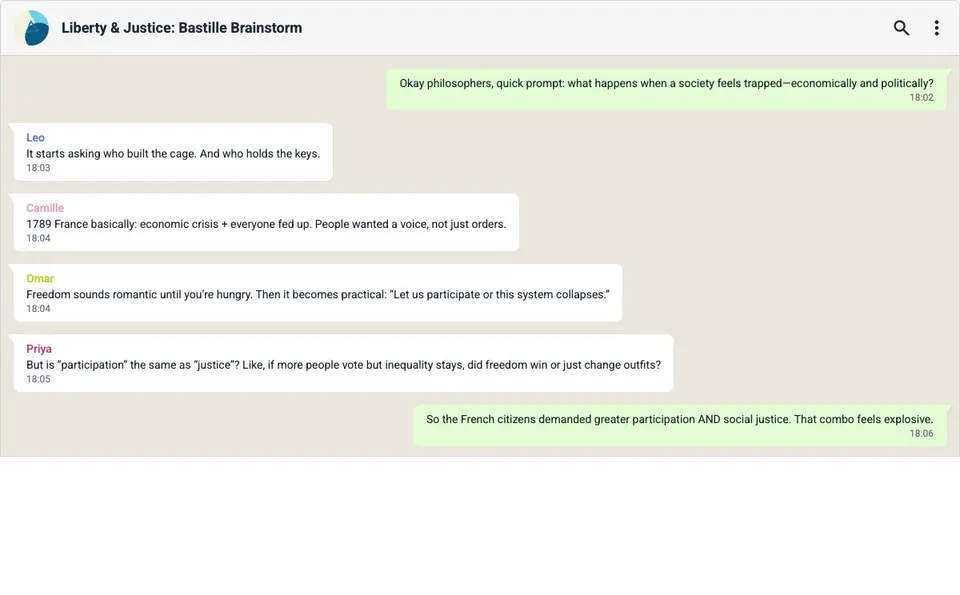
A simulated group chat turns a passage into short contributions from different speakers. In to teach, choose the Whatsapp Chat format, add your text and describe the discussion you want. Use the result after a first reading: pupils compare what the speakers say with the source, identify an interpretation and write a reply of their own. The example below turns a short French Revolution overview into a discussion about freedom and justice.
Read the source before the conversation
The source names an economic crisis, demands for participation and social justice, and three events: the storming of the Bastille, the Declaration of the Rights of Man and of the Citizen, and the fall of the monarchy. The chat expands those points into a fictional discussion. Its named speakers are invented; their messages are not historical quotations. Give pupils the source alongside the chat so that they can distinguish a statement supported by the passage from an opinion added by a speaker.
Read the classroom chat — open in full view
The source passage
The French Revolution began in 1789 amid economic crisis and widespread dissatisfaction. Citizens demanded greater participation and social justice. Key events included the storming of the Bastille, the Declaration of the Rights of Man and of the Citizen, and the fall of the monarchy.
Try one exchange with the class
Priya asks: “But is ‘participation’ the same as ‘justice’?” Ask pairs to underline the words in the source that prompted that question. Then ask them to explain what the question adds. The source lists participation and social justice as demands; it does not settle whether one guarantees the other. Pupils can write a two-sentence response: their position first, followed by a reason. Keep those responses on paper or in your usual classroom workspace; the example is a fictional conversation to read; pupils cannot post replies in it.
Model the distinction with two messages. “People wanted a voice” restates the source’s demand for greater participation. “The old structure couldn’t survive the new idea of legitimacy” offers a cause for the fall of the monarchy that the passage does not give. Label the first as supported by the passage and the second as an explanation to investigate. Ask pupils to find an additional source before accepting that explanation.
Create a chat for your own reading
Open Whatsapp Chat in Material Tools and add the passage as your source. Choose the output language. In the optional task instruction, specify the speakers, the question they should discuss and the language level your pupils need. For example: “Write a fictional discussion between three pupils about whether greater participation always creates greater fairness. Use the supplied passage. Keep the messages short. Make one speaker ask for evidence and end with an unanswered question for the class.” Create the chat, then read the complete conversation beside the source.
Decide which messages earn their place
The example contains twenty messages. For a brief lesson opening, use one exchange rather than asking the class to read the whole conversation. For a reading phase, choose a longer section and give each pair a question to follow. The opening “who built the cage” metaphor can invite discussion, but it adds a figurative layer to an already demanding subject. If your aim is checking factual understanding, ask for direct language instead. If your aim is interpreting language, ask pupils what the metaphor suggests and which part of the source supports that reading.
Keep interpretation and explanation separate
A lively response can sound like an explanation even when the source does not establish it. Near the end, the example connects the fall of the monarchy with a new idea of legitimacy. The short source only lists the fall as a key event; it does not explain its causes. Turn that assertion into a research question: ‘What factors contributed to the fall of the monarchy?’ Give pupils an additional historical source and ask whether it supports the chat’s explanation. Likewise, the date 1789 marks the beginning in the source, not a date supplied for every event listed. For a chronology task, provide a dated timeline rather than asking pupils to infer one from chat order.
Place the chat between reading and writing
Start with the shared passage and a clear question. Use the chat during the discussion phase: one pupil reads a message; another identifies what the passage supports, what the speaker interprets and which factual claims need another source. Finish with an individual response to the same question, using a detail from the passage. In a to teach lesson plan, that gives the chat a specific role between the source reading and the final written explanation.
Ready to turn this idea into your own lesson material?
Join thousands of teachers who use AI to prep faster, differentiate more easily, and teach more creatively.
GDPR compliant · Ready in 30 sec · No credit card required
Interested in a school license? Book a consultation