
Turn a text into a classroom script: keep the story, change how it is told
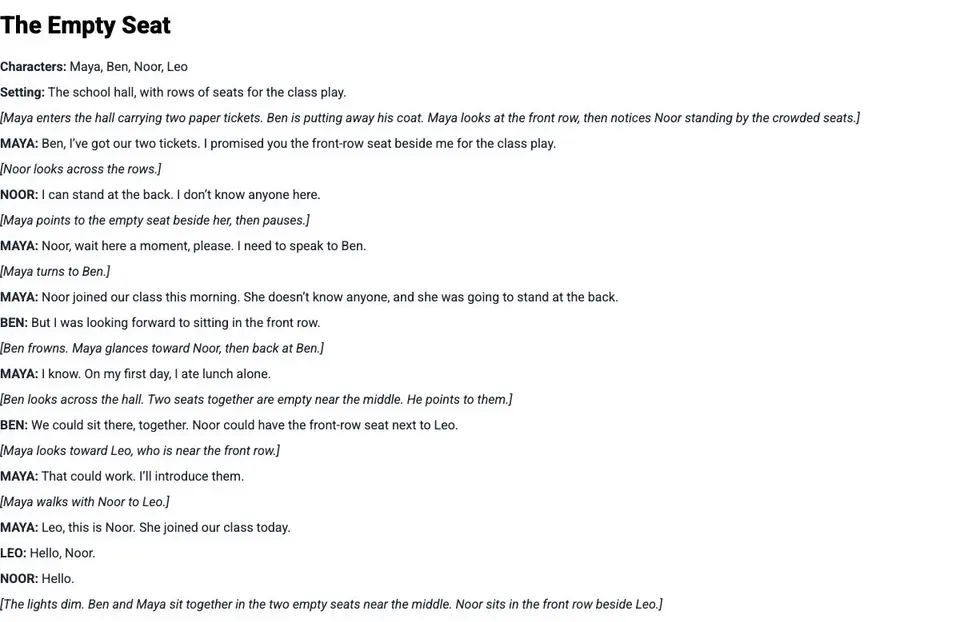
To turn a reading into a classroom script, keep its events and decisions, then express them through spoken lines and actions. In to teach, add the reading, choose the script format and specify the roles. The worked example starts with an editable story, shows a revision for performance, and then uses an image of the same reading to create the finished four-role scene below.
Read the scene, then return to the story
The Empty Seat is an original fictional reading written for this example. Maya has promised her brother Ben a front-row seat beside her. When a new classmate needs somewhere to sit, Ben proposes a compromise. Use the script below for a small-group reading, then ask: which part of the promise is kept, and which part changes?
The original reading
The empty seat Maya reached the school hall carrying two paper tickets. She had promised her younger brother Ben the front-row seat beside her for the class play. At the door, she found Noor looking at the crowded rows. Noor had joined the class that morning and did not know anyone. Maya pointed to the empty seat beside her, then stopped. Ben was still putting away his coat. Noor said she could stand at the back. Maya remembered her own first day, when she had eaten lunch alone. She asked Noor to wait while she spoke to Ben. Ben frowned when Maya explained, because he had been looking forward to sitting at the front. Then he noticed two empty seats together near the middle. He suggested that he and Maya sit there, and that Noor take the front-row seat next to their classmate Leo. Maya introduced Noor to Leo. When the lights dimmed, all four were seated. Maya had kept her promise to sit with Ben, although neither of them was in the front row.
Build the script in to teach
Open the text-format tool and add the reading through the source selector. Choose English as the output language and select the script option from the format menu. In the German interface used for this example, that option is called Drehbuch. The format menu also includes interview, diary and short story; the instruction box is where you describe your class, desired length and focus.
Turn your reading into a script
Give the model the decisions it must preserve
For this example, the instruction specified four speaking roles—Maya, Ben, Noor and Leo—and pupils aged 11–12. It also named the events that must stay: the promised front-row seat, Ben’s initial disappointment, his proposed compromise and the final seating. Those details matter more than asking for an engaging script. A scene in which Maya simply finds another front-row seat would remove the reading’s central problem.
Make thoughts audible or visible
The first output included a stage direction saying Maya remembered eating lunch alone on her first day. A reader can understand that sentence, but an audience cannot see a memory. The revised text version turns that memory into speech. In the finished image-based version below, Maya says: “I know. On my first day, I ate lunch alone.” This gives the actor a playable line and gives listeners evidence for Maya’s decision.
Keep the ending open to discussion
The revised scene ends with Maya and Ben sitting in the middle while Noor sits next to Leo in the front row. It does not announce that Maya has kept her entire promise. That leaves pupils with something to interpret. Ben had been promised both company and a front-row seat; the compromise preserves one and gives up the other. Ask groups to support their answer with a line from the story and a line or action from the script.
Use one revision, then compare the versions
The revision request removed an invented time of day, replaced invisible thoughts with speech or observable action, and retained Ben as the person who proposes the solution. In your own scene, check who makes the important decision and whether the ending still follows from the source. The dialogue is newly written for the adaptation; it is not a quotation from the original story.
A lesson sequence using both texts
Start with the prose reading and ask pupils to identify the promise, the problem and the solution. Then give a group the four roles and read the scene aloud. A second group can follow the prose and note where narration becomes dialogue. Finish with a short written answer: “How does Ben change the situation?” Require evidence from both versions. This places the script between reading for understanding and explaining a character’s decision.
When another written format fits better
Choose an interview if pupils need to formulate questions for a character and justify possible answers from the reading. A diary shifts attention to one character’s perspective; pupils should distinguish what the source tells them from what they infer. A script is useful when the class needs to hear how characters respond to one another. Keep the source beside any adaptation so the change of format remains a reading task.
Starting with printed text or a scan
For the image-based version shown above, we uploaded a clear PNG of the same original reading through the Text aus Bild (text from image) option in the German interface. We selected English and the script format, then asked for performable stage directions and the source’s exact promise and compromise. The result retained Maya, Ben, Noor and Leo, the front-row promise, Ben’s proposal and the final seating. Compare those details with the source before using a scene in class. This demonstration used a clean image of typed text; a photographed page may need a clearer crop or better lighting.
Ready to turn this idea into your own lesson material?
Join thousands of teachers who use AI to prep faster, differentiate more easily, and teach more creatively.
GDPR compliant · Ready in 30 sec · No credit card required
Interested in a school license? Book a consultation