Ingeniería genética - Nivel B1

TT
by to-teach Team
7 pagesSpanish learners at B1 levelSpanish, Biology, Sustainable Development Goals (SDG)
Template

Loading preview…

Your worksheet

Write down the type of fruit or vegetable you want to focus on in this worksheet.

Need an idea?

Popular topics from other teachers

How our AI templates work

  • Content gets adapted

    Examples, texts and tasks match your focus.

  • Method & structure stay

    The didactically reviewed structure of the template won't change.

Description

Objective: This worksheet aims to provide students with a basic understanding of genetic engineering and to facilitate a discussion of its advantages and disadvantages, particularly as they relate to fruits and vegetables.


Content and Methods: It explains the basics of genetic engineering and its applications (medicine, agriculture, research). The focus is on genetic engineering in fruits and vegetables, its advantages (pesticide resistance, productivity, nutritional value, climate adaptation), and concerns (environment, health, acceptance, costs). Methods include a prior knowledge assessment, multiple-choice questions, open-ended questions, and expressing an opinion in letter form.


Competencies:

  • Reading comprehension of scientific texts
  • Critical thinking about biotechnology
  • Argumentation and written expression skills


Target audience and level: Spanish learners at B1 level


ESD:

  • SDG 13 (Climate Action): Exploring climate adaptation
  • SDG 15 (Life on Land): Raising awareness of biodiversity conservation

Similar worksheets
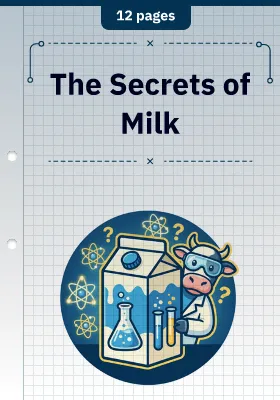
The Secrets of Milk

The Secrets of Milk

Objective: This workbook explores a historical and materials-science phenomenon: the production of casein, an early milk-based bioplastic. Students work as a team of researchers to investigate how the organic components of liquid cow’s milk can be transformed into a solid plastic through the action of acid.


Content and Methods: The content is conveyed through a combination of historical contextualization, experimental laboratory work, and material analysis: Starting with the question of how a solid material can be produced from milk, students explore the composition of milk and the effect of acids on proteins. They then experimentally extract casein, document the course of the reaction, and examine the properties of the resulting bioplastic. Finally, the results are used in a scientific application to evaluate the historical significance and material properties of casein as an alternative to plastic.


Competencies:

  • Technical expertise: Understanding of protein denaturation (acid precipitation of milk protein/casein) and the classification of galalith as a historical bioplastic
  • Knowledge acquisition: Planning, conducting, and systematically documenting a preparative organic chemistry experiment (filtration, solid isolation)
  • Materials and testing skills: Criteria-based analysis of the physical properties of a self-produced solid
  • Argumentation and language skills: Writing a technically sound report using precise scientific explanations


Target audience and level: Middle school

BiologyChemistry
The Green Battery

The Green Battery

Objective: This worksheet explores the electrochemical fundamentals of galvanic cells and how a lemon battery works in the context of modern, sustainable technology development. Students take on the role of a startup research team to experimentally and ecologically evaluate the suitability of a lemon as an environmentally friendly electrolyte, as well as the efficiency of various electrode pairings.


Content and Methods: The content is taught by combining theoretical fundamentals, experimental data collection, error analysis, and sustainability assessment: First, students explore the structure and functioning of electrochemical cells as well as the underlying redox reactions. They then test their hypotheses in an experiment, document measurement data, and analyze typical sources of error in the laboratory. Finally, they evaluate the performance and sustainability of various materials before summarizing their results in a technical report and a persuasive presentation.


Competencies:

  • Technical Competence: Understanding of redox reactions, electrode potentials, and the role of electrolytes in generating electrical power
  • Data Analysis: Conducting quantitative electrochemical measurements, systematically comparing variables, and identifying sources of methodological error
  • Evaluation Competence: Balancing maximum technical performance with environmental factors (extraction, recycling, toxicity) in the context of sustainable chemistry
  • Communication skills: Targeted, audience-oriented presentation of laboratory data for a business analysis or an investor pitch


Target audience and level: Middle School

BiologyChemistry