to teach logo
Sign up

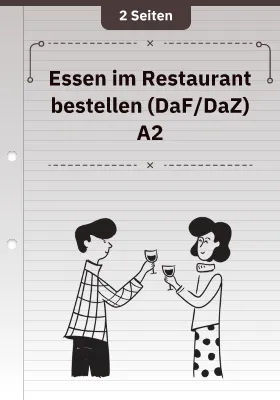
Essen bestellen im Restaurant (DaF/DaZ - A2)

TT
by to-teach Team
2 pagesDeutschlernende auf A2-NiveauGerman
Template

Loading preview…

Your worksheet

Where do you want to eat? A menu, a dialogue and multiple choice tasks will be created.

Need an idea?

Popular topics from other teachers

How our AI templates work

  • Content gets adapted

    Examples, texts and tasks match your focus.

  • Method & structure stay

    The didactically reviewed structure of the template won't change.

Description

Zielsetzung: Das Lernziel des Arbeitsblattes ist das Hör- und Leseverständnis im Kontext eines Restaurantbesuchs, um Informationen aus einer Speisekarte und einem Dialog zu entnehmen.


Inhalte und Methoden: Das Arbeitsblatt präsentiert eine Speisekarte eines Restaurants mit verschiedenen Kategorien (Vorspeisen, Hauptgerichte, Beilagen, Desserts, Getränke) und Preisen. Es verweist zudem auf einen externen Audio-Dialog. Die Methode besteht aus Multiple-Choice-Fragen, die sich auf den Inhalt der Speisekarte und des gehörten Dialogs beziehen, um das Verständnis von Bestellungen und Präferenzen zu überprüfen.


Kompetenzen:

  • Hörverstehen (Verstehen eines Dialogs im Restaurant)
  • Leseverständnis (Erfassen von Informationen aus einer Speisekarte)
  • Entnahme spezifischer Informationen (Gerichte, Preise, Vorlieben)
  • Grundlegender Wortschatz zum Thema "Restaurant" und "Essen bestellen"


Zielgruppe und Niveau:

A2
Similar worksheets

From Everyday to Academic Language: Analyzing, Formulating & Reflecting

From Everyday to Academic Language: Analyzing, Formulating & Reflecting

This worksheet aims to provide students with a solid understanding of the significance and function of academic language and to help them practice actively using it in subject-specific instruction. Students will recognize that academic language serves as an essential tool for presenting complex topics in an objective, impersonal, and precise manner, and that the ability to switch between everyday language and academic language is a key skill. Through guided practice in translating everyday observations into formal language, they learn to use subject-specific linguistic tools, to put their own thoughts into writing in a structured manner, and to reflectively evaluate their own learning process and linguistic expression.

Content and Methods:

The worksheet combines cognitive awareness, guided writing practice, independent text production, and self-evaluation. After an introductory informational text on the distinction between everyday language and academic language, as well as an introduction to subject-specific language tools (e.g., for cause-and-effect relationships, hypothesis formation, or evaluations), learners gradually translate given everyday statements into logically structured academic language. They then apply this translation technique to their own current course material and reflect on the advantages and challenges of academic language formulation. The module concludes with a structured self-assessment matrix designed to evaluate their own language competencies and identify remaining learning needs.

Competencies:

Learners can...

  • identify the difference between everyday language and academic language and explain the importance of precise technical language for subject-matter understanding.
  • identify and purposefully apply specific subject-specific language tools (e.g., phrasing guides for descriptions, justifications, and analyses).
  • systematically translate colloquial observations into precise, factual, and logically structured sentences using formal language.
  • structure their own conceptual ideas derived from current classroom activities and independently put them into writing using appropriate technical terms.
  • critically reflect on their own language translation process and evaluate their individual strengths and areas for development in the use of formal language.

Target Audience and Level:

Grade 8 and above

non-subject specific contentChemistryBiologyGeographyGerman