to teach logo
Sign up

Funktionaler Zusammenhang (Jahrmarkt)

TT
by to-teach Team
11 pages5.-7. KlasseMathematics
Template

Loading preview…

Your worksheet

Insert what the tickets are being purchased for. The graphics in the worksheet will be adjusted accordingly.

Need an idea?

Popular topics from other teachers

How our AI templates work

  • Content gets adapted

    Examples, texts and tasks match your focus.

  • Method & structure stay

    The didactically reviewed structure of the template won't change.

Description

Zielsetzung: Vermittlung eines grundlegenden und anschaulichen Verständnisses von funktionalen Zusammenhängen und proportionalen Zuordnungen anhand von motivierenden Alltagssituationen auf einem Jahrmarkt.

Inhalte und Methoden: Einführung in das Thema über einen enaktiven und haptischen Zugang mittels eines Rollenspiels (Käufer:in und Verkäufer:in am Stand „Wurfspaß“) unter Verwendung von Kopiervorlagen für Tickets und Spielgeld. Darauf aufbauend erfolgen das Zuordnen von Werten, das selbstständige Ausfüllen und Analysieren von Wertetabellen sowie das Berechnen des Quotienten zur Bestimmung des Proportionalitätsfaktors. Die mathematischen Grundlagen werden in einer formalen Regelbox (y=f(x) bzw. y=k⋅x) zusammengefasst und durch das kritische Überprüfen von Textaussagen (Abgrenzung von eindeutigen Zuordnungen zu Zufallsexperimenten wie Glücksrad oder Greifautomat) gefestigt.

Kompetenzen:

  • Fachkompetenz: Erkennen, Berechnen und mathematisches Darstellen von (proportionalen) Zuordnungen und funktionellen Zusammenhängen im Alltagskontext
  • Methodenkompetenz: Strukturierte Analyse von Tabellen, korrekte Bestimmung von Quotienten sowie das Abstrahieren von konkreten Sachverhalten in formale mathematische Regeln
  • Sozialkompetenz: Förderung der Kommunikations- und Kooperationsfähigkeit durch die Zusammenarbeit im Partner:innen-Rollenspiel bei wechselnden Rollen

Differenzierung (nach EIS-Prinzip (Enaktiv, Ikonisch, Symbolisch)):

Zur Differenzierung liegt dem AB eine Kopiervorlage für die erste Aufgabe bei, um den funktionalen Zusammenhang auch enaktiv ("greifbar") für Schüler:innen zu machen. Alternativ bzw. zusätzlich fungiert die Zurordnungsaufgabe als ikonischer Zugang für die Schüler:innen.

Zielgruppe und Niveau: 5.-7. Klasse
Similar worksheets

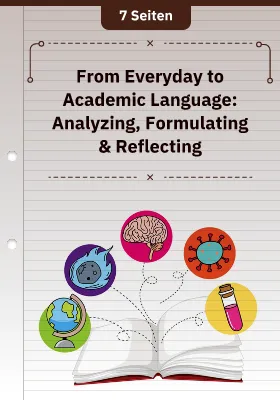
From Everyday to Academic Language: Analyzing, Formulating & Reflecting

From Everyday to Academic Language: Analyzing, Formulating & Reflecting

This worksheet aims to provide students with a solid understanding of the significance and function of academic language and to help them practice actively using it in subject-specific instruction. Students will recognize that academic language serves as an essential tool for presenting complex topics in an objective, impersonal, and precise manner, and that the ability to switch between everyday language and academic language is a key skill. Through guided practice in translating everyday observations into formal language, they learn to use subject-specific linguistic tools, to put their own thoughts into writing in a structured manner, and to reflectively evaluate their own learning process and linguistic expression.

Content and Methods:

The worksheet combines cognitive awareness, guided writing practice, independent text production, and self-evaluation. After an introductory informational text on the distinction between everyday language and academic language, as well as an introduction to subject-specific language tools (e.g., for cause-and-effect relationships, hypothesis formation, or evaluations), learners gradually translate given everyday statements into logically structured academic language. They then apply this translation technique to their own current course material and reflect on the advantages and challenges of academic language formulation. The module concludes with a structured self-assessment matrix designed to evaluate their own language competencies and identify remaining learning needs.

Competencies:

Learners can...

  • identify the difference between everyday language and academic language and explain the importance of precise technical language for subject-matter understanding.
  • identify and purposefully apply specific subject-specific language tools (e.g., phrasing guides for descriptions, justifications, and analyses).
  • systematically translate colloquial observations into precise, factual, and logically structured sentences using formal language.
  • structure their own conceptual ideas derived from current classroom activities and independently put them into writing using appropriate technical terms.
  • critically reflect on their own language translation process and evaluate their individual strengths and areas for development in the use of formal language.

Target Audience and Level:

Grade 8 and above

non-subject specific contentChemistryBiologyGeographyGerman