Haltungsformen von Nutztieren

TT
by to-teach Team
7 pagesAb Klasse 5Biology, Science, Economics, Politics, Ethics
Template

Loading preview…

Your worksheet

Add a type of animal husbandry and an animal. Using factual texts, a story told from an animal's perspective, creative writing and drawing tasks, and multiple-choice questions, the students learn about the living conditions, advantages, and challenges of this type of animal husbandry.

Need an idea?

Popular topics from other teachers

How our AI templates work

  • Content gets adapted

    Examples, texts and tasks match your focus.

  • Method & structure stay

    The didactically reviewed structure of the template won't change.

Description

Zielsetzung:

Die Lernenden setzen sich mit einer bestimmten Form der Nutztierhaltung auseinander und reflektieren deren Vor- und Nachteile.

Inhalte und Methoden:

Anhand von Sachtexten, einer Erzählung aus der Sicht eines Tiers, kreativen Schreib- und Malaufgaben sowie Multiple-Choice-Fragen erarbeiten die Schülerinnen und Schüler die Lebensbedingungen, Vorteile und Herausforderungen der Freilandhaltung.

Kompetenzen:

  • Erwerb von Sachwissen über Haltungsformen von Nutztieren
  • Förderung von Empathie und Perspektivwechsel
  • Kritisches Denken und Meinungsbildung

Zielgruppe und Niveau:

Ab Klasse 5

Similar worksheets

Adolescence: When Emotions Outpace Reason—Understanding Behavior and Providing Professional Guidance

Adolescence: When Emotions Outpace Reason—Understanding Behavior and Providing Professional Guidance

This worksheet introduces future professionals to the biopsychological foundations of adolescence. Learners should recognize that challenging behavior often results from neurological changes and is not a deliberate act of aggression. The goal is to distinguish between the person and their actions in order to act in a way that de-escalates situations, provides support, and maintains positive relationships in their daily professional practice.


Content and Methods:

The material combines theoretical input from developmental psychology with practical case studies and self-reflection. After exploring the neurological foundations, learners “decode” typical behaviors. In a subsequent case analysis, they critically evaluate educational interventions and develop alternative professional approaches. A concluding reflection on their own emotional “triggers” reinforces their professional attitude.


Competencies:

Learners can...

  • explain the neurological and psychological changes that occur during adolescence (particularly the interaction between the limbic system and the prefrontal cortex).
  • psychologically interpret observable, challenging adolescent behavior (such as provocation, rule-breaking, or shame) and classify it as an age-typical developmental task.
  • critically analyze the actions of professionals in acute crisis situations (e.g., in cases of extreme risk-taking behavior) with regard to de-escalation, the duty to protect, and relationship-building.
  • Develop professional and practical alternative courses of action that simultaneously set clear boundaries and preserve the adolescents’ emotional safety.
  • Reflect on one’s own emotional “triggers” when interacting with adolescents in order to maintain professional distance and composure in everyday work.


Target group and level:

Adult students or trainees in the field of social pedagogy, particularly aspiring educators.

Social PedagogyPedagogyEthicsHealth and Social Care
The Challenge of Youth– Understanding and Providing Educational Support for Developmental Tasks According to Hurrelmann

The Challenge of Youth– Understanding and Providing Educational Support for Developmental Tasks According to Hurrelmann

This worksheet aims to provide aspiring educators with a solid sociological understanding of the “adolescence” life stage based on Klaus Hurrelmann’s model of developmental tasks. Learners will gain an awareness of the specific challenges, areas of conflict, and identity-formation processes that adolescents must navigate. They will learn to apply theoretical developmental tasks to concrete everyday situations faced by adolescents, analyze critical factors such as school-related pressure to perform, and develop strategies to alleviate these pressures in educational practice.


Content and Methods: This worksheet addresses the specific characteristics and challenges of adolescence, the four central developmental tasks identified by Klaus Hurrelmann (acquiring skills, forming bonds, consuming, and participating), as well as the tension between various societal influences and the development of identity in children and adolescents. Methodologically, the worksheet employs a combination of personal reflection and partner discussions to define concepts, an informative academic text with a tabular classification of everyday examples, and a small-group problem analysis to develop practical, stress-reducing approaches for educational practice.


Competencies:

Learners can...

  • describe the characteristics of adolescence and distinguish it from childhood and adulthood, providing reasons for their distinctions.
  • explain the four developmental tasks identified by Klaus Hurrelmann (acquiring skills, forming bonds, consuming, participating) and classify everyday situations according to these criteria.
  • critically reflect on the causes and consequences of academic pressure on adolescents’ identity and personality development.
  • design and justify action-oriented approaches and strategies to alleviate pressure in schools and educational settings.


Target group and level:

Adult students or trainees in the field of social pedagogy, particularly aspiring educators.

PedagogyEthicsSocial PedagogyHealth and Social Care
Understanding Development: The Phases of Childhood

Understanding Development: The Phases of Childhood

This worksheet aims to provide aspiring educators with a solid understanding of the stages of child development (early, middle, and late childhood). Learners should be made aware of how to correctly classify developmental phenomena and milestones in the areas of motor skills, cognition, language, and emotional/social development. They will learn to critically compare their own everyday experiences with scientific findings, to analyze everyday observations from a professional perspective, and to design needs-based educational interventions based on a needs assessment.

Content and Methods:

The worksheet combines visual stimuli, prior knowledge, academic texts, social media analyses, and case studies. After assessing their prior knowledge of the three stages of childhood, students explore the developmental characteristics of each stage in terms of motor skills, cognition, language, and social behavior. Using fictional tweets from professional practice, they classify developmental phenomena according to academic categories. The unit concludes with a case study from a selected stage of childhood, for which students conduct a needs assessment and develop a well-reasoned practical plan.

Competencies:

Learners can...

  • describe and distinguish between the developmental stages of early, middle, and late childhood in terms of their motor, cognitive, and social-emotional dimensions,
  • identify key developmental phenomena (e.g., the emergence of self-awareness, magical thinking, acquisition of cultural skills) in observational data and explain them using specialized terminology,
  • systematically compare their own practical observations with expert knowledge of developmental theory,
  • conduct a pedagogical needs assessment for a specific case study and, based on this, develop and justify tailored pedagogical interventions.

Target group and level:

Adult students or trainees in the field of social pedagogy, particularly aspiring educators.

PedagogySocial PedagogyEthicsHealth and Social Care
Theories - Applying and Exploring Them in Depth

Theories - Applying and Exploring Them in Depth

The worksheet aims to provide students with a deep understanding of a pedagogical theory. Students apply central technical terms, transfer theoretical concepts to pedagogical scenarios, and reflect on the relevance of the theory for practical application.

Content and methods:

The focus is on the application, in-depth exploration, and critical reflection of an educational theory. Methodologically, the worksheet combines the translation of technical terms into everyday language, cooperative group work via an expert group method, the elaboration and presentation of subject-specific content, the development of practical case studies, the analysis of different positions and arguments, as well as a concluding reflection and self-assessment.

Competencies:

  • Apply and explain central terms and concepts of a theory
  • Comprehend, structure, and summarize specialized texts
  • Transfer theoretical content to pedagogical situations and case examples
  • Analyze and evaluate professional positions and arguments
  • Formulate and justify personal judgments
  • Reflect on and assess one's own learning progress

Target group and level:

Adult students or trainees in the field of social pedagogy, particularly aspiring educators.

Note on further work: The worksheet serves to deepen and apply a pedagogical theory. It can build upon an introductory worksheet and forms the foundation for further tasks in which theoretical concepts are applied to more complex practical examples and critically reflected upon. Introductory worksheet on the topic: Theories – Fundamentals


Note: Internet access is required for the group research phase.
PedagogyPhilosophyEthicsSocial PedagogyHealth and Social Care
Recognizing Greenwashing

Recognizing Greenwashing

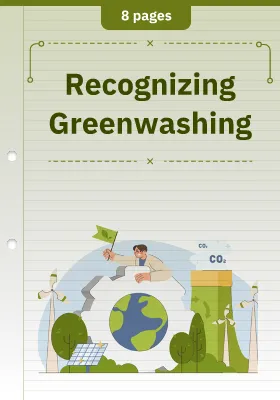
The goal of this worksheet is to enable students to independently identify and critically examine manipulative marketing strategies in retail. Using a specific case study, they will develop the theoretical foundation needed to distinguish between genuine sustainability promises and deliberate consumer deception, so they can make informed, independent consumer decisions in their daily lives.

Content and Methods: The content focuses on the definition and strategic characteristics of greenwashing, its psychological impact, and an analysis of legal consequences. Methodologically, the worksheet combines an image-based case analysis with in-depth journalistic text analysis. A video-based summary of theoretical categories of deception and a practical, criteria-based checklist serve to reinforce knowledge and facilitate active application to students’ own consumer behavior.

Competencies:

Analytical Competence: Students can systematically deconstruct visual design elements, price placements, and advertising messages in digital user interfaces.

Substantive Competence: They understand the definition of the technical term “greenwashing” and can distinguish between vague marketing phrases and verifiable sustainability labels.

Critical thinking skills: Students are able to critically evaluate the discrepancy between corporate sustainability reports and actual environmental impacts.

Reflective thinking skills: They can critically examine their own susceptibility to manipulative sales strategies and identify alternative courses of action.

Target audience and grade level: Intermediate (8th-10th grade)


EconomicsGeography
Understanding Influencer Marketing

Understanding Influencer Marketing

This worksheet aims to raise students’ awareness of the mechanisms, economic dimensions, and psychological strategies of modern digital marketing in everyday life.

Content and Methods: The material focuses on the economic significance of social media marketing based on statistical data, as well as the analysis of specific digital posts. Methodologically, the worksheet relies on a combination of practical case studies—in which an exemplary social media post is deconstructed both textually and statistically—and theoretical insights into behavioral economic effects. In addition, the material encourages multi-perspective discussion through reflective writing assignments and the comparison of contrasting stakeholder perspectives. Finally, the discussion of complex issues is used to synthesize what has been learned into the formation of independent judgments.

Competencies:

Analytical and Deconstructive Competence: The ability to systematically examine media content and linguistic and statistical devices for their manipulative or promotional effects

Reflective and Critical Thinking Competence: The ability to critically examine one’s own consumer behavior and evaluate economic phenomena from different perspectives

Media and Economic Competence: Understanding of digital market mechanisms, psychological influence strategies such as the authority bias or the bandwagon effect, and their impact on the economy

Target Audience and Level: 9th/10th grade

EconomicsPolitics
The Secrets of Milk

The Secrets of Milk

Objective: This workbook explores a historical and materials-science phenomenon: the production of casein, an early milk-based bioplastic. Students work as a team of researchers to investigate how the organic components of liquid cow’s milk can be transformed into a solid plastic through the action of acid.


Content and Methods: The content is conveyed through a combination of historical contextualization, experimental laboratory work, and material analysis: Starting with the question of how a solid material can be produced from milk, students explore the composition of milk and the effect of acids on proteins. They then experimentally extract casein, document the course of the reaction, and examine the properties of the resulting bioplastic. Finally, the results are used in a scientific application to evaluate the historical significance and material properties of casein as an alternative to plastic.


Competencies:

  • Technical expertise: Understanding of protein denaturation (acid precipitation of milk protein/casein) and the classification of galalith as a historical bioplastic
  • Knowledge acquisition: Planning, conducting, and systematically documenting a preparative organic chemistry experiment (filtration, solid isolation)
  • Materials and testing skills: Criteria-based analysis of the physical properties of a self-produced solid
  • Argumentation and language skills: Writing a technically sound report using precise scientific explanations


Target audience and level: Middle school

BiologyChemistry
The Green Battery

The Green Battery

Objective: This worksheet explores the electrochemical fundamentals of galvanic cells and how a lemon battery works in the context of modern, sustainable technology development. Students take on the role of a startup research team to experimentally and ecologically evaluate the suitability of a lemon as an environmentally friendly electrolyte, as well as the efficiency of various electrode pairings.


Content and Methods: The content is taught by combining theoretical fundamentals, experimental data collection, error analysis, and sustainability assessment: First, students explore the structure and functioning of electrochemical cells as well as the underlying redox reactions. They then test their hypotheses in an experiment, document measurement data, and analyze typical sources of error in the laboratory. Finally, they evaluate the performance and sustainability of various materials before summarizing their results in a technical report and a persuasive presentation.


Competencies:

  • Technical Competence: Understanding of redox reactions, electrode potentials, and the role of electrolytes in generating electrical power
  • Data Analysis: Conducting quantitative electrochemical measurements, systematically comparing variables, and identifying sources of methodological error
  • Evaluation Competence: Balancing maximum technical performance with environmental factors (extraction, recycling, toxicity) in the context of sustainable chemistry
  • Communication skills: Targeted, audience-oriented presentation of laboratory data for a business analysis or an investor pitch


Target audience and level: Middle School

BiologyChemistry