to teach logo
Sign up

Politische Strömungen

TT
by to-teach Team
7 pagesAb Klasse 10Economics, History, Politics
Template

Loading preview…

Your worksheet

Insert a desired political movement. Using an informative text and a fictional eyewitness account, the students explore the central characteristics of the political movement.

Need an idea?

Popular topics from other teachers

How our AI templates work

  • Content gets adapted

    Examples, texts and tasks match your focus.

  • Method & structure stay

    The didactically reviewed structure of the template won't change.

Description

Zielsetzung:

Die Lernenden setzen sich mit politischen Strömungen als innerparteiliche Denkrichtungen auseinander und analysieren die Entstehung, Ideen, Ziele und aktuellen Herausforderungen.

Inhalte und Methoden:

Anhand eines informativen Textes und eines fiktiven Zeitzeugenberichts erschließen sich die Schüler:innen die zentralen Merkmale der politischen Strömung. Ein Steckbrief dient der strukturierten Sicherung der Informationen. Abschließend wird die heutige Bedeutung der Strömung in einer fiktiven Fachmeinung einer Expertin vertieft und kritisch reflektiert.

Kompetenzen:

  • Analyse politischer Strömungen und innerparteilicher Debatten
  • Reflexion über politische Kompromissfähigkeit und Werteorientierung
  • Entwicklung einer eigenen begründeten Position zu politischen Strategien

Zielgruppe und Niveau:

Ab Klasse 10
Similar worksheets

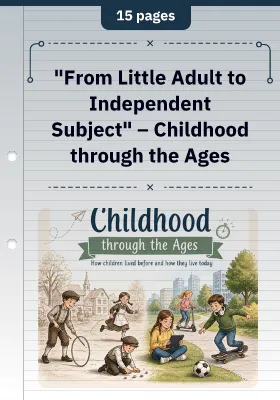
"From Little Adult to Independent Subject" – Childhood through the Ages

"From Little Adult to Independent Subject" – Childhood through the Ages

This worksheet aims to provide trainee teachers with a historically informed and socially critical understanding of the life stage known as ‘childhood’. Learners are to be made aware that childhood is not a rigid, biological state, but is subject to constant social change. They will learn to analyse historical patterns of upbringing and living environments, to contextualise the contemporary view of the child (including the UN Convention on the Rights of the Child), and to draw conclusions for their own professional approach by comparing the past and the present.

Content and methods:

This worksheet combines historical text analysis, the development of empathy, analysis of contemporary issues and research into international law. Following a personal reflection and an analysis of a historical period, the pupils write a fictional diary entry from a child’s perspective and contrast this with the reaction of a child today. They then map out the cornerstones of modern childhood in a practical matrix and compare historical and contemporary living conditions. The activity concludes with research into the UN Convention on the Rights of the Child, including its historical context, and a reflection on their own pedagogical approach.


Competencies:

Learners can...

  • Explain the concept of childhood as a socially shaped and historically changeable construct.
  • Analyse children’s historical living environments in terms of educational objectives, work requirements and legal status, guided by specific criteria.
  • Develop historical empathy through methods of shifting perspectives and reflect on different living conditions from multiple perspectives.
  • Identify the dimensions of modern childhood (including subject status, institutionalisation and mediatisation) and illustrate them using concrete examples from practice.
  • Independently research articles of the UN Convention on the Rights of the Child, place them in their historical context and relate them to today’s image of the child.
  • Use historical insights to critically examine current patterns of upbringing and apply them to one’s own professional approach.


Target group and level:

Adult students or trainees in the field of social pedagogy, particularly aspiring educators.


Note: Internet access is required for the research task

PedagogySocial PedagogyHistoryHealth and Social Care
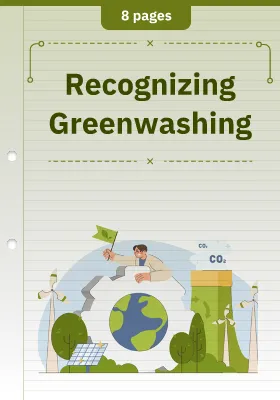
Recognizing Greenwashing

Recognizing Greenwashing

The goal of this worksheet is to enable students to independently identify and critically examine manipulative marketing strategies in retail. Using a specific case study, they will develop the theoretical foundation needed to distinguish between genuine sustainability promises and deliberate consumer deception, so they can make informed, independent consumer decisions in their daily lives.

Content and Methods: The content focuses on the definition and strategic characteristics of greenwashing, its psychological impact, and an analysis of legal consequences. Methodologically, the worksheet combines an image-based case analysis with in-depth journalistic text analysis. A video-based summary of theoretical categories of deception and a practical, criteria-based checklist serve to reinforce knowledge and facilitate active application to students’ own consumer behavior.

Competencies:

Analytical Competence: Students can systematically deconstruct visual design elements, price placements, and advertising messages in digital user interfaces.

Substantive Competence: They understand the definition of the technical term “greenwashing” and can distinguish between vague marketing phrases and verifiable sustainability labels.

Critical thinking skills: Students are able to critically evaluate the discrepancy between corporate sustainability reports and actual environmental impacts.

Reflective thinking skills: They can critically examine their own susceptibility to manipulative sales strategies and identify alternative courses of action.

Target audience and grade level: Intermediate (8th-10th grade)


EconomicsGeography
Understanding Influencer Marketing

Understanding Influencer Marketing

This worksheet aims to raise students’ awareness of the mechanisms, economic dimensions, and psychological strategies of modern digital marketing in everyday life.

Content and Methods: The material focuses on the economic significance of social media marketing based on statistical data, as well as the analysis of specific digital posts. Methodologically, the worksheet relies on a combination of practical case studies—in which an exemplary social media post is deconstructed both textually and statistically—and theoretical insights into behavioral economic effects. In addition, the material encourages multi-perspective discussion through reflective writing assignments and the comparison of contrasting stakeholder perspectives. Finally, the discussion of complex issues is used to synthesize what has been learned into the formation of independent judgments.

Competencies:

Analytical and Deconstructive Competence: The ability to systematically examine media content and linguistic and statistical devices for their manipulative or promotional effects

Reflective and Critical Thinking Competence: The ability to critically examine one’s own consumer behavior and evaluate economic phenomena from different perspectives

Media and Economic Competence: Understanding of digital market mechanisms, psychological influence strategies such as the authority bias or the bandwagon effect, and their impact on the economy

Target Audience and Level: 9th/10th grade

EconomicsPolitics