to teach logo
Sign up

Selbst- und Fremdbild: Blinde Flecken erkennen und Feedback nutzen

TT
by to-teach Team
3 pagesAuszubildende im sozialpädagogischen BereichEthics, Social Pedagogy, Pedagogy
Template

Loading preview…

Your worksheet

Enter the name of the desired reflection tool that will be covered in depth in the worksheet. This entry determines which model the tasks, texts, and reflection questions will be aligned with.

Need an idea?

Popular topics from other teachers

How our AI templates work

  • Content gets adapted

    Examples, texts and tasks match your focus.

  • Method & structure stay

    The didactically reviewed structure of the template won't change.

Description

Zielsetzung:

Das Arbeitsblatt zielt darauf ab, den Lernenden ein fundiertes Verständnis für die Dynamik zwischen Selbstbild und Fremdbild zu vermitteln. Sie werden dafür sensibilisiert, dass die eigene Wahrnehmung nicht völlig objektiv ist und wie wichtig der systematische Abgleich zwischen der eigenen Perspektive und der Außenwahrnehmung für das Aufdecken blinder Flecken sowie das Vermeiden von Missverständnissen ist. Die Lernenden erlangen die Fähigkeit, eigene Verhaltensmuster kritisch zu hinterfragen, und lernen strukturierte Reflexionswerkzeuge (wie etwa das Johari-Fenster oder vergleichbare Feedback-Modelle) als Instrumente für persönliches Wachstum und professionelle Beziehungsgestaltung im Alltag und Beruf zu nutzen.

Inhalte und Methoden:

Das Arbeitsblatt kombiniert einen Selbsteinschätzungstest, vertiefende Textarbeit, Einzel- und Partnerreflexionen sowie die praktische Anwendung eines strukturierten Reflexionsmodells. Zunächst absolvieren die Lernenden den mehrteiligen Persönlichkeitstest „Selbstbild-Kompass“, der ihr Selbstbild in Typologien wie beispielsweise stabil, sensibel, ehrgeizig, unabhängig oder empathisch einordnet. Anschließend analysieren sie ihr Ergebnis anhand konkreter Alltagserfahrungen, ergänzen fehlende Facetten und vergleichen ihre Selbstwahrnehmung sowohl hypothetisch als auch im optionalen Partneraustausch mit der Außenperspektive. Nach der Erarbeitung der theoretischen Grundlagen von Reflexionswerkzeugen wenden die Lernenden diese auf eine konkrete Interaktionssituation aus Schule, Praktikum oder Alltag an. Dabei formulieren sie reflektierte Selbstoffenbarungen mittels Ich-Botschaften sowie ressourcenorientierte Feedbackfragen, um ihren blinden Fleck zu verkleinern.

Kompetenzen

Die Lernenden können...

  • die Begriffe Selbstbild und Fremdbild fachlich präzise voneinander abgrenzen und die Notwendigkeit ihres Abgleichs für die professionelle Beziehungsgestaltung begründen.
  • das eigene Selbstbild mithilfe von standardisierten Testverfahren sowie individuellen Praxisbeispielen kritisch analysieren und differenziert beschreiben.
  • Diskrepanzen zwischen Eigen- und Fremdwahrnehmung im Austausch mit anderen konstruktiv identifizieren und hinterfragen.
  • strukturierte Reflexionswerkzeuge kriteriengeleitet zur systematischen Aufarbeitung von Kommunikations- und Interaktionssituationen anwenden.
  • zielgerichtete Ich-Botschaften zur angemessenen Selbstoffenbarung formulieren sowie ressourcenorientierte Feedbackfragen zur eigenen Weiterentwicklung erarbeiten.

Zielgruppe und Niveau

Auszubildende im sozialpädagogischen Bereich


Hinweis: Der Persönlichkeitstest funktioniert nur in der Online-Version des Arbeitsblattes.

Similar worksheets

Adolescence: When Emotions Outpace Reason—Understanding Behavior and Providing Professional Guidance

Adolescence: When Emotions Outpace Reason—Understanding Behavior and Providing Professional Guidance

This worksheet introduces future professionals to the biopsychological foundations of adolescence. Learners should recognize that challenging behavior often results from neurological changes and is not a deliberate act of aggression. The goal is to distinguish between the person and their actions in order to act in a way that de-escalates situations, provides support, and maintains positive relationships in their daily professional practice.


Content and Methods:

The material combines theoretical input from developmental psychology with practical case studies and self-reflection. After exploring the neurological foundations, learners “decode” typical behaviors. In a subsequent case analysis, they critically evaluate educational interventions and develop alternative professional approaches. A concluding reflection on their own emotional “triggers” reinforces their professional attitude.


Competencies:

Learners can...

  • explain the neurological and psychological changes that occur during adolescence (particularly the interaction between the limbic system and the prefrontal cortex).
  • psychologically interpret observable, challenging adolescent behavior (such as provocation, rule-breaking, or shame) and classify it as an age-typical developmental task.
  • critically analyze the actions of professionals in acute crisis situations (e.g., in cases of extreme risk-taking behavior) with regard to de-escalation, the duty to protect, and relationship-building.
  • Develop professional and practical alternative courses of action that simultaneously set clear boundaries and preserve the adolescents’ emotional safety.
  • Reflect on one’s own emotional “triggers” when interacting with adolescents in order to maintain professional distance and composure in everyday work.


Target group and level:

Adult students or trainees in the field of social pedagogy, particularly aspiring educators.

Social PedagogyPedagogyEthicsHealth and Social Care
The Challenge of Youth– Understanding and Providing Educational Support for Developmental Tasks According to Hurrelmann

The Challenge of Youth– Understanding and Providing Educational Support for Developmental Tasks According to Hurrelmann

This worksheet aims to provide aspiring educators with a solid sociological understanding of the “adolescence” life stage based on Klaus Hurrelmann’s model of developmental tasks. Learners will gain an awareness of the specific challenges, areas of conflict, and identity-formation processes that adolescents must navigate. They will learn to apply theoretical developmental tasks to concrete everyday situations faced by adolescents, analyze critical factors such as school-related pressure to perform, and develop strategies to alleviate these pressures in educational practice.


Content and Methods: This worksheet addresses the specific characteristics and challenges of adolescence, the four central developmental tasks identified by Klaus Hurrelmann (acquiring skills, forming bonds, consuming, and participating), as well as the tension between various societal influences and the development of identity in children and adolescents. Methodologically, the worksheet employs a combination of personal reflection and partner discussions to define concepts, an informative academic text with a tabular classification of everyday examples, and a small-group problem analysis to develop practical, stress-reducing approaches for educational practice.


Competencies:

Learners can...

  • describe the characteristics of adolescence and distinguish it from childhood and adulthood, providing reasons for their distinctions.
  • explain the four developmental tasks identified by Klaus Hurrelmann (acquiring skills, forming bonds, consuming, participating) and classify everyday situations according to these criteria.
  • critically reflect on the causes and consequences of academic pressure on adolescents’ identity and personality development.
  • design and justify action-oriented approaches and strategies to alleviate pressure in schools and educational settings.


Target group and level:

Adult students or trainees in the field of social pedagogy, particularly aspiring educators.

PedagogyEthicsSocial PedagogyHealth and Social Care
Understanding Development: The Phases of Childhood

Understanding Development: The Phases of Childhood

This worksheet aims to provide aspiring educators with a solid understanding of the stages of child development (early, middle, and late childhood). Learners should be made aware of how to correctly classify developmental phenomena and milestones in the areas of motor skills, cognition, language, and emotional/social development. They will learn to critically compare their own everyday experiences with scientific findings, to analyze everyday observations from a professional perspective, and to design needs-based educational interventions based on a needs assessment.

Content and Methods:

The worksheet combines visual stimuli, prior knowledge, academic texts, social media analyses, and case studies. After assessing their prior knowledge of the three stages of childhood, students explore the developmental characteristics of each stage in terms of motor skills, cognition, language, and social behavior. Using fictional tweets from professional practice, they classify developmental phenomena according to academic categories. The unit concludes with a case study from a selected stage of childhood, for which students conduct a needs assessment and develop a well-reasoned practical plan.

Competencies:

Learners can...

  • describe and distinguish between the developmental stages of early, middle, and late childhood in terms of their motor, cognitive, and social-emotional dimensions,
  • identify key developmental phenomena (e.g., the emergence of self-awareness, magical thinking, acquisition of cultural skills) in observational data and explain them using specialized terminology,
  • systematically compare their own practical observations with expert knowledge of developmental theory,
  • conduct a pedagogical needs assessment for a specific case study and, based on this, develop and justify tailored pedagogical interventions.

Target group and level:

Adult students or trainees in the field of social pedagogy, particularly aspiring educators.

PedagogySocial PedagogyEthicsHealth and Social Care
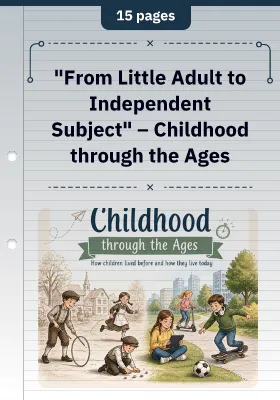
"From Little Adult to Independent Subject" – Childhood through the Ages

"From Little Adult to Independent Subject" – Childhood through the Ages

This worksheet aims to provide trainee teachers with a historically informed and socially critical understanding of the life stage known as ‘childhood’. Learners are to be made aware that childhood is not a rigid, biological state, but is subject to constant social change. They will learn to analyse historical patterns of upbringing and living environments, to contextualise the contemporary view of the child (including the UN Convention on the Rights of the Child), and to draw conclusions for their own professional approach by comparing the past and the present.

Content and methods:

This worksheet combines historical text analysis, the development of empathy, analysis of contemporary issues and research into international law. Following a personal reflection and an analysis of a historical period, the pupils write a fictional diary entry from a child’s perspective and contrast this with the reaction of a child today. They then map out the cornerstones of modern childhood in a practical matrix and compare historical and contemporary living conditions. The activity concludes with research into the UN Convention on the Rights of the Child, including its historical context, and a reflection on their own pedagogical approach.


Competencies:

Learners can...

  • Explain the concept of childhood as a socially shaped and historically changeable construct.
  • Analyse children’s historical living environments in terms of educational objectives, work requirements and legal status, guided by specific criteria.
  • Develop historical empathy through methods of shifting perspectives and reflect on different living conditions from multiple perspectives.
  • Identify the dimensions of modern childhood (including subject status, institutionalisation and mediatisation) and illustrate them using concrete examples from practice.
  • Independently research articles of the UN Convention on the Rights of the Child, place them in their historical context and relate them to today’s image of the child.
  • Use historical insights to critically examine current patterns of upbringing and apply them to one’s own professional approach.


Target group and level:

Adult students or trainees in the field of social pedagogy, particularly aspiring educators.


Note: Internet access is required for the research task

PedagogySocial PedagogyHistoryHealth and Social Care
Theories - Applying and Exploring Them in Depth

Theories - Applying and Exploring Them in Depth

The worksheet aims to provide students with a deep understanding of a pedagogical theory. Students apply central technical terms, transfer theoretical concepts to pedagogical scenarios, and reflect on the relevance of the theory for practical application.

Content and methods:

The focus is on the application, in-depth exploration, and critical reflection of an educational theory. Methodologically, the worksheet combines the translation of technical terms into everyday language, cooperative group work via an expert group method, the elaboration and presentation of subject-specific content, the development of practical case studies, the analysis of different positions and arguments, as well as a concluding reflection and self-assessment.

Competencies:

  • Apply and explain central terms and concepts of a theory
  • Comprehend, structure, and summarize specialized texts
  • Transfer theoretical content to pedagogical situations and case examples
  • Analyze and evaluate professional positions and arguments
  • Formulate and justify personal judgments
  • Reflect on and assess one's own learning progress

Target group and level:

Adult students or trainees in the field of social pedagogy, particularly aspiring educators.

Note on further work: The worksheet serves to deepen and apply a pedagogical theory. It can build upon an introductory worksheet and forms the foundation for further tasks in which theoretical concepts are applied to more complex practical examples and critically reflected upon. Introductory worksheet on the topic: Theories – Fundamentals


Note: Internet access is required for the group research phase.
PedagogyPhilosophyEthicsSocial PedagogyHealth and Social Care