

My body belongs to me
8

The world of Start Ups
5

AI skills
26
Substitute Lessons
16

Countdown to Summer
9

Focus on women
6
Filters
Worksheets
The Secrets of Milk
Objective: This workbook explores a historical and materials-science phenomenon: the production of casein, an early milk-based bioplastic. Students work as a team of researchers to investigate how the organic components of liquid cow’s milk can be transformed into a solid plastic through the action of acid.
Content and Methods: The content is conveyed through a combination of historical contextualization, experimental laboratory work, and material analysis: Starting with the question of how a solid material can be produced from milk, students explore the composition of milk and the effect of acids on proteins. They then experimentally extract casein, document the course of the reaction, and examine the properties of the resulting bioplastic. Finally, the results are used in a scientific application to evaluate the historical significance and material properties of casein as an alternative to plastic.
Competencies:
- Technical expertise: Understanding of protein denaturation (acid precipitation of milk protein/casein) and the classification of galalith as a historical bioplastic
- Knowledge acquisition: Planning, conducting, and systematically documenting a preparative organic chemistry experiment (filtration, solid isolation)
- Materials and testing skills: Criteria-based analysis of the physical properties of a self-produced solid
- Argumentation and language skills: Writing a technically sound report using precise scientific explanations
Target audience and level: Middle school
The Green Battery
Objective: This worksheet explores the electrochemical fundamentals of galvanic cells and how a lemon battery works in the context of modern, sustainable technology development. Students take on the role of a startup research team to experimentally and ecologically evaluate the suitability of a lemon as an environmentally friendly electrolyte, as well as the efficiency of various electrode pairings.
Content and Methods: The content is taught by combining theoretical fundamentals, experimental data collection, error analysis, and sustainability assessment: First, students explore the structure and functioning of electrochemical cells as well as the underlying redox reactions. They then test their hypotheses in an experiment, document measurement data, and analyze typical sources of error in the laboratory. Finally, they evaluate the performance and sustainability of various materials before summarizing their results in a technical report and a persuasive presentation.
Competencies:
- Technical Competence: Understanding of redox reactions, electrode potentials, and the role of electrolytes in generating electrical power
- Data Analysis: Conducting quantitative electrochemical measurements, systematically comparing variables, and identifying sources of methodological error
- Evaluation Competence: Balancing maximum technical performance with environmental factors (extraction, recycling, toxicity) in the context of sustainable chemistry
- Communication skills: Targeted, audience-oriented presentation of laboratory data for a business analysis or an investor pitch
Target audience and level: Middle School
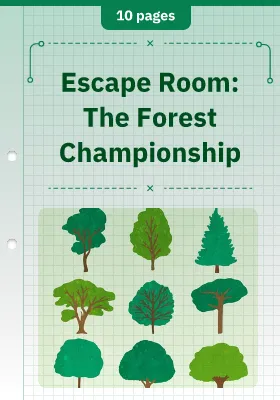
Escape Room: The Forest Championship
Students playfully immerse themselves in the world of trees, solve puzzles, and identify different tree species in order to find a “forest treasure” and break a “curse.”
Content and Methods:
In an escape room scenario, students solve various puzzles related to tree species. They must identify trees based on descriptions, fill in gaps in texts, evaluate statements about trees as true or false, and classify trees as deciduous or coniferous. The worksheet also encourages students to document the trees they find, e.g., through photos or drawings.
Skills:
- Knowledge of tree species
- Analytical thinking and problem-solving
- Reading comprehension and text analysis
- Classification and categorization
Target audience and grade level:
Grade 5 and up
Ingeniería genética - Nivel B1
Objective: This worksheet aims to provide students with a basic understanding of genetic engineering and to facilitate a discussion of its advantages and disadvantages, particularly as they relate to fruits and vegetables.
Content and Methods: It explains the basics of genetic engineering and its applications (medicine, agriculture, research). The focus is on genetic engineering in fruits and vegetables, its advantages (pesticide resistance, productivity, nutritional value, climate adaptation), and concerns (environment, health, acceptance, costs). Methods include a prior knowledge assessment, multiple-choice questions, open-ended questions, and expressing an opinion in letter form.
Competencies:
- Reading comprehension of scientific texts
- Critical thinking about biotechnology
- Argumentation and written expression skills
Target audience and level: Spanish learners at B1 level
ESD:
- SDG 13 (Climate Action): Exploring climate adaptation
- SDG 15 (Life on Land): Raising awareness of biodiversity conservation
AI Detective: AI and its usage in a specific field
Students investigate how artificial intelligence is transforming a specific field, gaining an understanding of both the benefits and challenges of AI. The goal is to develop critical awareness of AI’s capabilities, ethical issues, and the ongoing need for human judgment in decision-making.
Content and Methods:
The worksheet guides students through an exploration of AI in a specific field by examining real-world examples. Students analyze ethical concerns. Methods include comprehension questions, multiple-choice tasks, comparison of benefits and risks, open-ended reflection questions, and a short argumentative essay about AI’s role in that field.
Competencies:
- Understanding technological applications of AI in a real-world professional field
- Critical evaluation of the benefits and risks of AI in that field
- Ethical reasoning about data privacy, bias, and human–machine interaction
- Analytical thinking about the balance between AI capabilities and human expertise
- Argumentative and reflective writing skills
Target Group and Level:
Grade 8 and up.
Films in the classroom: Brochure
With the help of the worksheet, learners engage with a film in a structured way in order to develop a deeper understanding and to reflect on and transfer what they have seen.
Contents and methods:
The worksheet is structured like a brochure and asks questions about the content and further questions about the film. The worksheet ends with a personal evaluation of the film.
Skills:
- Concentrated extraction of information from a visual medium
- Analysis, reflection and transfer of film content
Target group and level:
Grade 7 and above
Films in the classroom
With the help of the worksheet, learners engage with the content of a film in a structured manner before, during and after viewing it in order to develop a deeper understanding and to reflect on and transfer what they have seen.
Content and methods:
The worksheet begins by testing prior knowledge of the film. While watching, the pupils complete multiple-choice tasks to actively engage with and consolidate their understanding. After the film, transfer tasks are used for further processing and reflection on the topic.
Skills:
- Activating and building on prior knowledge
- Concentrated extraction of information from a visual medium
- Analysis, reflection and transfer of film content
Target group and level:
Grade 7 and above
Goals for sustainable development
The worksheet provides in-depth knowledge about one of the 17 Sustainable Development Goals of the United Nations. Learners develop an understanding of the relevance of the selected goal and can also explain it.
Content and methods: The worksheet provides information about the basics of the selected goal and the current status in this area. Methodologically, information texts, tasks for text comprehension (multiple choice questions) and open questions are used. As a bonus, an individual reflection task on behaviours that contribute to the achievement of the 17 goals is attached.
Competences:
- Expertise: Students acquire knowledge about the importance of a selected goal and the measures taken to achieve it.
- Methodological competence: Pupils practise reading and understanding information texts, answering questions and writing short texts.
Level: 7th/8th grade
Where does the plastic drift to? The adventurous journey of a plastic particle
The learners follow a plastic (particle) on its journey through the ecosystem. In addition, they can explain the effect of the journey on the environment and reflect on its impact on the ecosystem.
Content and methodology: With the help of text messages, learners follow a plastic particle on its journey through the ecosystem and learn more about its experiences and effects on the ecosystem. Learners answer questions about the content and reflect on the effects of the particle. There is also a bonus task where the learners create a profile of the particle.
Competences:
- Spatial perception and orientation: The students follow the spatial displacement of plastic particles and develop an understanding of the interconnectedness of different environmental areas.
- Cause-effect thinking: Students analyze the causes and consequences of plastic pollution and recognize the complex relationships between human activity and environmental change.
- Systemic thinking: Students follow the path of the plastic particle through various ecosystems and recognize connections.
- Problem-solving skills: Learners work out the possible effects of particles on the environment and living organisms.
Level: 7th/8th grade
Smartphone Puzzle
Students learn to analyze information from various digital sources and link it logically in order to draw conclusions.
Content and Methodology: The worksheet offers an interactive puzzle task based around a found smartphone. The students analyze chat histories, pictures and an audio file to identify the owner of the smartphone.
Skills:
- Critical analysis of texts and media
- Logical thinking and reasoning
- Understanding historical and/or scientific contexts
Target Audience and Level: Suitable for teaching at lower secondary level.
Superheroes and Mutations: Reality or Fiction?
The overarching learning objective of this worksheet is to explore the concept of genetic mutations, differentiate between various types, understand their real-world implications (genetic disorders) and critically assess the scientific realism of superhero mutations.
Content and Methods: The worksheet begins by posing a question about the realism of superhero mutations. It then delves into the scientific content by explaining and categorizing gene, genome and chromosomal mutations, providing examples for each. The methods include a pair discussion task, sorting exercises for mutation types, open-ended questions requiring descriptions and explanations of mutations, and multiple-choice questions about specific genetic disorders. Finally, it prompts a discussion on the impact of superhero stories on scientific understanding.
Competencies:
- Scientific literacy: Understanding fundamental concepts of genetic mutations and their biological effects.
- Critical thinking: Evaluating the scientific plausibility of fictional scenarios (superhero powers).
- Information categorization: Differentiating and sorting various types of mutations.
- Reading comprehension: Extracting detailed information from scientific texts.
- Problem-solving: Explaining complex biological phenomena.
- Discussion and communication: Engaging in peer discussions about scientific concepts.
Target Audience and Level:
Grade 10 and above

Write a Script for a Podcast
This worksheet aims to guide students through the process of creating their own podcast script for a school project, focusing on planning, researching, structuring, and writing.
Content and methods: The worksheet begins by asking students to brainstorm podcasts they know and their topics, encouraging initial engagement with the medium. It then prompts students to think about what is needed to create a school podcast, before presenting a dialogue between two students, Jenny and Aisha, who are planning their podcast, highlighting aspects like introduction, main content segments, and conclusion. Multiple-choice questions assess comprehension of podcast structure and planning. The worksheet provides detailed instructions on "How to write a podcast script," covering researching the topic, outlining the script (introduction, guest introduction, main part with transitions and multiple topics, summary, conclusion, call to action), and writing tips (conversational tone, conciseness, bullet points). It also offers relevant source titles and summaries for research on adolescent leisure activities and well-being. Students are then guided to create their own podcast outline based on the provided structure and subsequently write their full podcast script. The final step involves revising and marking important parts of their script for emphasis or pronunciation. A sample script is included for teachers as an additional resource.
Competencies:
- Understanding of podcast structure and content planning
- Research skills for topic development
- Scriptwriting, including elements of introduction, transitions, and conclusion
- Critical thinking and self-correction through revision
- Creative thinking and content generation
Target group: 7th-12th grade
Fetching more worksheets...
Next Page