Turn a PDF reading into a classroom chat pupils can check against the source
A short PDF reading can become a conversation that gives pupils something to question. In to teach, add the document as a source, choose the Whatsapp Chat format and ask for a discussion around one important idea. Keep the PDF beside the chat: the activity is to explain and check the messages using the original text.
Try it with a school pond food chain
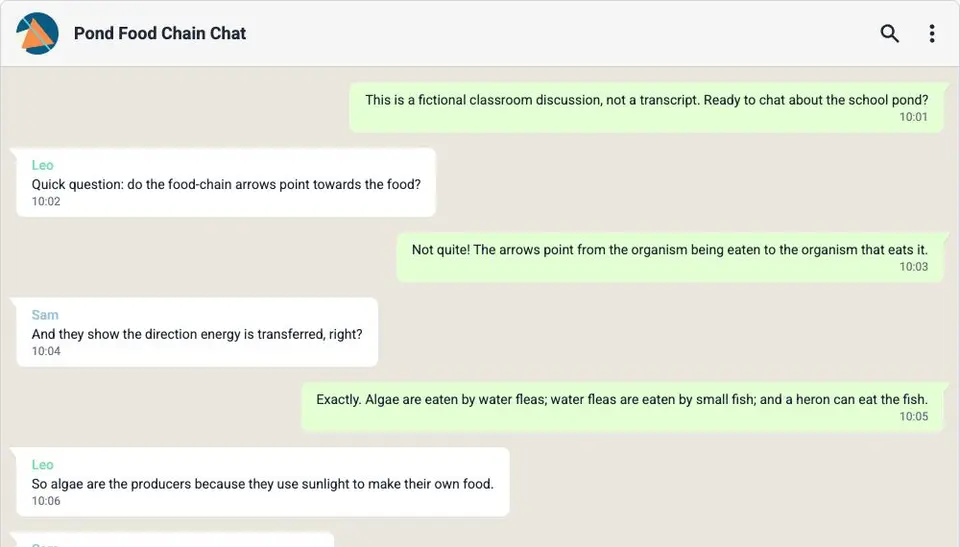
Our one-page reading follows algae, water fleas, small fish and a heron. After a short introduction, the generated chat has Leo ask whether the food-chain arrows point towards the food. Another speaker corrects him: the arrows go from the organism being eaten to the organism that eats it. Sam connects that direction to energy transfer. The final message asks pupils to explain one arrow using the PDF.
Give pupils the reading first. Then show the chat and ask them to locate the sentence that answers Leo's question. This works as a short explanation task after pupils have met food chains: they have to use the meaning of an arrow, rather than just name the animals in order.
Open the one-page school pond reading (PDF)
Read the food-chain classroom chat
Add the PDF as your source
Open the Whatsapp Chat tool and use the source panel to choose Document. Select your PDF and save the source. The current upload dialog accepts PDF files up to 26 MB and offers an Extract images checkbox. For this text-only reading, we switched image extraction off. Once analysis finished, the PDF appeared in the source panel and the chat could be generated.
Use a short, relevant document for this task. If your original is a long booklet, prepare a copy containing the passage pupils will actually use. In our example, the source is a one-page reading with no diagram; the chat does not need a textbook chapter around it. Retain any caption or diagram that pupils need to understand a different source, and keep that part available during the discussion.
Give the conversation a question to resolve
We selected English as the output language and used the instruction box to specify pupils aged 11–13, three fictional speakers and roughly ten short messages. We asked for one opening misconception, an immediate source-based correction and a final question. The age and message count were written instructions, not separate controls.
For your own reading, choose the distinction pupils often miss. That might be the direction of an arrow, the difference between a cause and a consequence, or which sentence supports a character's conclusion. Ask the speakers to resolve that question using the document. A general instruction to discuss everything in the PDF makes it harder to see what pupils should learn from the exchange.
Check the finished messages against the PDF
The ten-message example keeps the food chain in the right order and identifies algae as producers, with water fleas, fish and herons as consumers. It also keeps the separate role of bacteria and fungi: they break down dead organisms and release nutrients that plants and algae can use again. Those statements are present in the source reading.
Check that the correction is as clear as the misconception. Here, Leo asks a question and receives the correction in the next message. Do not stop the activity on the mistaken idea alone. The conversation is labelled as fictional: its speakers and wording are a classroom adaptation of the reading, not evidence that real pupils held this discussion.
Make pupils explain, not just read the bubbles
In pairs, ask one pupil to draw algae → water fleas and the other to explain the arrow aloud. Both should point to the supporting sentence in the PDF. Then swap roles for water fleas → small fish. Finish with an individual sentence: “The arrow points from ___ to ___ because ___.” A suitable explanation connects the organism eaten with the eater and the direction of energy transfer.
If pupils reverse the arrow, return to the correction in the chat and compare it with the PDF. If they name the organisms correctly but cannot explain the direction, ask what is transferred between them. This gives you a concrete response to discuss before moving on to a larger food web.
Use the chat within a connected lesson
Place the source reading before the paired explanation and use the final sentence as a short check of understanding. In to teach, you can build the lesson plan around these phases and create the material needed for each one. The same pond reading also supports flashcards for vocabulary or a multiple-choice quiz when you want a different follow-up.
Open the finished example through its shared link, or use the embedded version in this guide. Pupils read a simulated conversation; they do not need to send WhatsApp messages for this classroom activity. For a reading you already have as editable text, use the text-to-chat guide instead of creating a PDF just to upload it.
Create flashcards from the same reading
Bereit, diese Idee in eigenes Unterrichtsmaterial umzusetzen?
Schließe dich tausenden Lehrkräften an und bereite deinen Unterricht mit KI schneller, differenzierter und kreativer vor.
DSGVO-konform · In 30 Sek. startklar · Keine Kreditkarte nötig
Du interessierst dich für eine Schullizenz? Beratungsgespräch vereinbaren