
Create flashcards from a YouTube video for a post-viewing lesson
To make flashcards from a YouTube video, add the video link as a source in to teach, choose Flashcards and specify the ideas pupils should recall. Use the cards after viewing to check the explanation, then return to the film when an answer is incomplete. Four focused cards can be more useful than a long list of disconnected terms.
This guide uses TED-Ed’s “What really happens to the plastic you throw away”, by Emma Bryce. The four-minute animation follows three discarded bottles. Our finished English set asks pupils to distinguish the possible journeys, explain two important terms and recall a process.
Watch the original TED-Ed video
Open TED-Ed’s original lesson and credits
Try the four finished video flashcards — full view
Import the video before choosing the cards
Open Material Tools, add a source and choose Video. Paste the YouTube link, select the video’s language and save it. Wait for the title and player to appear in the source panel. In this example, the imported player shows a duration of 4 minutes 7 seconds.
Keep the original video available during the activity. The cards are a way to retrieve and discuss its ideas, not a replacement for the narration and animation. If you use a different film, watch it first and decide which explanation your class needs from it.
Give the set one job
For pupils aged 12–14, we chose four cards, English output and the middle explanation level. The task instruction named four targets: the possible destinations of a bottle, leachate, why smaller plastic pieces remain a problem, and the recycling sequence. It also asked for original wording, short answers and no claim that every bottle follows the same path.
You can adapt that instruction to your own video: “Create four short question-and-answer flashcards after viewing. Cover [the four ideas]. Use one or two sentences per answer, based only on this video. Preserve distinctions between different examples.” Naming the ideas avoids filling the set with incidental dates or names.
Review the explanation on each back
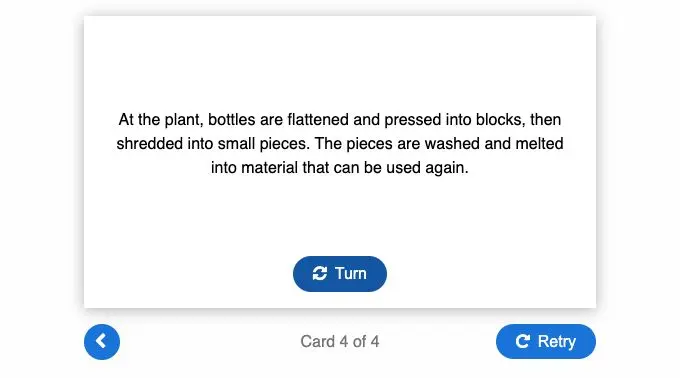
The first card distinguishes landfill, the ocean and recycling. It explicitly treats them as different journeys. The next cards explain polluted landfill liquid and the problem of small plastic fragments. The final card keeps the recycling stages in order: flattening, shredding, washing and melting.
The first answer lists three alternative destinations: landfill, the ocean and recycling. In this film, these are separate journeys; one bottle does not travel through all three. For a class that needs shorter reading, split the spoken response into two parts: name the destinations, then explain why they are alternatives. Keep the qualification when reviewing the answer; removing it would change the task.
Check process cards in sequence, not just for familiar vocabulary. A learner who lists the right verbs in the wrong order has not yet explained the process. For terms such as leachate, ask which part of the film the explanation belongs to. That connects a definition to its context.
Return to the exact part of the film
When an answer needs another look, use these points in the original video. For the first card, compare all three journeys; for the process card, listen for the order of the actions.
Landfill journey — 1:10; leachate explanation starts at 1:27
Ocean journey — 1:54; animals and the food chain from 2:32
Run a short post-viewing activity
Before viewing, give pupils three headings to listen for: landfill, ocean and recycling. After the film, let pairs work through the cards. One pupil answers before turning the card; the partner checks for the essential idea and asks a follow-up question. Switch roles for the next card.
After the card round, ask each pair to choose one journey and explain it without the cards. For recycling, they can arrange four process verbs and connect them with first, next and finally. For the other journeys, ask for a cause-and-effect explanation rather than a list of nouns. Return to the film where the explanation remains unclear.
Differentiate the follow-up, not only the wording
The Flashcards form offers an explanation level for the set. Choose it for the language your group can read. You can also vary the follow-up: offer the three destination headings to pupils who need a starting point; ask more confident pupils to explain a process without those headings. Both groups work with the same source and central ideas.
If the lesson needs a second task, use the existing cloze or supporting reading below. Choose the cloze for recalling vocabulary in a connected summary; choose the reading when pupils need to revisit the explanation in written form. In a lesson plan, place the video in the exploration phase, the cards in the review phase and the independent explanation at the end.
Create flashcards from your video
Ready to turn this idea into your own lesson material?
Join thousands of teachers who use AI to prep faster, differentiate more easily, and teach more creatively.
GDPR compliant · Ready in 30 sec · No credit card required
Interested in a school license? Book a consultation